Transcription of Resene Enamel Undercoat - general purpose | D44 ...
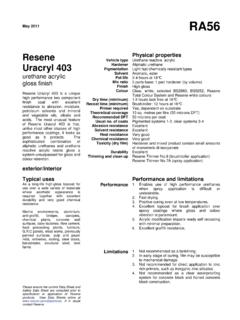
1 May 2014 D44 Resene Enamel Undercoat general purpose Resene Enamel Undercoat is a blend of special solventborne resins balanced with unique pigments. An easy brushing, quick, hard drying Undercoat with exceptional flow and sanding properties that dries without the unwanted and strong solvent odours associated with traditional solventborne products. exterior/interior Vehicle type Pigmentation Solvent Finish Colour Dry time (minimum) Recoat time (minimum) Primer required Theoretical coverage Dry film thickness Usual no. of coats Chemical resistance Heat resistance Solvent resistance Sanding properties Durability Thinning Clean up VOC Physical properties Alkyd Titanium dioxide/fillers Low odour hydrocarbon, less than 1% aromatic hydrocarbon content Low sheen White and grey shades. Resene Enamel Undercoat can also be tinted to colours off white if desired, but a white Undercoat is recommended for topcoats tinted off white 4 hours at 18 C 12 hours Yes, on exterior timber, metal, hardboard, particle and fibreboard 12 sq.
2 Metres per litre 40 microns at 12 sq. metres per litre 1-2 Fair Good Good Excellent Excellent when overcoated Resene Thinner (lower odour) or Mineral turps (brush/roller); Resene Thinner (spray) Resene Thinner , Mineral turps or Resene Brush Cleaner (brush/roller); Resene Thinner (spray) c. 411 grams per litre (see Resene VOC Summary) Typical uses Performance and limitations All exterior and interior prepared surfaces Architraves Bathrooms Fibre and particle board Furniture Kitchens Laundries Paperfaced plasterboard Skirtings Suitably primed metals Timber doors Wallboards Weatherboards Performance 1. Lower odour formulation, less than 1% aromatic hydrocarbon content. 2. Extremely good flow and sanding properties. 3. Excellent adhesion to timber substrates and old painted surfaces. 4. Available in white and grey shades suitable for use under Resene Total Colour System colours to facilitate perfect hiding and finish.
3 5. Designed with a low sheen to give exceptional Enamel hold-out. 6. Suitable for overcoating with most finishing systems, such as Resene Super Gloss (see Data Sheet D32) and Resene Lusta-Glo (see Data Sheet D33). Please ensure the current Data Sheet and Safety Data Sheet are consulted prior to specification or application of Resene products. View Data Sheets online at If in doubt contact Resene . Limitations 1. Not suitable for new or damp cementitious surfaces. 2. Not alkali resistant. 3. Not for use as the first coat on fibre or particle board, use Quick Dry (see Data Sheet D45) on particle board. On fibre cement board use Resene Sureseal (see Data Sheet D42). 4. Not for use as the first coat on hardboard, use Resene Sureseal (see Data Sheet D42). 5. Not suitable for prolonged exterior exposure without topcoating.
4 Please ensure the current Data Sheet is consulted prior to specification or application of Resene products. View Data Sheets online at If the surface you propose to coat is not referred to by this Data Sheet, please contact Resene for clarification. In Australia PO Box 924, Beenleigh, Qld 4207 Call 1800 738 383, visit or email In New Zealand PO Box 38242, Wellington Mail Centre, Lower Hutt 5045 Call 0800 Resene (737 363), visit or email Printed on environmentally responsible paper, which complies with the requirements of environmental management systems EMAS and ISO14001. Please recycle. Enamel Undercoat general purpose Surface preparation Clean down thoroughly to remove all dirt, dust and loose material. Ensure surface is free from oil, grease and mould. Any timber that has been exposed to weather for more than one week requires thorough sanding of the surface or treatment with Resene TimberLock (see Data Sheet D48).
5 If moss and mould are present, treat with Resene Moss & Mould Killer (see Data Sheet D80). Sand to smooth finish and dust off. Prime as per the following: Galvanised steel, Zincalume Resene Galvo One (see Data Sheet D41). Particle board Resene Quick Dry (see Data Sheet D45). Plasterboard Plasterboard and stoppings in non wet areas should be primed ( Resene Broadwall Waterborne Wallboard Sealer - see Data Sheet D403). Fibrous plaster or plasterboard and stoppings in wet areas should be sealed with Resene Sureseal (Data Sheet D42). Resene Sureseal (see Data Sheet D42) must be used where plasterboard has yellowed due to prolonged exposure to sunlight. Timber - Matai, Spotted Gum, Totara Resene Quick Dry (see Data Sheet D45). Timber - Exterior (all other timbers) Resene Wood Primer (see Data Sheet D40). Timber - Interior (all other timbers) Resene Quick Dry (see Data Sheet D45).
6 Varnished surfaces, laminated surfaces Resene Waterborne Smooth Surface Sealer (see Data Sheet D47a). Sanding dust from old lead or chromate based paints or old building materials containing asbestos may be injurious to the health if inhaled or ingested. Seek expert advice if the presence of these materials is suspected. Application Ensure the Resene Enamel Undercoat is used as white or the correct grey shade for your project. If you are applying multiple coloured topcoats, each may require a different Resene Enamel Undercoat white or grey shade. Apply by brush, roller ( Resene roller sleeve) or spray. Exterior - new 1. Prepare as per schedule above. 2. Apply one coat of Resene Enamel Undercoat in required colour over preprimed surface. Exterior - repaint 1. Prepare as per schedule above. 2. Apply one coat of Resene Enamel Undercoat in required colour over preprimed surface. Interior - new 1. Prepare as per schedule above.
7 2. Apply two coats of Resene Enamel Undercoat in required colour allowing 12 hours between coats. 3. Sand smooth between coats. Interior - repaint 1. Prepare as per schedule above and spot prime according to surface. 2. On repaint work one coat of Resene Enamel Undercoat should be sufficient. If a major colour change is planned two coats of Resene Enamel Undercoat in required colour allowing 12 hours between coats may be needed. Sand smooth between coats. Precautions 1. While this product is formulated using low odour solvents, you must ensure there is good ventilation during application and curing. Avoid breathing vapour. 2. Ensure correct primer, sealant and/or sealer is used. 3. FLAMMABLE - Keep away from heat and open flame. Keep closed when not in use.