Transcription of Resene X-300E - high build elastomeric membrane | …
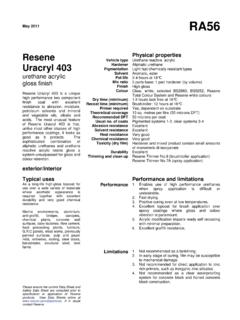
1 Apr 2015 D64 Resene X-300E high build elastomeric membrane Resene X-300E is an elastomeric high build coating and is part of the Resene High Performance Coatings range, which includes Resene X-200 and X-400. Based on a tough acrylic elastomer that has an excellent 'memory' of its original shape when distorted. The coating, when specified at the correct dry film thickness, has unique crack bridging properties and any movement of cracks beneath the coating layer does not result in film fracture. Ideally suited for structures that will flex and develop minor cracks. Protects flexing structures from concrete carbonisation by maintaining a seal over the micro cracks that develop. Vehicle type Pigmentation Solvent Finish Colour Dry time (minimum) Recoat time (minimum) Primer required Theoretical coverage Dry film thickness Usual no.
2 Of coats Abrasion resistance Chemical resistance Heat resistance Solvent resistance Durability Thinning and clean up VOC Physical properties Pure acrylic elastomeric resin Titanium dioxide, mineral fillers Water Semi-gloss White and colours off white (Available in most colours from the Resene Total Colour System in a minimum order size of 200L) 1 hour per 100 microns 3 hours per 100 microns Yes, dependent on surface Up to 2 sq. metres per litre in one application 270 microns at 2 sq. metres per litre 125 microns at sq. metres per litre Varies with specification and application method Good Very good Fair, some surface softening Fair Excellent Do not thin; clean up with water c. 12 grams per litre (see Resene VOC Summary) exterior/interior Typical uses Concrete road bridges High rise concrete buildings All other cementitious surfaces Performance Performance and limitations 1.
3 Due to its unique rheology, Resene X-300E may be applied at very high thicknesses without sagging or film cracking. Where possible, film thickness should be achieved with one coat for optimum film formation. 2. Formulated for airless spray application. 3. Superior void and crack filling properties. 4. Can bridge and contain propagating cracks. The dry film thickness of the applied Resene X-300E must be a minimum of twice the crack width. 5. An Environmental Choice approved product. Please ensure the current Data Sheet and Safety Data Sheet are consulted prior to specification or application of Resene products. View Data Sheets online at If in doubt contact Resene . Limitations 1. Old, weathered concrete requires surface conditioning with Resene Sureseal (see Data Sheet D42).
4 2. Do not apply at temperatures below 3 C or when it is liable to drop below 3 C during the drying period. Drying rate is dependent upon applied wet film thickness. 3. Resene X-300E will pick up dirt in unwashed areas but this is easily removed by rinsing off with diluted Resene Paint Prep and Housewash (see Data Sheet D812). Cleaning may be enhanced by the addition of a suitable Resene decorative waterborne topcoat, such as Resene Sonyx 101 (see Data Sheet D30). Please ensure the current Data Sheet is consulted prior to specification or application of Resene products. View Data Sheets online at If the surface you propose to coat is not referred to by this Data Sheet, please contact Resene for clarification. In Australia PO Box 924, Beenleigh, Qld 4207 Call 1800 738 383, visit or email In New Zealand PO Box 38242, Wellington Mail Centre, Lower Hutt 5045 Call 0800 Resene (737 363), visit or email Printed on environmentally responsible paper, which complies with the requirements of environmental management systems EMAS and ISO14001.
5 Please recycle. X-300E high build elastomeric membrane Surface preparation Cracked surfaces Due to its high film build , Resene X-300E will completely fill cracks up to 1mm. For cracks from 1mm and up to 2mm seal cracks with Resene Sureseal (see Data Sheet D42) before filling with multiple brush coats of Resene Brushable Crack Filler (see Data Sheet D811). New cementitious surfaces Clean down thoroughly to remove all dirt, dust and loose material. For tilt slab and in-situ concrete off formwork ensure surface is free from oil, grease, form release and curing agents. Apply a full coat of Resene ConcreteSeal 3 in 1 (see Data Sheet D409). Old cementitious surfaces (bare) Treat areas of moss or mould with Resene Moss & Mould Killer (see Data Sheet D80). Waterblasting at 3000 psi is the best surface preparation method prior to painting weathered cementitious surfaces.
6 If waterblasting is not possible, remove all loose powdery material by thorough wire brushing. Allow to dry and apply one coat of Resene Sureseal (see Data Sheet D42). If cracks are present treat as in Cracked Surfaces. Repaints Contact Resene Technical Services or your local Resene Paints representative. Application Airless spray Use a LTX 523 tip or similar and a unit such as a Graco 795 capable of spraying more than 2 litres per minute. Can be applied up to a maximum wet film thickness of 600 microns, Application under cold conditions will affect sag resistance and rate of drying. Roller application Masonry: Resene sleeve Smooth surfaces: Resene sleeve (Hi-Solids sleeve) Roller application is not recommended for large flat areas and will create a texture which will depend upon the sleeve used. If required the surface texture can be reduced by back rolling using a Resene sleeve.
7 On flat surfaces typically the application rate is 8 square metres per litre (also varies with surface roughness and porosity), which corresponds to a dry film thickness of 56 microns. On masonry application rates are typically 3 square metres per litre onto bare and 5 square metres for subsequent coats. Brush Brush application is suitable for small areas or for stripe coating cracks. Concrete blocks Due to regional variations in concrete block standards, two coats may be insufficient to produce a weathertight membrane . Weathertightness can only be assured when all voids are filled, therefore three coats over block is a safer specification. Brush or roller application is preferred over block and essential for at least the first coat. A minimum dry film thickness of 180 microns is required to achieve weathertightness in accordance with CCANZ CP01 2014.
8 Precautions 1. Do not thin. 2. Ensure correct pre-treatment is used.