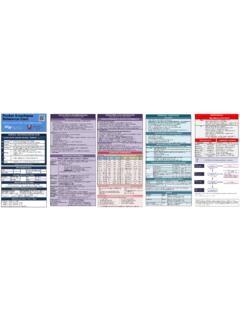
Transcription of Respiratory Therapy Pocket Reference P
1 AC Assist Control; AC-VC, ~CMV (controlled mandatory ventilation = all modes with RR and fixed Ti)SettingsRR, Vt, PEEP, FiO2, Flow Trigger, Flow pattern, I:E (either directly or via peak flow, Ti settings)FlowSquare wave/constant vs Decreasing Ramp (potentiallymore physiologic)I:EDetermined by set RR, Vt, & Flow Pattern ( for any set peak flow, Square ( Ti) & Ramp ( Ti); Normal Ti: ; to airtrapping& asynchrony-Increase flow rate will decrease inspiratory time (Ti)-Example: Vt 500/RR20/Flow 60--Cycle time = 3s; Ti = = ( )(60s per minute)--Texp = = I:E = = 1:5 ProsGuaranteed MV regardless of changing Respiratory system mechanics; Precise control of Vtto limit lung injuryConsDelivers Vt at all cost = PIPs vary with C breath stacking; fixed flow and Ti can increase asynchrony when pt Vt and flow demand > vent settingsBreath InitiationControl: Time trigger (60s/set RR): fixed VEAssist: Pt effort triggers full breath at set Tiand fixed VT and flowrateIf no pt triggerDelivers full set Vt at set rateBreath terminationTime cycled= breath ends at Tilimit; Alarms if VT not achieved; flow is set, breath ends once Vt deliveredPressure cycled= (safety mechanism); breath termination by clinician set high pressure limit; pop-off breath ends; Default set to 50 cmH2 ONotesInspiratory pause (~ ) can be built into each breath, will increase mean airway pressureDisclaimer: This card is intended to be educational in nature and is not a substitute for clinical decision making based on the medical condition presented.)
2 It is intended to serve as an introduction to terminology. It is the responsibility of the user to ensure all information contained herein is current and accurate by using published references. This card is a collaborative effort by representatives of multiple academic medical Control NCPros: Ubiquitous, easy; Range 1-8 LPMCons: Cold and dry if >4 LPM, epistaxisFiO2: 2-4% /LPM; variable (mouth breathing, high minute ventilation)NRB/FMPros: Higher FiO2; Can be more comfortable than NCCons: Bad if high MV; difficult to estimate severity of hypoxemia FiO2: Simple 5-10 LPM (~FiO2 35-50%); NRB 10-15 LPM (~ FiO2 60-80% if MV not too high)HFNCPros: Able to achieve high FiO2 even w/ high MV; washout CO2 (less rebreathing); heated/humidified; Possible improved outcomes in acute hypoxrespfailureCons: Requires special deviceFiO2: >90% FiO2 (variability with MV, mouth breathing)HelioxPros: Possibly decrease density = better ventilationCons: Requires special device; Caution w/ 80/20 mix in severe hypercarbic failure; not all NIPPV or IPPV can useFiO2: 20% or 30% mixes available.
3 $$$NIPPVPros: May avoid intubation (COPD, cardiogenic pulmedema, mild ARDS, upper airway obstruction) by decrwork of breathing & adding PEEPCons: Gastric insufflation (if PIP>20-25); Cannot use if aspiration risk or unable to protect airway (or if can t remove mask themselves); uncomfortable/skin breakdown; may worsen lung injury due to increased transpulmonary pressure gradient; caution if RHFC onfusing terminology: IPAP (=driving pressure + PEEP) and EPAP (=PEEP). PS of 5 over 5 is the same as PS delta 5 over 5, is the same as IPAP 10/EPAP 5 FiO2: Settings:PS( P)5 / PEEP (EPAP) 5-10; Titrate P up to 15 to reduce insprworkRespiratory Therapy Pocket ReferenceCard design byRespiratory care providers from: intermittent mandatory ventilation; mixed modeProsGuaranteed MV (control breaths by PC, VC, Dual); Spont breath (CPAP or PSV) = better synchrony; avoids breath stacking; sometimes useful if vent triggering inappropriatelyConsLess control over Vt and MV; May prolong weaning ; Assist Control Pressure Control.
4 ~CMV-PCSettingsRR, Pinsp, PEEP, FiO2, Flow Trigger, rise time, I:E (set directly or by inspiratory time Ti)Flow-Decreasing Ramp (potentiallymore physiologic)-Peak Flow determined by 1) Pinsplevel, 2) R, 3)Ti(shorter = more flow), 4) pressure rise time( Rise Time Peak Flow), 5) pteffort ( effort peak flow)I:EDetermined by set Ti & RR (Volume & flow variable)Time cycled = Ti or I:E set, then flow adjusts to deliver VtPros-Avoids high PIPs-Variable flow pteffort causes flow to maintain constant airway pressure = Potentiallybetter synchrony: pteffort flow & Vt- Automated/active expiratory valves -transiently opens expiratory valve to vent off pressure w/ coughing, asynchrony. comfort & barotrauma riskConsVT and MV not guaranteed; Vt determined by C and R (might be bigger or smaller than is optimal)Breath InitiationControl: Time trigger (60s/set RR)Assist: Pt trigger delivers Pinsp for inspiratory time cycleIf no pt triggerDelivers Pinsp at set rate and TiBreath terminationTime cycled = I:E or Ti set, breath ends at set time Notes-When changing from AC-VC, set Pinsp as Pplat-PEEP from AC-VC or consider half of PIP from AC-VC-Can Tito allow pause or Tito peak flow at the end inspiration ~decrasynchrony when VE demand is highPressure Control (~BiPAP).
5 Spontaneous: Pressure-presentSettingsPinsp, PEEP, FiO2, Flow Trigger, Rise timeFlowDecreasing Ramp (potentially more physiologic)Determined by:1) PS level, 2)R, Rise Time ( rise time peak flow and 3.) pteffortI:EDetermined by patient effort & flow termination ( Esens see below Breath Termination )Pros Synchrony: allows ptto determine peak flow, VT and TiConsNo guaranteed MV; Vtdetermined by pt(big or small); high PS and/or low Esensin COPD can incrair-trapping asynchrony. Muscle Weakness/Fatigue: effort or ability to sustain effort) hypoventilation, fatigueBreath InitiationPt flow or pressure triggeredIf no pt triggerApnea; (Most vents will have backup rate; all have alarm)Breath TerminationFlow cycled: Delivers Pinsp until flow drops to predetermined % of initial peak flow ~Esens(Standard setting ~25%; ~40-50% if OPD to prevent air trapping)NotesHigher Pinsp, short rise time, low trigger sensitivity = less work or air hunger; PS does not = regulated volume control (PRVC); VC+, AutoFlow~PC with a target Vt& variable Pinsp( 1-3cmH2O per breath) to meet goal Vtdespite chagningC and R;Pros Likelihood of hypo/hyperventilation associated with PC when R or C changes.
6 As C or R Pinsp . As C or R expiratory valve presentCons-C & R can change significantly without notification-Vent can t discern if VT>target is due to Pt effort or C; vent response to both = Pinsp; Can lead to closed-loop runaway ( Pinsp Pt Effort Pinsp); Pt workNote: If PIP<20; evaluate for VT starvation (VT>set VT)Oxygen & Delivery Devicesv FlowConstant FlowFlowPressureDecelerating FlowFlowPressureSIMVTi Appropriate (flow to zero)Ti too longTi too shortPressure SupportDual ModeFrat et al, NEJM, 2015 Brochard et al, NEJM 1995 Winck et al,Crit Care 2006 Hilbert et al,NEJM 2001 PPlateauMeasure of static lung compliance. If in AC-VC, perform inspiratory pause(when there is no flow, there is no effect of Resistance; Pplat@Palv); or set Pause Time ~ ; Target:< 30, Optimal:~ 25 PPeak inspiratoryPIP: Total inspiratory work by vent; Reflects resistance & compliance; Normal~20 cmH20 (@8cc/kg and adult ETT); Respfailure30-40 (low VT use); Concernif >40.
7 PDrivingPplat-PEEP: tidal stress (lung injury & mortality risk). Target <15 cmH2O. Signifmort risk >20 cmH2O. I:EAt rest ~1:2, exertion ~1:1; Obstructive pulmonary dz~1:3 Minute VentNormal 4-6 LPM; may be lower if drug OD, hypothermic, deep sedation; may be higher 8-14 LPM if OPD or 6-8 LPM OPD, 10-15 ARDSPeak FlowClinical range: 50-80 LPM. With exertion or distress 100-150; ventilator default ~60 LPMC ompliance v / p = VT/Plateau-PEEP -Static compliance: (Normal~100 mL/cmH2O) = lung (50) + chest wall (50); measured at end inspiratory pause; Normal intubated recumbent 60-80; ARDS<40) -Dynamic compliance:includes system resistance & inertiaResistanceR= PIP-Pplat/ inspirflow(square pattern, 60 LPM)Normal< 10cmH2O/L/sec, Concern:> 15cmH2O/L/secPulmonary Physiology 80153037 Volume* (ml/kg) *adult maleAlveolar Gas Equation (A-a)[(FiO2%/100) * (Patm-47 mmHg) -(PaCO2 )] -PaO2-Always small gradient = (age/4) +4; Patmsea level ~760mmHg*PAO2 = function of oxygen in air (Patm-Pwater)FiO2 and ventilation (PaCO2 )*Remember, Patm notFiO2 changes with altitude (top of Everest, FiO2 = )*Healthy subject on FiO2 , ABG PaO2 ~660 Causes of Hypoxemia (PaO2)*NormalA-a: Not enough 02 (low Patm, or low FiO2), too much CO2 (hypercarbia), hypoventilation *Elevated A-a: Diffusion defect, V/Q mismatch, shuntHypoxiaInsp TimeIf Time-cycled, set I:E or Ti; If Volume cycled, flow is set; ~ Rise TimeAka slope or flow attack; Speed of rise of flow (VC) or pressure (PC); how quick PIP reached; too short = uncomfortable; too long = low Vt (PCV) or higher P (VCV); ~ fastestInsp Trigger Flow (3-5 LPM) more sensitive than pressure trigger (-2cmH20)Misc Vent SettingsTLCVCRVFRCICIRVRVERVTVE steban et al, N Engl J Med 1995 Inspiratory hold to measure Pplateau(force back against closed circuit)End Expiratory phase prior to breathPIP PpltNormal PpltNormal PpltNormal PIPI nspiratoryFlowopens alveoli.
8 Determine PIPsNormal alveoliCompliance problemResistance problemPIP Recruitment Maneuvers(S1-3)Vent LiberationSelective Pulmonary Vasodilator Therapy -Caution: can kill a pt. Check with attending and RT -many contraindications-Must have arterial line; adequately sedated and/or paralyzed patient-Consider if (approximately): FiO2 >70%, 16 PEEP and P:F<150-Threshold opening pressure <35 in most ARDS pts; AC-PC more stable and effective than sustained inflation RMExample Protocol:-AC-PC Pdr15-20, PEEP 20; RR 20; I:E 1:1 (Ti ) -Increase PEEP q2min by 5cmH20 to max 50/35 (if tolerated hemodynamically) -Return to 40/25 5-15min -Then decrementalPEEP trial(If hypoTNor TBI, consider PEEP 16 and Pdr20; Increase Pdrq2min by 5cmH20 to max 50/16 then back to 15-20/16)Post RM Stabilization: Wean by decrementalPEEP trial: f/25cmH20 by 2-3cmH20 q5-10min until desats(target SpO2 90% throughout in order to be able to assess real-time effects)Inhaled Prostacyclin (aka: PGI2)*Dose: start at 50 ng/kg/min PBW (range: 10-50).
9 Should be weaned (10ng/kg/min increments q30min) to avoid hemodynamic compromise Notes: Possibly more beneficial in secondary ARDS and pts with baseline RV dysfunction; incr surfactant production via cAMPpathway; antiplatelet activity only demonstrated thus far for IV route; half-life = minutes; iNO*Dose: 20ppm (range 2-80ppm); should be weaned (5ppm increments q30min) to avoid hemodynamic compromiseNotes: $, requires $ delivery equipment; no direct SVR effect; met-Hgb; half-life = seconds; free radicals; can cause acute LVEDP overload (caution if reduced LV function); caution of pulmhemorrhage, plts<50 or anticoagulated *No survival data; Caution: pulm vasodilators can cause incr LVEDP; do not use if pulmonary hemorrhageBerlin Definition(2012)1. Acute (<1 week)2. Bilateral opacities on CXR or Chest CT3. P:F ratio< 300mmHg w/ >5cmH20 PEEP4. Must not be fully explained by cardiac failure or fluid overload on clinical exam ARDS SeverityMild = P/F 200 300 = ~27% mortalityModerate = P/F 100 200 = ~32% mortalitySevere = P/F < 100 = ~45% mortalityVentilator Set-Up per ARDSNet ideal body weight (IBW) to set VT See box vent mode (Usually start w/AC-VC , can use PC) initial Vt = 8cc/kg Vt by 1 cc/kg as able until Vt = 6cc/kg Vt and RR to achieve Pplat <30; pay attention to preintubation minute ventilation as initial >5; FiO2/PEEP as below (see PEEP Box) goal: PaO2 55-80; SpO2 88-95% goal:pH> , permissive hypercapneaTidal Volumes-Goal 6 cc/kg (range 4-6)-Consider decreasing below 6cc/kg if not meeting plateau goals -EVERY CC/KG counts!
10 -Consider liberalization if/when: Oxygenation, C, Vd/Vtimproving (PEEP<10; FiO2<60) anddysynch/uncomfortableFluid ManagementFACTT Trial of conservative vs. liberal fluid strategy showed conservative fluid strategy improved oxygenation, more ventilator-free & ICU-free days, no increased shock, no mortality effect-concentrate drips, consider diuresis early if appropriate Pplateau& Pdriving GoalsPlateau Pressure:check at least q4h--if>30cmH20, consider decrease Vt by 1cc/kg steps --If <30cmH20 anddysynchrony andunable to address with sedation (and can t paralyze), consider increase by 1cc/kgDriving Pressure: deltaP=Vt/CRS= Pplat-PEEP--Uses Vt normalized to functional aerated lung--Goal <15 (**each 7cmH2O = RR increase**)ParalysisACURASYS Trial:Paralysis w/in 48h, x48h, severe ARDS, 24% vs 33% @30d mortality benefit; placebo got more BDZs;some caveats w/data analysisROSE Trial: Similar toACURASYS, larger (1006 pts), no mortality difference--Cisatracurium ($): Loading: mg/kg; gtt: mg/hr--Vecuronium: Loading: mg/kg; gtt dose: 1-10 mg/kgVd/VtMeasure Vd/Vt w/ vent changes.