Transcription of Responding to COVID-19
1 Responding to COVID -19 UNICEF Annual Report 2020 Data in this report are drawn from the most recent available statistics from UNICEF and other United Nations agencies, annual reports prepared by UNICEF country offices, and the Annual Report of the Executive Director of UNICEF presented to the Executive Board in June 2021. For any corrigenda found subsequent to printing, please visit our website at by UNICEFD ivision of Communication3 United Nations PlazaNew York, NY 10017, USAC ontact: citation. Responding to COVID-19 : UNICEF Annual Report 2020. New York: United Nations Children s Fund (UNICEF), : 978-92-806-5223-9 United Nations Children s Fund (UNICEF), June 2021 Cover photograph: UNICEF/UNI372363/Pouget Responding to COVID -19 UNICEF Annual Report 2020 Responding TO COVID-192 The global crisis sparked by the COVID-19 pandemic has been unprecedented in its scope and the inequality of its impact.
2 In one short year, it wiped out hard-won development gains for children and pushed more families into poverty. It also revealed and in many cases, widened the gulf between those people who have access to critical services and support and those who do not. But the crisis also revealed the strength and character of UNICEF and our global family. And it underscored the critical importance of our organization s work as the world recovers and rebuilds. As communities struggled to contain the virus, UNICEF was there to provide information, deliver supplies like personal protective equipment or PPE, syringes and testing kits, and keep vital health services like immunizations and treatment for malnutrition up and running.
3 As schools were closed, UNICEF was there to provide a range of remote learning options including online delivery of education. As families struggled economically, UNICEF was there to provide social protection initiatives, like cash transfers. As the vaccines were rapidly developed, UNICEF was there playing a leading role in the COVAX Facility to ensure their equitable procurement, distribution and delivery including working with transportation and logistics companies, and preparing communities and health workers for the rollout with training and supplies. As communities and countries alike rebuild and recover, UNICEF is there once again to support them as they strengthen all the systems upon which their populations are relying from health and nutrition, to water and sanitation, to education and protection.
4 In the face of economic pressures, UNICEF will continue working with governments to prioritize spending on these critical needs of children and families. And as children face a rapidly changing world, UNICEF is standing with them, looking ahead to the challenges on the horizon. In my annual letter earlier this year, I highlighted five opportunities to not only respond to COVID-19 , but also to reimagine a better world for every child: providing equal access to vaccines for all; revolutionizing learning through bridging the digital divide; giving mental health the attention and investment it deserves; ending discrimination and ensuring no child is left behind; and addressing the worsening climate crisis.
5 This year, UNICEF celebrates its 75th anniversary. When UNICEF was created in the aftermath of World War II, the scale of the problems facing children was immense. Undaunted, as a global community, we reimagined what was possible by building new health and welfare systems, driving a revolution in child rights, survival and development, and creating new forums for global coordination and action. The progress we achieved was substantial and lasting. With 2020 behind us, we can do so again. We must. And we are. But UNICEF cannot do it alone. The long-term, large-scale change that children and young people require is only possible through concerted action in is proud to be part of this extraordinary period of global recovery, standing with children and our partners with hope and optimism.
6 Again, undaunted by the challenges before us. Together, we will seize this moment in history and reimagine a better future for children. Henrietta Fore UNICEF Executive Director ForewordRESPONDING TO COVID-192 UNICEF ANNUAL REPORT 20203 ContentsCross-cutting PrioritiesGender Equality 32 Humanitarian Action 34 01 Goal Areas Goal Area 1: Every child survives and thrives 12 Goal Area 2: Every child learns 16A world learning at home 18 Goal Area 3: Every child is protected from violence and exploitation 20 Goal Area 4: Every child lives in a safe and clean environment 22 Goal Area 5: Every child has an equitable chance in life 24 Cash transfers ease the economic strain of COVID-19 26 How UNICEF adapted to COVID-19 3003 Change StrategiesWinning support for children and young people 37 Partnerships 38 Innovation 4403 Foreword 2 Introduction 4 UNICEF at 75 years 9 How COVID-19 affected childen 10 Financials 4602 Responding TO COVID-194 The year 2020 will always be remembered for COVID 19 and the disruptions, uncertainty and pain it caused worldwide.
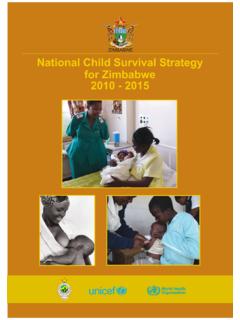
7 While children seem to be less vulnerable to the virus directly, school closures, increased vulnerability to abuse, the mental health strains of parents and families, distance from friends, and loss of access to vital health care and protection services have hurt children deeply. But not all children were affected equally. The pandemic exposed deep inequalities that have existed for too long, with the worst impact on children in the poorest countries and communities and those already disadvantaged by discrimination, social exclusion, fragility and conflict. Aruna Patel, 28, gives Kangaroo Mother Care (KMC) through skin to skin contact with her newborn child in Baria District Hospital in Gujarat, India.
8 Mothers of newborns are trained and educated on benifits of KMC by hospital staff. UNICEF/UNI341033/PANJWANII ntroduction An unprecedented year UNICEF ANNUAL REPORT 20205 INTRODUCTIONThe data bear this out: the number of children in monetarily poor households is estimated to have risen by 142 million by the end of 2020. At least 1 in 7 children and young people has lived under stay-at-home policies for most of the last year. Up to 94 per cent of students worldwide were affected by school closures at the height of the pandemic and at least one third were unable to access remote learning. Disruptions in food systems and health and nutrition services could leave 44 million children inequities and injustice mobilized children and young people in 2020.
9 It can be seen in the streets of cities worldwide filled with youth that mobilized in the face of pervasive and deeply rooted racism and injustice to change their societies. It can be heard in their passionate calls to address the climate crisis. And it can be read in the reflective perspectives they contributed to UNICEF s platforms such as U-Report, Voices of Youth and GenU. UNICEF s nimble and innovative response to the pandemic allowed for new approaches to its work. UNICEF s Supply Division leveraged its logistical expertise to ship half a billion items of personal protective equipment in support of 138 countries in 2020. UNICEF used its data systems to rapidly assess the pandemic s impact on children and its extensive presence across more than 190 countries and territories and dual humanitarian and development mandate to play a key role in the response to COVID-19 across the United the pandemic, and often beyond the spotlight, ongoing work continued in 2020 toward the Sustainable Development Goals (SDGs).
10 UNICEF s 2019 Annual Report, reflecting the mid-term review of UNICEF s 2018 2021 Strategic Plan, showed that the world was already off track to achieve child-related SDGs even before COVID-19 , contending with mounting humanitarian crises, persistent fragility, climate change and inequalities. Top results in 2020 Providing leadership in the COVAX Facility, resulting in the financing of COVID-19 vaccines for 92 low- and middle-income countries and preparing countries to deliver the vaccine Providing critical water, sanitation and hygiene services and supplies (WASH) for 106 million people, including 58 million children in 153 countries Managing risk communication, disseminating community engagement information and supporting activities that reached 3 billion people, including approximately billion women and girls and 810 million children Providing personal protective equipment for nearly million health workers and facilitating training on infection prevention and control for 4 million health workers Training more than 30,000 social service workers in delivering essential services Putting in place community-based mental health and psychosocial interventions that reached 78 million children, adolescents.