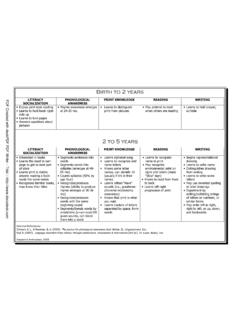
Transcription of Revised Concise Symbolic Play Scale (Westby, 2000)
1 1 Revised Concise Symbolic play Scale ( westby , 2000) Ages Theory of Mind Content Themes Organization (Episodic Memory) Decontextualization 17-19 mo pretend play on self events personally experienced that happen daily single activities realistic props 19-22 mo pretends on doll (doll passive recipient) caregiver activities combines 2 toys or performs actions on 2 people 2 yr talks to doll several actions on a theme (doll in tub, wash, dry) 2 yr events personally experienced that happen periodically (associated with emotion) 3 yr events child has seen or read about but not personally experienced short sequences of temporally-related activities; events evolve low representation toys.
2 Object substitutions 3-3 yr gives voice to dolls/puppets 4 yr gives characters multiple roles (mother, wife, doctor) planned events with cause-effect sequences language used to set scene 5-6 yr highly imaginative themes multiple planned sequences 2 Table 1: Developmental Playscale Phase 1: Presymbolic play _____ COMMUNICATION _____ Object Permanence Means-End/Problem Solving Object Use Presymbolic Level I: 8 to 12 months ___ Aware that objects exist when not seen; finds toy hidden under cloth, box, etc., associates object with location ___ Attains toy by pulling cloth on which toy is resting ___ Attains toy by pulling string ___ Touches adult to continue activity ___ Explores moveable parts of toy ___ Does not mouth all toys.
3 Uses several different schemes (patting, banging, turning, throwing, etc.); uses some differential schemas on familiar objects ___ Joint attention on toy and person ___ No true language; may have performative words that are associated with action or the total situation ___ Shows and gives objects Exhibits the following communicative intents: ___ Request (instrumental) ___ Command (regulatory) Presymbolic II: 13 to 17 months ___ Aware that objects exist separate from location; finds objects hidden in first one place and then in a second or third location ___ Understands in-ness.
4 Dumps objects out of bottle ___ Hands toy to adult if unable to operate ___ Hands toy to adult to get attention ___ Uses index finger to point to desired object ___ Recognizes operating parts of toys (attends to knobs, levers, buttons) ___ Discovers operations of toys through trial and error ___ Construction of toy relationships ( , puts one toy in another such as figure in car; nests boxes) ___ Uses familiar objects appropriately ___ Context dependent single words, , child may use the word car when riding in a car, but not when he sees a car; words tend to come and go in child s vocabulary Exhibits the following communicative functions.
5 ___ Request ___ Protest ___ Command ___ Label ___ Interactional ___ Response ___ Personal ___ Greeting 3 Summary of Symbolic Playscale AGE PROPS THEMES ORGANIZATION ROLES LANGUAGE USE IN play by 18 months uses one realistic object at a time familiar everyday activities in which child is active participant ( , eating, sleeping) short, isolated pretend actions autosymbolic pretend, ( , child feeds self pretend food language used to get and maintain toys and seek assistance operating toys ( , "baby," "mine," "help") by 22 months uses two realistic objects at a time familiar everyday activities that caregivers do ( , cooking, reading) combines two related toys or performs actions on two people ( , uses spoon to eat from plate; feeds mother, then doll) child acts on dolls and others ( , feeds doll or caregiver) uses word combinations to comment on toy or action.)
6 Uses word for intents, needs, feelings ("want that," "mad," "hungry") by 24 months uses several realistic objects multischeme combinations of steps ( , put doll in tub, apply soap, take doll out and dry) talks to doll briefly; describes some of the doll's actions ( , "baby sleeping"); uses phrases and markers for ing and plurals/possessives by 30 months common but less frequently experienced or especially traumatic experiences ( , shopping, doctor) emerging limited doll actions ( , doll cries) talking to doll and commenting on doll's actions increase in frequency; uses by 3 years observed, but not personally experienced activities ( , police, firefighter).
7 Compensatory play -- Re-enacts experienced events, but modifies original outcomes temporal sequences of multischeme events ( , prepare food, set table, eat food, clear table, wash dishes) child talks to doll in response to doll's actions ( , "don't cry now," "I'll get you a cookie."); brief complementary role play with peers ( , mother and child; doctor and patient) use complete sentences with past tense and future aspect; children may comment on what they have just completed or what they will do next ( , "Dolly ate the cake." "I'm gonna wash dishes.") by 3 1/2 years miniature props, small figures, and object substitutions attributes emotions and desires to dolls; reciprocal role taking with dolls (child treats doll as partner--talks for doll and as caregiver) use dialogue for dolls and metalinguistic markers ( , "he said"); use words to refer to emotions and thoughts by 4 years imaginary props (language and gesture help set the scene) familiar fantasy themes ( , Batman, Wonder Woman, Cinderella, etc.)
8 ; violent themes common planned play events with cause-effect sequences ( , child decides to play a birthday party and gathers necessary props and assigns roles) child or doll has multiple roles (mother, wife, doctor; firefighter, husband, father) child can handle two or more dolls in complementary rolls (dolls are doctor and patient) attributes thoughts and plans to doll use language to plan and narrate the story line; use of connecting words so, because, but-effect by 6 years language and gesture can carry the play without props create novel fantasy characters and plots multiple planned sequences (plans for self and other players) more than one role per doll (doll is mother, wife, doctor) elaboration of planning and narrative story line; uses sentences with temporal markers, then, when, while, before, first, next 4 Phase 2: Symbolic play _____ LANGUAGE _____ Decontextualization What props are used in pretend play ?
9 Thematic Content What schemas/scripts does the child represent? Organization How coherent and logical are the child s schemas/scripts? Self/Other Relations What roles does the child take and give to toys and other people? Function Form and Content Symbolic level I: 17-19 months Child exhibits internal mental representation ___ Tool-use (uses stick to reach toy) ___ Finds toy invisibly hidden (when placed in a box and box emptied under scarf) ___ Pretends using life-like props ___ Does not stack solid ring ___ Familiar, everyday activities (eating, sleeping) in which child has been an active participant ___ Short isolated schemas (single pretend actions) ___ Self as agent (auto- Symbolic or self-representational play , , child pretends to go to sleep, to eat from a spoon, or to drink from an empty cup)
10 Directing ___ Requesting ___ Commanding ___ Interactional Self-maintaining ___ Protesting ___ Protecting self and self interests Commenting ___ Labeling (objects and activity) ___ Indicating personal feeling Beginning of true verbal communication. Words have following functional and semantic relations: ___ Recurrence ___ Existence ___ Nonexistence ___ Rejection ___ Denial ___ Agent ___ Object ___ Action or state ___ Object or person associated with object or person Symbolic Level II: 19-22 months ___ Activities of familiar others (cooking, reading, cleaning, shaving) ___ Short, isolated schema combinations (child combines two actions or toys in pretend, , rocking doll and putting it to bed.)