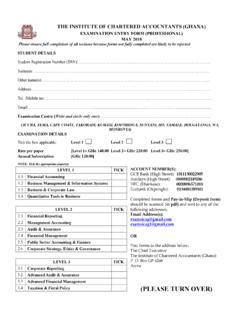
Transcription of REVISED SYLLABUS FOR PROFESSIONAL …
1 THE INSTITUTE OF CHARTERED ACCOUNTANTS(GHANA)////////////////////// //////////////////////////////////////// //////////////////////////////////////// //////////////////////////////////////// //////////////////////////////////////// //////////////////////////////////////// ////////MAY 2015 REVISED SYLLABUS FOR PROFESSIONAL QUALIFYING EXAMINATIONSI ntroduction 2 Features and Inovations of the New Scheme 3 Objectives and Expected Performance Outcomes of Each Part financial Accounting Business management and Information Business and Corporate Quantitative Tools in financial Reporting management Accounting Audit and financial Public Sector Accounting and Finance Corporate Strategy, Ethics and Corporate Reporting Advanced Audit and Advanced financial management Taxation and Fiscal Policy46 LEVEL 1 LEVEL 2 LEVEL 3 PAPERSPAPERSPAPERSC ontentsIntroduction 2 Features and Inovations of the New Scheme 3 Objectives and Expected Performance Outcomes of Each Part financial Accounting Business management and Information Business and Corporate Quantitative Tools in financial Reporting management Accounting Audit and financial Public Sector Accounting and Finance Corporate Strategy, Ethics and Corporate Reporting Advanced Audit and Advanced financial management Taxation and Fiscal Policy46 LEVEL 1 LEVEL 2 LEVEL 3 PAPERSPAPERSPAPERSC ontentsINTRODUCTIONThe job of the Chartered Accountant has become more sophisticated now because of the effects of globalisation, developments in information technology and the complexity of the modern business organisation.
2 The modern day chartered accountant, for instance, not only expresses an opinion on the accuracy and fairness of financial statements, but also advises management on the viability of investment projects, tax matters and renders specialised advisory services, etc. In many cases, he is called upon to serve the nation as a member of a special investigation order to perform these functions creditably, he/she needs to have acquired proficiency in accounting theory and practice. The new SYLLABUS would be examined in May 2015. The new SYLLABUS attempts to meet the goals of the scheme through the subject structure and coverage. The proposed 14-subject, 3-level-structure examination combines subjects which address the practical skills requirements of the potential PROFESSIONAL accountants with others which are mainly of the theoretical or conceptual nature and therefore serves as a good grounding for the PROFESSIONAL nearly four years of organizing examinations on the current SYLLABUS of the Institute of Chartered Accountants (Ghana), it is now considered appropriate and timely to revise and update the SYLLABUS in order to bring it in line with current state of knowledge and to make it more relevant to the current demands of employers and clients.
3 AIMThe ICAG qualification aims to ensure that all newly qualified chartered accountants have the technical and PROFESSIONAL skills to begin their career and from which to build their ongoing PROFESSIONAL SYLLABUS has been designed to develop core technical, commercial, and ethical skills and knowledge in a structured and rigorous manner. Progression through the ICAG qualifying examinations, in combination with integrated and monitored work experience, will equip and prepare students for the demanding multi-disciplinary job content of the accountant. The subjects at the PROFESSIONAL /advance level assess the highest level of analysis, synthesis and communication skills, commercial and ethical awareness and the application of PROFESSIONAL judgment. The SYLLABUS has been designed to ensure that students understand the fundamental principles of ethics, can apply relevant ethical guidance and are able to recommend actions to resolve ethical LEVEL 1: KNOWLEDGE Business management and Information Business and Corporate Quantitative Tools in Business LEVEL 2: APPLICATION financial management Audit and Assurance financial Public Sector Accounting and Corporate Strategy, Ethics and Governance LEVEL 3: PROFESSIONAL Corporate Reporting Advanced Audit and Advanced financial Taxation and Fiscal PoliciesFEATURES AND INNOVATIONS OF THE NEW SCHEMEThis new scheme has been developed on a well-established context for a review and change.
4 The following new features and innovations stand out: A three-Level structure of 14 papers in total. Fusion and integration of some courses. This is meant to encourage an integrative learning approach and to minimize the negative of the tunnel vision subject-by-subject training. The combination of related courses is therefore meant to derive more meaning and synergies. Clearly defined and achievable learning outcomes from level to level. This should partly resolve the problems associated with the placement of partly qualified candidates in industry and on other programs. A more rational, easy-to-fit and implement graduate conversion and exemption scheme has been incorporated. It is hoped that this will motivate higher grade candidate entrants degree and diploma holders to acquire sufficient accountancy competence and speed up their eventual PROFESSIONAL qualification. All students have ten (10) years from the date of registration within which to complete all the examinations of the Institute of Chartered Accountants (Ghana).
5 SUMMARY OF STRUCTUREPAPERSPAPERSPAPERSINTRODUCTIONT he job of the Chartered Accountant has become more sophisticated now because of the effects of globalisation, developments in information technology and the complexity of the modern business organisation. The modern day chartered accountant, for instance, not only expresses an opinion on the accuracy and fairness of financial statements, but also advises management on the viability of investment projects, tax matters and renders specialised advisory services, etc. In many cases, he is called upon to serve the nation as a member of a special investigation order to perform these functions creditably, he/she needs to have acquired proficiency in accounting theory and practice. The new SYLLABUS would be examined in May 2015. The new SYLLABUS attempts to meet the goals of the scheme through the subject structure and coverage. The proposed 14-subject, 3-level-structure examination combines subjects which address the practical skills requirements of the potential PROFESSIONAL accountants with others which are mainly of the theoretical or conceptual nature and therefore serves as a good grounding for the PROFESSIONAL nearly four years of organizing examinations on the current SYLLABUS of the Institute of Chartered Accountants (Ghana), it is now considered appropriate and timely to revise and update the SYLLABUS in order to bring it in line with current state of knowledge and to make it more relevant to the current demands of employers and clients.
6 AIMThe ICAG qualification aims to ensure that all newly qualified chartered accountants have the technical and PROFESSIONAL skills to begin their career and from which to build their ongoing PROFESSIONAL SYLLABUS has been designed to develop core technical, commercial, and ethical skills and knowledge in a structured and rigorous manner. Progression through the ICAG qualifying examinations, in combination with integrated and monitored work experience, will equip and prepare students for the demanding multi-disciplinary job content of the accountant. The subjects at the PROFESSIONAL /advance level assess the highest level of analysis, synthesis and communication skills, commercial and ethical awareness and the application of PROFESSIONAL judgment. The SYLLABUS has been designed to ensure that students understand the fundamental principles of ethics, can apply relevant ethical guidance and are able to recommend actions to resolve ethical LEVEL 1: KNOWLEDGE Business management and Information Business and Corporate Quantitative Tools in Business LEVEL 2: APPLICATION financial management Audit and Assurance financial Public Sector Accounting and Corporate Strategy, Ethics and Governance LEVEL 3: PROFESSIONAL Corporate Reporting Advanced Audit and Advanced financial Taxation and Fiscal PoliciesFEATURES AND INNOVATIONS OF THE NEW SCHEMEThis new scheme has been developed on a well-established context for a review and change.
7 The following new features and innovations stand out: A three-Level structure of 14 papers in total. Fusion and integration of some courses. This is meant to encourage an integrative learning approach and to minimize the negative of the tunnel vision subject-by-subject training. The combination of related courses is therefore meant to derive more meaning and synergies. Clearly defined and achievable learning outcomes from level to level. This should partly resolve the problems associated with the placement of partly qualified candidates in industry and on other programs. A more rational, easy-to-fit and implement graduate conversion and exemption scheme has been incorporated. It is hoped that this will motivate higher grade candidate entrants degree and diploma holders to acquire sufficient accountancy competence and speed up their eventual PROFESSIONAL qualification. All students have ten (10) years from the date of registration within which to complete all the examinations of the Institute of Chartered Accountants (Ghana).
8 SUMMARY OF STRUCTUREPAPERSPAPERSPAPERSLEVEL 1: KNOWLEDGE LEVELFINANCIAL ACCOUNTINGSCOPEThe SYLLABUS for Paper , financial Accounting, introduces the candidate to the fundamentals of the regulatory framework relating to accounts preparation and to the qualitative characteristics of useful information. The SYLLABUS concentrates on in-depth recording, processing, and reporting of business transactions and events. The SYLLABUS then covers the use of the trial balance and how to identify and correct errors, and then the preparation of financial statements for incorporated and unincorporated entities. The SYLLABUS requires candidates to be able to conduct a basic interpretation of financial statements; SPECIFIC OBJECTIVESOn successful completion of this paper, candidates should be able to:A. Explain the context and purpose of financial accountingB. Define the qualitative characteristics of financial informationC. Demonstrate the use of double-entry and accounting systemsD.
9 Record transactions and events E. Prepare a trial balance (including identifying and correcting errors)F. Prepare basic financial statements for incorporated and unincorporated Interpretate of financial statementsSYLLABUS WEIGHTING GRIDThis grid shows the relative weightings of topics within this subject and should guide the required study time spent on each. The marks available in the assessment will equate to the weightings below. However, there might be slight variations in some instances as they serve as a guide the ten (10) years period any student who has not completed the examinations of the Institute will not be eligible to take the examinations. Better focus on business [ financial ] strategy and reporting or communication skills, thereby enabling candidates to appreciate the overall realities of the business environment and to use advisory skills more effectively. Increased emphasis on business advisory skills at the [final] Level of the 3 levels of this examination scheme has broad objective and expected performance outcomes.
10 Additionally, within each subject at any level, the SYLLABUS coverage as well as the detailed but specific objectives and learning outcomes are stated. The broad objectives and learning outcomes of the proposed (3) levels are as follows:OBJECTIVES AND EXPECTED PERFORMANCE OUTCOME OF EACH PARTLEVEL 1 LEVEL 2 LEVEL 3?4 basic/foundation of basic principles and knowledge required to understand the Business Environment. Six (6) traditional core papers. Test of technical expertise required of a modern accountant. Acquisition of background knowledge and skills necessary for effective performance at middle management (4) core on business cases, strategy and advisory and InterpretationThe pass mark is 50%. The results will be published as pass or fail. A candidate who fails has the option of rewriting this paper in subsequent examinations till his/her candidature develop knowledge and understanding of the underlying principles and concepts relating to financial accounting and technical proficiency in the use of double-entry accounting techniques including the preparation of basic financial statements for single entities.