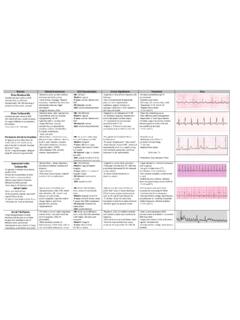
Transcription of Rhythm ECG Characteristics Example
1 ECG review ACLS Program Ohio State University Medical Center Published by: Department of Educational Development and Resources, OSU Medical Center December 2001 by The Ohio State Univeristy Medical Center All Rights Reserved 1 Rhythm ECG Characteristics Example Normal sinus Rhythm (NSR) Rate: 60-100 per minute Rhythm : R- R = P waves: Upright, similar P-R: -0 .20 second & consistent qRs: second P:qRs: 1P:1qRs sinus Tachycardia Causes: Exercise Hypovolemia Medications Fever Hypoxia Substances Anxiety, Fear Acute MI Fight or Flight Congestive Heart Failure Rate: > 100 Rhythm : R- R = P waves: Upright, similar P-R: -0 .20 second & consistent qRs: second P:qRs: 1P:1qRs sinus Bradycardia Causes: intrinsic sinus node disease increased parasympathetic tone drug effect.
2 Rate: < 60 Rhythm : R- R = P waves: Upright; similar P-R: -0 .20 second & consistent qRs: second P:qRs: 1P:1qRs ECG review ACLS Program Ohio State University Medical Center Published by: Department of Educational Development and Resources, OSU Medical Center December 2001 by The Ohio State Univeristy Medical Center All Rights Reserved 2 Rhythm ECG Characteristics Example Premature Atrial Contractions (PAC) Causes: normal excessive use of caffeine, tobacco, or alcohol CHF Myocardial ischemia or injury Hypokalemia, Dig toxicity COPD Rate: usually < 100, dependant On underlying Rhythm Rhythm : irregular P waves: Early & upright, different from sinus PR: second; different from sinus qRs: second P:qRs = 1:1 Atrial Flutter Causes: ischemic heart disease Hypoxia Acute MI Dig Toxicity Mitral or Tricuspid valve disease Pulmonary embolism Rate: Atrial rate 250-350 Vent 150 common Rhythm : Atrial = Regular Vent = Reg.
3 Or irreg P waves: Not identifiable F waves: Uniform (sawtooth or picket fence ) PRI: not measurable qRs: second Atrial Fibrillation Ischemic heart disease Hypoxia Acute MI Digitalis toxicity Mitral or tricuspid disease Rate: Atrial: 400-700 Vent. 160-180/minute Rhythm : Atrial: irregular; Vent.: irregular P waves: No identifiable Ps f waves: may be seen. PRI: unable to measure (No identifiable P) qRs: usually normal PAC = ECG review ACLS Program Ohio State University Medical Center Published by: Department of Educational Development and Resources, OSU Medical Center December 2001 by The Ohio State Univeristy Medical Center All Rights Reserved 3 Rhythm ECG Characteristics Example Paroxysmal Atrial Tachycardia Causes: Same as PACs Rate: usually 160-220 Rhythm : Regular P waves: differ in shape from sinus Ps; usually difficult to identify (rate related) PR Interval: Normal when the Ps can be identified.
4 Short if WPW present qRs: usually normal Other: Onset sudden, often initiated by a PAC Premature Junctional Contraction (PJC) Causes: Same as PACs Rate: usually < 100, dependant on the underlying Rhythm Rhythm : irregular P waves: Inverted before or after qRs or not visible PR interval: < second when inverted P is before qRs qRs: second P:qRs = 1:1 if Ps are visible ECG review ACLS Program Ohio State University Medical Center Published by: Department of Educational Development and Resources, OSU Medical Center December 2001 by The Ohio State Univeristy Medical Center All Rights Reserved 4 Rhythm ECG Characteristics Example Junctional escape Rhythm Causes: healthy athlete at rest related to medications- Beta Blockers, Calcium Channel Blockers, Dig Toxicity or increased parasympathetic tone Acute Inferior Wall MI Rheumatic Heart Disease Post-Cardiac Surgery Valvular Disease SA Node Disease Hypoxia Rate: 40-60 61 100 (accelerated) Rhythm : Regular P waves: Inverted before or after qRs or not visible PR interval: < second when inverted P is before qRs qRs: second P:qRs 1:1 if Ps are visible Junctional Tachycardia Causes: Same as Paroxysmal Atrial Tachycardia (PAT) Rate: 101-200 Same as Junctional Escape Rhythms.
5 Supraventricular Tachycardia (SVT) An umrella term used when unable to distinguish which Rhythm is present. Causes: Same as sinus , Atrial, and Junctional Tachycardia, and Atrial Flutter Rhythm : Absolutely regular Rate: > 150 per minute P Waves: Not visible (PRI not measurable) qRs: normal sec ECG review ACLS Program Ohio State University Medical Center Published by: Department of Educational Development and Resources, OSU Medical Center December 2001 by The Ohio State Univeristy Medical Center All Rights Reserved 5 Rhythm ECG Characteristics Example Premature Ventricular Complex (PVC) Causes: Gastric overload Stress Caffeine, Alcohol, Nicotine Heart Disease Acid-Base Imbalance Electrolyte Imbalance Cyclic Antidepressants Hypoxia Acidosis Acute MI Rate: Dependent upon underlying Rhythm Rhythm : R R P waves.
6 Usually absent, if present, not associated with PVC qRs: second or greater; bizarre and notched ST & T: Often opposite in direction to the qRs. Timing One on a strip = Rare One in a row = Isolated Two in a row = Pair, couplet Three in a row = V Tachycardia Pattern Every other = Bigeminy Every third = Trigeminy Morphology Similar shape = Uniformed Different shape = Multiformed Location R on T = PVC falls on the T wave of the complex before the PVC PVCPVC ECG review ACLS Program Ohio State University Medical Center Published by: Department of Educational Development and Resources, OSU Medical Center December 2001 by The Ohio State Univeristy Medical Center All Rights Reserved 6 Rhythm ECG Characteristics Example Ventricular Tachycardia Causes: Same as PVCs R on T Phenomenon Rate: > 100 per minute and usually not > 220 Rhythm : Usually regular P Waves.
7 P waves or if present, not associated with qRs qRs: Wide ( sec), bizarre ST/T wave: Opposite direction of qRs A group of three PVCs in a row or more at a rate greater than 100/ minute or more constitutes Ventricular Tachycardia. Ventricular Fibrillation Causes: Acute Myocardial Infarction Untreated Ventricular Tachycardia Hypothermia R-on-T PVCs Electrolyte imbalance Electrical shock Rate: Rhythm : regularity, chaotic undulating waves P Waves: qRs: ST/T Wave: Organized activity: No Cardiac Output or Pulse ECG review ACLS Program Ohio State University Medical Center Published by: Department of Educational Development and Resources, OSU Medical Center December 2001 by The Ohio State Univeristy Medical Center All Rights Reserved 7 Rhythm ECG Characteristics Example Idioventricular Rhythm Causes: Myocardial Infarction Digitalis toxicity Metabolic imbalances Post resuscitation Rhythm Rate: 20-40 per minute Rhythm : R R = P waves.
8 No P waves associated to qRs qRs: > sec, notched, bizarre appearance ST/T : Opposite direction of qRs Rate > 40 to 100 = Accelerated Asystole Causes: Extensive myocardial damage Acute respiratory failure Ischemia or Infarction Traumatic cardiac arrest Ventricular aneurysm Countershock Hypoxia, Hypothermia Hyperkalemia, Hypokalemia Preexisting acidosis Drug overdose Rate: Ventricular rate = 0 Rhythm : unless Ps are present, then regular or irregular P waves: may be present qRs: P:qRs ECG review ACLS Program Ohio State University Medical Center Published by: Department of Educational Development and Resources, OSU Medical Center December 2001 by The Ohio State Univeristy Medical Center All Rights Reserved 8 Rhythm ECG Characteristics Example 1st degree AV Block X 1P : 1 qRs X Prolonged PRI (> sec not > sec) 2nd degree AV Block, Type I X More P waves than qRs X PRI progressively increases in a cycle until P appears w/o qRs.
9 X Cyclic pattern reoccurs X R R 2nd degree AV Block, Type II More P waves than qRs X PRI consistent X qRs normal or wide (bundle branch block) X R - R or R R = = non-conducted P wave = non-conducted P wave ECG review ACLS Program Ohio State University Medical Center Published by: Department of Educational Development and Resources, OSU Medical Center December 2001 by The Ohio State Univeristy Medical Center All Rights Reserved 9 Rhythm ECG Characteristics Example 3rd degree AV Block X More P waves than qRs X P not r/t qRs (P too close, P too far) X PRI varies greatly X qRs normal or wide X R R = = non-conducted P wave