Transcription of Right to Know Hazardous Substance Fact Sheet
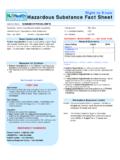
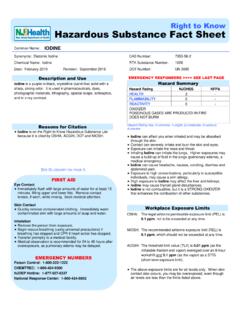
1 Right to know Hazardous Substance fact Sheet Common Name: CHLORINE Synonym: Molecular Chlorine Chemical Name: Chlorine Date: November 2007 Revision: October 2015 CAS Number: 7782-50-5 RTK Substance Number: 0367 DOT Number: UN 1017 Description and Use Chlorine is a yellow-green gas with a strong, irritating odor. It can be a liquid under pressure or cold temperatures. It is used as a bleach and disinfectant in water purification and sewage treatment, and in making other chlorinated chemicals. ODOR THRESHOLD= to ppm The range of accepted odor threshold values is quite broad. Caution should be used in relying on odor alone as a warning of potentially Hazardous exposures. Reason for Citation Chlorine is on the Right to know Hazardous Substance List because it is cited by OSHA, ACGIH, DOT, NIOSH, DEP, IRIS, NFPA and EPA. SEE GLOSSARY ON PAGE 5. FIRST AID Eye Contact Immediately flush with large amounts of cool water.
2 Continue for at least 30 minutes, occasionally lifting upper and lower lids. Remove contact lenses, if worn, while rinsing. Immediate medical attention is necessary. Skin Contact Quickly remove contaminated clothing. Immediately wash contaminated skin with large amounts of soap and water. Seek medical attention Immediately. Breathing Remove the person from exposure. Begin rescue breathing (using universal precautions) if breathing has stopped and CPR if heart action has stopped. Transfer promptly to a medical facility. Medical observation is recommended for 24 to 48 hours after breathing overexposure, as pulmonary edema may be delayed. EMERGENCY NUMBERS Poison Control: 1-800-222-1222 CHEMTREC: 1-800-424-9300 NJDEP Hotline: 1-877-927-6337 National Response Center: 1-800-424-8802 EMERGENCY RESPONDERS >>>> SEE BACK PAGE Hazard Summary Hazard Rating NJDHSS NFPA HEALTH - 4 FLAMMABILITY - 0 REACTIVITY - 0 NONFLAMMABLE GAS STRONG OXIDIZER CYLINDERS MAY EXPLODE IN FIRE Hazard Rating Key: 0=minimal; 1=slight; 2=moderate; 3=serious; 4=severe Chlorine can affect you when inhaled and may pass through the skin.
3 Contact can severely irritate and burn the skin and eyes. Contact with liquid Chlorine can cause frostbite. Exposure can irritate the nose and throat. Inhaling Chlorine can irritate the lungs. Higher exposure may cause a build-up of fluid in the lungs (pulmonary edema), a medical emergency. Chlorine may cause an asthma-like allergy. Exposure to Chlorine can cause headache, dizziness, nausea and vomiting. Repeated exposure can lead to permanent lung damage. Workplace Exposure Limits OSHA: The legal airborne permissible exposure limit (PEL) is 1 ppm, not to be exceeded at any time. NIOSH: The recommended airborne exposure limit (REL) is ppm, which should not be exceeded during any 15-minute work period. ACGIH: The threshold limit value (TLV) is ppm averaged over an 8-hour workshift and 1 ppm as a STEL (short-term exposure limit). The above exposure limits are for air levels only. When skin contact also occurs, you may be overexposed, even though air levels are less than the limits listed above.
4 CHLORINE Page 2 of 6 Determining Your Exposure Read the product manufacturer s Material Safety Data Sheet (MSDS) and the label to determine product ingredients and important safety and health information about the product mixture. For each individual Hazardous ingredient, read the New Jersey Department of Health Hazardous Substance fact Sheet , available on the RTK website ( ) or in your facility s RTK Central File or Hazard Communication Standard file. You have a Right to this information under the New Jersey Worker and Community Right to know Act, the Public Employees Occupational Safety and Health (PEOSH) Act if you are a public worker in New Jersey, and under the federal Occupational Safety and Health Act (OSHA) if you are a private worker. The New Jersey Right to know Act requires most employers to label chemicals in the workplace and requires public employers to provide their employees with information concerning chemical hazards and controls.
5 The federal OSHA Hazard Communication Standard (29 CFR ) requires private employers to provide similar information and training to their employees. This fact Sheet is a summary of available information regarding the health hazards that may result from exposure. Duration of exposure, concentration of the Substance and other factors will affect your susceptibility to any of the potential effects described below. Health Hazard Information Acute Health Effects The following acute (short-term) health effects may occur immediately or shortly after exposure to Chlorine: Contact can severely irritate and burn the skin and eyes with possible eye damage. Contact with liquid Chlorine can cause frostbite. Exposure can irritate the nose and throat causing coughing and wheezing. Inhaling Chlorine can irritate the lungs causing coughing and/or shortness of breath. Higher exposure may cause a build-up of fluid in the lungs (pulmonary edema), a medical emergency, with severe shortness of breath.
6 Exposure can cause headache, dizziness, nausea and vomiting. Chronic Health Effects The following chronic (long-term) health effects can occur at some time after exposure to Chlorine and can last for months or years: Cancer Hazard While Chlorine has been tested, it is not classifiable as to its potential to cause cancer. Reproductive Hazard While Chlorine has been tested, it is not classifiable as to its potential to cause reproductive harm. Other Effects Chlorine may cause an asthma-like allergy. Future exposure can cause asthma attacks with shortness of breath, wheezing, coughing, and/or chest tightness. Repeated exposure may cause bronchitis to develop with cough, phlegm, and/or shortness of breath and may lead to permanent lung damage. Long term exposure can damage the teeth, cause a skin rash, swelling and blisters, and hoarseness or loss of voice. Medical Medical Testing For those with frequent or potentially high exposure (half the TLV or greater), the following are recommended before beginning work and at regular times after that: Lung function tests Check teeth for signs of erosion If symptoms develop or overexposure is suspected, the following is recommended: Consider chest x-ray after acute overexposure Any evaluation should include a careful history of past and present symptoms with an exam.
7 Medical tests that look for damage already done are not a substitute for controlling exposure. Request copies of your medical testing. You have a legal Right to this information under the OSHA Access to Employee Exposure and Medical Records Standard (29 CFR ). Mixed Exposures Because smoking can cause heart disease, as well as lung cancer, emphysema, and other respiratory problems, it may worsen respiratory conditions caused by chemical exposure. Even if you have smoked for a long time, stopping now will reduce your risk of developing health problems. CHLORINE Page 3 of 6 Workplace Controls and Practices Very toxic chemicals, or those that are reproductive hazards or sensitizers, require expert advice on control measures if a less toxic chemical cannot be substituted. Control measures include: (1) enclosing chemical processes for severely irritating and corrosive chemicals, (2) using local exhaust ventilation for chemicals that may be harmful with a single exposure, and (3) using general ventilation to control exposures to skin and eye irritants.
8 For further information on workplace controls, consult the NIOSH document on Control Banding at The following work practices are also recommended: Label process containers. Provide employees with information and training concerning their hazards. Monitor airborne chemical concentrations. Use engineering controls if concentrations exceed recommended exposure levels. Provide eye wash fountains and emergency showers. Wash or shower if skin comes in contact with a Hazardous material. Always wash at the end of the workshift. Change into clean clothing if clothing becomes contaminated. Do not take contaminated clothing home. Special training is required to wash contaminated clothing. Do not eat, smoke, or drink in areas where chemicals are being handled, processed or stored. Wash hands carefully before eating, smoking, drinking, applying cosmetics or using the toilet. In addition, the following may be useful or required: Specific engineering controls are required for this chemical by OSHA.
9 Refer to the OSHA Compressed Gases Standard (29 CFR ). Personal Protective Equipment The OSHA Personal Protective Equipment Standard (29 CFR ) requires employers to determine the appropriate personal protective equipment for each hazard and to train employees on how and when to use protective equipment. The following recommendations are only guidelines and may not apply to every situation. Gloves and Clothing Avoid skin contact with Chlorine. Wear personal protective equipment made from material which can not be permeated and/or degraded by this Substance . Safety equipment suppliers/manufacturers can provide recommendations on the most protective glove/clothing material for your operation. Safety equipment manufacturers recommend Butyl, Neoprene or Viton for gloves and DuPont Tychem CPF3, CPF4, Responder , TK , Reflector , and Kappler Zytron 300 and Zytron 500 as protective materials for clothing.
10 Where exposure to cold equipment, vapors, or liquid may occur, employees should be provided with special clothing designed to prevent the freezing of body tissues. All protective clothing (suits, gloves, footwear, headgear) should be clean, available each day, and put on before work. Eye Protection Wear non-vented, impact resistant goggles when working with fumes, gases, or vapors. Wear a face shield along with goggles when working with corrosive, highly irritating or toxic substances. Respiratory Protection Improper use of respirators is dangerous. Such equipment should only be used if the employer has a written program that takes into account workplace conditions, requirements for worker training, respirator fit testing, and medical exams as described in the OSHA Respiratory Protection Standard (29 CFR ). Where the potential exists for exposure over ppm, use a NIOSH approved full facepiece respirator with an acid gas cartridge which is specifically approved for Chlorine.