Transcription of Risk Calculation Worksheet - Calculating Risk Using Model ...
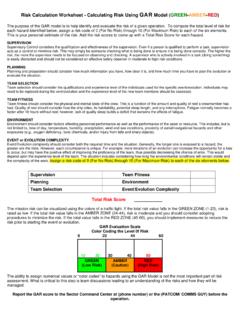
1 Risk Calculation Worksheet - Calculating Risk Using GAR Model ( green - amber -RED) Assign a risk code of 0 (For No Risk) through 10 (For Maximum Risk) to each of the six elements below: Element Description of Element Risk Score Supervision How closely do you need to supervise the crew/unit? The higher the risk the more a supervisor must focus on observing and checking. Planning How much information is available, how clear is it, how much time is available to plan/execute the mission? Crew Selection Consider the experience of the crews performing the mission. If individuals are replaced during the mission, assess their experience level and ensure proper turnover. Crew Endurance Refer to published crew fatigue standards.
2 Weather Environment should include all contributing factors; time ofday, lighting atmospheric/oceanic conditions, chemical hazards, proximity to other external and geographic hazards/barriers, among other factors. Case Complexity Event or evolution complexity considers both time and resources required to conduct the mission. Generally, the longer the exposure to a hazard, the greater the risk. Total Risk Score: The mission risk can be visualized us ing the colors of a traffic light. If the total risk value falls in the green ZONE (1-23), risk is rated as low. If the total risk value falls in the amber ZONE (24-44), risk is moderate and you should cons ider adopti ng procedures to minimize the risk.
3 If the total value falls in the RED ZONE (45-60), you should implement measures to reduce the risk prior to st arting the event or evolution. GAR Evaluation Scale Color Coding the Level of Risk 0 23 24 44 45 60 green (Low Risk) amber (Caution) RED (High Risk) The ability to assign numerical values or color codes to hazards Using the GAR Model is not the most important part of risk assessment. What is critical to this step is team discussions leading to an understanding of the risks and how they will be FORM RISK ASSESSMENT Worksheet (BACK) WX CONDITIONS (Add pts to total for night): Sea Conditions:_____ Visibility_____ Winds_____ 6-8 4-6 2-4 <2 <1mile 1-3 miles >3miles >20kts 15-20kts 10-15kts <10kts _____ TIDAL CONDITIONS AND CURRENT: State of Tide_____ Speed and Direction of Current_____ >3kts 2kts 1kt <1kt