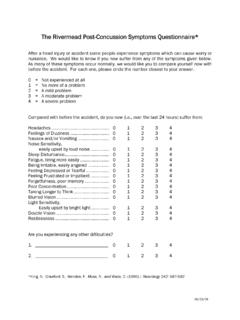
Transcription of Rivermead Post Concussion Symptoms …
1 Name:Date:After a head injury or accident some people experience Symptoms that can cause worry or nuisance. We would like to know if you now suffer any of the Symptoms given below. Because many of these Symptoms occur normally, we would like you to compare yourself now with before the accident. For each symptom listed below please circle the number that most closely represents your = not experienced at all1 = no more of a problem2 = a mild problem3 = a moderate problem4 = a severe problemCompared with before the accident, do you now ( , over the last 24 hours) suffer from.
2 Not experiencedno more of a problemmild problemmoderate problemsevere problemHeadaches01234 Feelings of dizziness01234 Nausea and/or vomiting01234 Noise sensitivity (easily upset by loud noise)01234 Sleep disturbance01234 Fatigue, tiring more easily01234 Being irritable, easily angered01234 Feeling depressed or tearful01234 Feeling frustrated or impatient01234 Forgetfulness, poor memory01234 Poor concentration01234 Taking longer to think01234 Blurred vision01234 Light sensitivity (easily upset by bright light) 01234 Double vision 01234 Restlessness01234 Are you experiencing any other difficulties?
3 Please specify, and rate as Administration only:RPQ-3 (total for first three items)RPQ-13 (total for next 13 items) post Concussion Symptoms QuestionnaireModified (Rpq-3 And Rpq-13)42 Printed With Permission: Modified Scoring System From Eyres 2005 28 Administration onlyIndividual item scores reflect the presence and severity of post concussive Symptoms . post concussive Symptoms , as measured by the RPQ, may arise for different reasons subsequent to (although not necessarily directly because of) a traumatic brain injury.
4 The Symptoms overlap with broader conditions, such as pain, fatigue and mental health conditions such as questionnaire can be repeated to monitor a patient s progress over time. There may be changes in the severity of Symptoms , or the range of Symptoms . Typical recovery is reflected in a reduction of Symptoms and their severity within three scoring system has been modified from Eyres, items are scored in two groups. The first group (RPQ-3) consists of the first three items (headaches, feelings of dizziness and nausea) and the second group (RPQ-13) comprises the next 13 items.
5 The total score for RPQ-3 items is potentially 0 12 and is associated with early symptom clusters of post concussive Symptoms . If there is a higher score on the RPQ-3, earlier reassessment and closer monitoring is RPQ-13 score is potentially 0 52, where higher scores reflect greater severity of post concussive Symptoms . The RPQ-13 items are associated with a later cluster of Symptoms , although the RPQ-3 Symptoms of headaches, dizziness and nausea may also be present. The later cluster of Symptoms is associated with having a greater impact on participation, psychosocial functioning and lifestyle.
6 Symptoms are likely to resolve within three months. A gradual resumption of usual activities is recommended during this period, appropriate to Symptoms . If the Symptoms do not resolve within three months, consideration of referral for specialist assessment or treatment services is :Eyres, S., Carey, A., Gilworth, G., Neumann, V., Tennant, A. (2005). Construct validity and reliability of the Rivermead post Concussion Symptoms Questionnaire. Clinical Rehabilitation, 19, , N. S., Crawford, S., Wenden, , Moss, Wade, (1995).
7 The Rivermead post Concussion Symptoms Questionnaire: a measure of Symptoms commonly experienced after head injury and its reliability Journal of Neurology, 242, , S., Leigh, E., Wade, D., Fleminger, S. (2006). The Rivermead post Concussion Symptoms Questionnaire Journal of Neurology, October 1-12. post Concussion Symptoms Questionnaire (cont.)Modified (Rpq-3 And Rpq-13)42 Printed With Permission: Modified Scoring System From Eyres 2005 28