Transcription of Robert’s Rules of Order Cheat Sheet - BoardEffect
1 TYPES OF MOTIONS1. main motion : Introduce a new item2. Subsidiary motion : Change or affect how to handle a main motion (vote on this before main motion )3. Privileged motion : Urgent or important matter unrelated to pending business4. Incidental motion : Questions procedure of other motions (must consider before the other motion )5. motion to Table: Kills a motion6. motion to Postpone: Delays a vote (can reopen debate on the main motion )EVERY motion HAS 6 STEPS1. motion : A member rises or raises a hand to signal the Second: Another member seconds the Restate motion : The chairperson restates the Debate: The members debate the Vote: The chairperson restates the motion , and then first asks for affirmative votes, and then negative Announce the vote: The chairperson announces the result of the vote and any ! If the board is in obvious agreement, the chairperson may save time by stating, If there is no objection, we will adopt the motion Then wait for any objections.
2 Then say, Hearing no objections, (state the motion ) is adopted. And then state any instructions. If a member objects, first ask for debate, then vote and then announce the POINTSC ertain situations need attention during the meeting, but they don t require a motion , second, debate or voting. It s permissible to state a point during a meeting where the chairperson needs to handle a situation right away. Board members can declare a Point of Order , Point of Information, Point of Inquiry or Point of Personal of Order : Draws attention to a breach of Rules , improper procedure, breaching of established practices, of Information: A member may need to bring up an additional point or additional information (in the form of a nondebatable statement) so that the other members can make fully informed of Inquiry: A member may use Point of Inquiry to ask for clarification in a report to make better voting of Personal Privilege: A member may use Point of Personal Privilege to address the physical comfort of the setting such as temperature or noise.
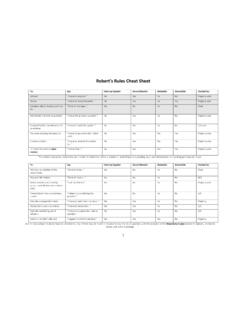
3 Members may also use it to address the accuracy of published reports or the accuracy of a member s conduct.* A member may make a motion to Reconsider something that was already disposed; however, the reconsidered motion may not be subsequently reconsidered. A motion to Reconsider must be made during the same meeting and can extend to a meeting that lasts for more than one s Rules of OrderCheat Sheet Robert s Rules of Order Cheat TO SAY I move I move to amend the motion (Add or strike words or both) I move that we refer the matter to committee. I move to postpone the matter I move the previous question. Point of Order . I move that we recess I move to adjourn the meeting. Point of information. I move to overrule the chair s ruling. I move to extend the time by _____ minutes. Point of Order . I move to table. ACTIONI ntroduce main motionAmend a motionMove item to committeePostpone itemEnd debateObject to procedureRecess the meetingAdjourn the meetingRequest informationOverrule the chair s rulingExtend the allotted timeEnforce the Rules or pointout incorrect procedureTable a motionNEED A SECOND?
4 YesYesYesYesYesNoYesYesNoYesYesNoYesCAN BE DEBATED?YesYesYesYesYesNoNoNoNoYesNoNoNo CAN I INTERRUPT SPEAKER?NoNoNoNoNoYesNoNoYesYesNoYesNoCA N BE AMENDED?YesYesNoNoNoNoNoNoNoNoYesNoNoVOT ESNEEDEDM ajorityMajorityMajorityMajorityMajorityC hair decisionMajorityMajorityNo voteMajority2/3 voteNo voteMajorityFollow the agenda to keep the group moving toward its s Rules of Order , which is also widely known as parliamentary procedure, was developed to ensure that meetings are fair, efficient, democratic and orderly. The following tips and reminders will help chairpersons to run a successful and productive meeting without being run over or running over the group do its own work; don t the flow of the meeting by recognizing members who ask to all members speak once before allowing anyone to speak a second discussions get off-track, gently guide the group back to the courtesy and respect, and insist that others do the to develop the board s skills in parliamentary procedure by properly using motions and points of each speaker your undivided an emotional pulse on the a consensus to have the final authority of the s Rules of OrderTips and s Rules of OrderTips and RemindersSPECIAL TIPS AND REMINDERS FOR ELECTRONIC MEETINGSThe COVID-19 pandemic is requiring many boards to use the electronic meeting format for board meetings to help prevent the spread of the virus.
5 These tips and reminders for electronic meetings will ensure that your board is following good governance practices and will help you to run your electronic meetings more smoothly. The National Association of Parliamentarians offers the following four sets of guidelines for conducting electronic meetings. 1. Revise your bylaws to authorize electronic meetings. Review the specific language in the bylaws to ensure that the Rules clearly state what s required to hold an electronic meeting that qualifies as an official board meeting. 2. Bylaws authorize absent members to participate electronically; however, the entire meeting cannot be conducted electronically. Note the difference between a fully electronic meeting and permissible electronic participation for what is largely an in-person meeting. The bylaws should state clear Rules for allowable locations and quorum requirements. For example, do the bylaws allow the chair to host an electronic meeting with one member in attendance and the remainder of the members attending via electronic means?
6 3. Hold informal electronic meetings without transacting official business. For boards that aren t permitted by their bylaws to hold official electronic meetings, their bylaws may allow them to meet via electronic means informally for discussions. Official decisions would then have to wait to be voted on until the organization could hold an official board meeting. 4. Bylaws may authorize boards to transact business without holding a meeting for example, via telephone or email. Where this is allowed, boards wouldn t have to meet in person. Boards could discuss matters informally and transact official business in the manner described by the bylaws. TIPS TO MAINTAIN GOOD GOVERNANCE DURING ELECTRONIC MEETINGS1. The secretary should post the date and time, URL, and any meeting passcodes in the agenda well before the meeting starts. Ideally the agenda is stored within a secure board management platform, like BoardEffect .
7 The secretary should also set up an alternative audio connection to the internet meeting platform along with the phone number and access codes for those that can only participate by phone. 2. The secretary should set up the meeting time for at least 15 minutes before the actual meeting start time to allow members time to enter the platform and resolve any technical Members should identify themselves upon entering the meeting and plan to remain on the platform for the duration of the meeting. If they need to leave early, they should sign out of the platform as they leave the meeting. 4. Each member is responsible for their own audio and internet connections. Boards shouldn t invalidate any actions because an individual member s electronic connection prevented them from participating in the The chair may mute or disconnect a member s connection if it s causing interference with the meeting. If the chair makes this decision, it s subject to any member requesting an undebatable appeal.
8 The decision and the appeal should be announced during the meeting and be recorded in the meeting minutes. 6. If the chair recognizes a member to speak on the floor, the chair should clear the queue of members who also sought recognition. Members can seek recognition again and the chair should recognize a member for the purpose of determining whether the member is entitled to preference in Certain groups are too large for everyone to be seen on video. The chair, secretary or tech assistant should arrange the platform so that the chair s video is pinned to the screen throughout the meeting. Also, the person handling tech issues should arrange the platform so that a member being recognized to speak has that person s video displayed. 8. At the close of the meeting, the board chair may choose to summarize discussions and ask if they missed anything. 9. Consider holding a recap session at the close of your board meeting to get feedback from the members on how well the technology worked and ask for suggestions on how to ensure your meetings are being run efficiently.
9 Nonprofit Board Meeting Agenda SampleTRADITIONAL NONPROFIT AGENDA SAMPLEThe most common type of agenda format is the traditional agenda. There s some room for flexibility based on the organization s needs, but this agenda generally follows the following format. Welcome Call to Order Roll Call or Attendance (make note of members attending electronically) Approve the minutes of the last meeting (if one or more members are attending electronically, must determine if the bylaws qualify this as an official meeting; if it isn t, the board can t approve the prior minutes or vote on other matters) Executive Director s report Finance committee report Nominating and governance committee report Program committee report Fundraising committee report Unfinished business New business Board development Guest presentations (you may move this up earlier in the agenda so guests don t have to sit through the entire meeting) AdjournmentThe finance committee usually distributes quarterly reports, and the board may have a brief discussion about the projected budget and the actual budget.
10 The agenda may also include cyclical items, such as the audit, elections or other annual NONPROFIT AGENDA SAMPLE Welcome Opening thoughts. A different board member starts the meeting with an opening thought. Call to Order Roll Call or Attendance (make note of members attending electronically) Consent Agenda. This usually includes the minutes of the last meeting and other routine items that require little or no discussion. Board members can move to withdraw an item from the consent agenda if it needs additional discussion (if one or more members are attending electronically, must determine if the bylaws qualify this as an official meeting; if it isn t, the board can t approve the prior minutes or vote on other matters) Finance committee report Nominating and governance committee report Program committee report Fundraising committee report Discussion of strategic initiatives Board development Unfinished business AdjournmentThe idea behind a strategic agenda is to streamline routine items to allow board members to spend most of the meeting time on strategic planning.