Transcription of Role of Schools, - CBSE
1 Role of Schools, Principals & FacilitatorsAdvocacy ManualAdolescence Education ProgrammeA Four Part Training PackageivContents of the Training PackageThis set of materials have been field-tested, reviewed/revised and are currently being utilised by different agencies for implementing AEP through curriculum plus. The following Manuals have been developed as a comprehensive package for school based Adolescence Education AdvoCACy MAnuAl FoR PRinCiPAlS And FACiliTAToRSTo be used byResource Persons/TrainersContentl Needs and concerns of Adolescents l Adolescence Education Programmel Role of Stakeholders and ResponsibilitiesPurposel The Manual can be used for sensitising various Stakeholders/School Principals/Opinion Makers/Professionals towards Adolescent Issues and Concerns, Policy Framework and Programmes.
2 The section on the role of the Stakeholders however, will need to be modified according to the Target Group. l The Manual is essentially developed as a component of the comprehensive package for the school based Adolescence Education programme . However, it can be used for advocacy for out-of-school Adolescents with focus on their Special Needs, Programmes and Community For more information on Adolescent Issues the Manual can be supplemented by the Advocacy Kit Healthy Adolescents - Empowered Adolescents (MoYAS-UNFPA, 2005). Duration1 day2. FACiliTAToRS HAndbook FoR TRAining oF RESouRCE PERSonS And nodAl TEACHERSTo be used byResource Persons/Trainers ContentIncludes knowledge and Life-Skills enhancement sessions in the following areas:l Perspective Building on Life-Skillsl Understanding Adolescencel Adolescent Health Issues (AHI)Duration 5 daysvl Basic facts, transmission, prevention of RTIs/STIs and HIV/AIDSl Basic facts, risk and protective factors in Substance-AbusePurposel The Handbook can be used for training Resource Persons at the National and State Levels.
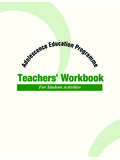
3 These trained Resource People would further use this Handbook for training Nodal Teachers at the District As part of the five-day training programme , Resource Persons and Nodal Teachers conduct class room sessions on the last two days with either class IX or class XI in a school close to the training venue. The debriefing session enables them to know their skills before conducting the co-curricular activities in their respective schools. l Before the initiation and at the end of the training session, Resource Persons and Nodal Teachers are administered knowledge, attitude and skills For more information on adolescent issues the Handbook can be supplemented by the accompanying Reference Material TEACHERS WoRkbook FoR STudEnT ACTiviTiESTo be used byNodal TeachersContentl Classroom Session 1: Healthy growing up, Adolescent Health Issues (AHI)l Classroom Session 2: STIs/RTIs and HIV/AIDSl Classroom Session 3.
4 Preventing Substance AbusePurposel The Workbook has been designed to guide Nodal Teachers while conducting classroom sessions for AEP in The classroom sessions are planned to enhance both the knowledge base as well as Life-Skills such as Critical-Thinking, Decision-Making, Negotiation-Skills, Problem-Solving, Interpersonal-Communication, Empathy, Self-Awareness, Coping with Stress, etc. l Wherever possible, optional activities have been provided and Nodal Teachers can choose activities based on their socio-cultural milieu. l Planned activities will be used for revision and reinforcement of 16 hours per academic yearvi4.
5 REFEREnCE MATERiAl FoR RESouRCE PERSonS/nodAl TEACHERS/PEER EduCAToRSTo be used byResource Persons/Nodal Teachers/Peer-EducatorsContentl Understanding Growing Up, Adolescent Health Issues (AHI)l STIs/RTIs and HIV/AIDSl Preventing Substance-Abusel Teachers as CounsellorsPurposel The Reference Material has been organised in accordance with the classroom sessions so that the Nodal Teachers/Peer Educators and Trainers can read the relevant section for information and knowledge before conducting the References are given for further (people in the 10-19 age group) constitute nearly one-fifth of India s population and yet their identity as a distinct demographic group has been ignored so far.
6 It has been realised very recently that adolescents have been an under-served population group and require urgent attention for meeting their health,needs. This group is particularly vulnerable because of rapid physical, psychological and social changes occurring during adolescence about which they lack proper and authentic knowledge, information that they should be receiving from schools, parents, service providers and peers. Several studies have emphasised serious concerns relating to adolescents that need urgent attention. Increasing numbers of Adolescents are adopting irresponsible behaviour practising Substance-Abuse, and suffering from mental and emotional stress.
7 They adopt risky behaviour primarily because they are not informed appropriately, lack the skills to manage their emotions and do not have youth-friendly services available to them. In view of the above, the Ministry of Human Resource Development, Government of India has launched the Adolescence Education programme (AEP). AEP is aimed at providing adolescents with authentic knowledge about the process of growing up during Adolescence, HIV/AIDS and Substance-Abuse. It aims to enhance the necessary Life-Skills in Adolescents so that they can manage risky situations competently and develop a positive attitude towards people living with is important to note that this educational programme requires special social and political support as it deals with many issues and concerns related to matters that are culturally very sensitive.
8 A sustained advocacy, therefore, is needed for convincing Policy Framers, Educational Administrators, Parents, Teachers and Community Leaders about the urgency of this educational intervention by using all means of communication available, including the mass media, interpersonal communication, and other formal and informal information channels. You as an advocate can influence the process of policy and programme formulation and execution, social climate and social norms, generate community support for the well-being of Adolescents and help in improving the conditions that have a bearing on their present Advocacy material for Facilitators and school principals has been developed to meet the strong need for sensitising various target groups and providing them information on issues and concerns relating to adolescents and also on this educational programme .
9 It is sincerely hoped that the Advocacy Manual will help you in opening a dialogue with Policy Makers, Principals, Teachers, Parents, Community Leaders and other stakeholders for mobilising their support for the National Adolescence Education of the Training PackageivIntroductionvAbbreviations xIndex of overhead transparenciesxiAbout the ManualxiiiGuidelines for Facilitatorsxivintroduction SESSion i: getting Started Introduction and Expectations of Participants Objectives of the Advocacy workshop Being an Advocate for Adolescence Education Setting Group Norms50 Activity2 Critical Concerns SESSion ii: Setting the Context Situation of Adolescent Health in India Vision for Healthy and Empowered Adolescents National Policies and Programmes50 Discussion and Presentation8 The Adolescence Education programme (AEP)SESSion iii: About the programme Introduction to AEP: Objectives and Coverage Content of AEP Concept of Life-Skills Applying Life-Skills Monitoring and Evaluation50 Discussion, Situation Analysis and Presentation 21 The Adolescence Education programme : Stakeholders Roles and ResponsibilitiesSESSion iv.
10 Role of Stakeholders Role of School Principals Role of Nodal-Teachers Role of Peer-Educators30 and Presentation38 Summary and FeedbackSESSion v: Summary and Feedback30 Discussion44 SESSion vi: guided Meditation & Creative visualisation48 ContentsAdolescence Education ProgrammeixAppendicesAppendix 1: Fact Sheets About Adolescence Situation of Adolescent Health in India HIV/AIDS Substance- Abuse Life- Skills Commonly asked questions by Parents50 Appendix 2: Implementation Checklist68 Appendix 3: Child Abuse : Types, Sign and Risk Factors for Child Abuse69 References74 ContentsAn Advocacy Manual: Role of Schools, Principals and Facilitatorsxlist of AbbreviationsList of AbbreviationsAdolescence Education ProgrammeAEP-Adolescence Education programme AIDS -Acquired Immune Deficiency SyndromeAHI-Adolescent Health IssuesART-Anti-retroviral TherapyCBSE-Central Board of Secondary EducationCOBSE-Council of Boards of School Education in IndiaELISA-Enzyme Linked Immunosorbent AssayHIV -Human Immunodeficiency VirusHAART-Highly Aggressive Anti-retroviral TherapyKVS-Kendriya Vidyalaya SangathanMHRD-Ministry of Human Resource DevelopmentMoHFW-Ministry of Health and Family WelfareMOYAS-Ministry of Youth Affairs and SportsNACO -National AIDS Control OrganisationNCERT-National