Transcription of Rubrics Presentation - Swarthmore College
1 RUBRICST eagle Foundation Systematic Improvement Grant:Sustainable Departmental-Level Assessment of Student pLearningPresentation at 1/26/2010 meeting at Haverford College , with grant participants from Bryn Mawr, Haverford, and Swarthmore CollegesCollegesRobin H. Shores, Director, Institutional Research, Swarthmore CollegeThis summary combines speaker notes and ypexample slides shown during end for sources of examples Number of our projects (10 of 12) use Rubrics Logical form of Assessment Presentation intended to review and establish common starting point Rubrics used more commonly in K-12, but less at College LevelLess pedagogical training?
2 Complexity of College Level work?pygR b i tili t d t Rubrics operationalize student learning objectives A rubric is a tool for scoring an assignment that breaks the work into the component parts (which reflect objectives) The rubric provides a score (at a minimum) or a detailed description (ideally) of good or bad performance on each component bi b d t d t d t E h t b ihtd Rubrics can be used to grade students. Each component can be weighted and combined for an overall score.
3 They can be used to provide feedback about the extent to which all students They can be used to provide feedback about the extent to which all students are achieving each of the learning goals intended => Assessment. Any performance assignmentcan be scored with a rubric a lab assignment , group project, lhldfhllhoral Presentation , essay, thesis, etc. (Wouldn t use for short response, multiple ) A rubric can be designed by an individualfaculty member or by a group of faculty and boltsDeveloping a rubric (the hard part)1.
4 List the objectives( Broad learning targets, Evaluation criteria ..) and, if helpful, sub-objectives. Evaluation criteria ..) and, if helpful, subobjectives. You may see examples of Rubrics that simply list skills or the component of assignment ( content, Presentation , organization) but in order to use Rubrics for meaningful organization), but in order to use Rubrics for meaningful assessment of student learning for our work on the Teagle grant, the components ought to be explicitly tied to learning objectives.
5 This articulation can be accomplished through the combination of objectives and their quality descriptions (see next item).their quality descriptions (see next item).Nuts and boltsDeveloping a rubric (the hard part)2. Describe with examples the gradations of qualityfor each objective. Usually three to five gradations are used. Use the same number of d ti f h bj ti b t th di ti ld f b gradations for each objective, but the descriptions would, of course, be different. It can be difficult to label the gradations (Excellent, Adequate, etc.)
6 You don t have to label them if they don t lend themselves to it you can just use numbers or letters. If you have past assignments, it is jfypg,helpful to review them for examples. Rubric with descriptions of each level of quality. Rating Scale rubric or Scoring rubric defines standard for highest llf fdilili il(level of performance, and simply uses a simple numeric rating scale ( excellent, good, )Avoid unclear language be as specific as possible. Unclear objective: uses clear language Better objective: provides a Unclear objective: uses clear language.)
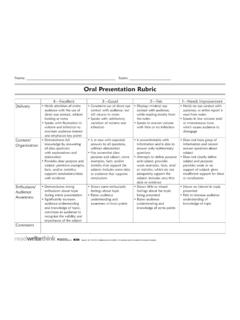
7 Better objective: provides a detailed description . Your descriptions in the gradations will provide further clarificationNuts and boltsDeveloping a rubric (the hard part)Developing a rubric (the hard part)3. Review, test, and adjust work with past examples of the assignment or a similar examples of the assignment or a similar assignment , if possible, to see whether your rubric is capturing what you want it to. Ask rubric is capturing what you want it to. Ask respected colleagues to review the rubric and ask if it makes sense or if they see any gapsStandard RubricDIMENSIONS or OBJECTIVESL abel for Lowest LevelLabel for Next LevelLabel for Highest LevelObjective 1 Objective 2 Objective 3 Objective 4 Standard RubricTask Description: Each student will make a 5 minute Presentation on the changes in one Portland community over the past 30 years.
8 The student may focus the Presentation in any way s/he wishes, butthere needs to be a thesis of some sort, not just a chronological DIMENSIONS or OBJECTIVESN eeds WorkCompetentExcellentypyy/,,jgexpositio n. The Presentation should include appropriate photographs, maps, graphs, and other visual aids for the / UnderstandingThinking/InquiryCommunicati onUse of Visual AidPresentationskillsPresentation skillsSource: or OBJECTIVESN eeds workCompetentExcellentKnowledge/ UnderstandingThe Presentation uses little relevant or accurate information, not even that which was presented in class or in the idttThe Presentation uses knowledge which is generally accurate with only minor inaccuracies, and which is generally relevant to the t d t th iThe Presentation demonstrates a depth of historical understanding by using relevant and accurate detail to support the student s th iassigned texts.
9 Student s or no research is is adequate but does not go much beyond what was presented in class or in the assigned is thorough and goes beyond what was presented in class or in the assigned InquiryThe Presentation shows no analytical structure and noThe Presentation shows an analytical structure and a centralThe Presentation is centered around a thesis which shows aanalytical structure and no central structure and a central thesis, but the analysis is not always fully developed and/or linked to the a thesis which shows a highly developed awareness of historiographic or social issues and a high level of conceptual Presentation fails to capture the interest of the audience Presentation techniques used are effective in conveying main ideas.
10 The Presentation is imaginative and effective in conveying ideas and/or is confusing in what is to be a bit the questions from the audience remain presenter responds effectively to audience reactions and questionsUse of visual aidsThe Presentation includes no visual aids or visual aids that areThe Presentation includes appropriate visual aids, but theseThe Presentation includes appropriate and easilyvisual aids or visual aids that are inappropriate, and/or too small or messy to be understood. appropriate visual aids, but these are too few, in a format that makes them difficult to use or understand, and/or the presenter does not refer to or explain them in the and easily understood visual aids which the presenter refers to and explains at appropriate moments in the presenter makes no mention of them in the skillsThe presenter cannot be heard The presenter speaks clearly and The presenter speaks clearly and and/or speaks so unclearly that s/he cannot be enough to be heard.