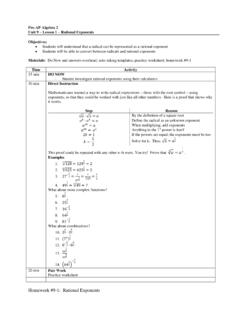
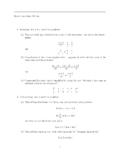
Transcription of Rules for Operations with Exponents
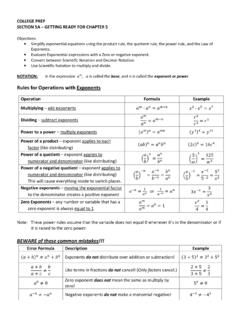
1 COLLEGE PREP SECTION 5A GETTING READY FOR CHAPTER 5 Objectives: Simplify exponential equations using the product rule, the quotient rule, the power rule, and the Law of Exponents . Evaluate Exponential expressions with a Zero or negative exponent . Convert between Scientific Notation and Decimal Notation. Use Scientific Notation to multiply and divide. NOTATION: in the expression , is called the base, and is called the exponent or power. Rules for Operations with Exponents Operation Formula Example multiplying add Exponents Dividing subtract Exponents Power to a power multiply Exponents Power of a product exponent applies to each factor (like distributing) 2 16 Power of a quotient exponent applies to numerator and denominator (like distributing) 5 125 Power of a negative quotient exponent applies to numerator and denominator (like distributing) This will cause everything inside to switch places.
2 5 5 5 Negative Exponents moving the exponential factor to the denominator creates a positive exponent or 3 3 Zero Exponents any number or variable that has a zero exponent is always equal to 1 1 4 14 Note: These power Rules assume that the variable does not equal 0 whenever it s in the denominator or if it is raised to the zero power. BEWARE of these common mistakes!!! Error Formula Description Example Exponents do not distribute over addition or subtraction! 3 5 3 5 Like terms in fractions do not cancel! (Only factors cancel.) 2 53 5 23 0 Zero exponent does not mean the same as multiply by zero! 5 0 Negative Exponents do not make a monomial negative!
3 4 4 EXAMPLES: Simplify each expression Product Rule: Remember to deal with the coefficients separately. A) 3 3 243 B) 2 5 10 Quotient Rule: Coefficients (numbers) are divided, Exponents are subtracted. C) 6 6 216 D) Zero exponent Rule: Anything with an exponent of zero should be changed to a 1 E) 1 F) 18 1 18 Negative exponent Rule: Move ONLY the variable that the exponent is attached to. If it s outside parentheses, move everything within the parentheses. G) H) I) J) Power Rule: If you raise a power to a power, you are multiplying it by itself, therefore, you must raise any coefficient to the power outside the parentheses, and multiply all Exponents .
4 K) 3 3 3 3 3 3 L) 7 7 1 M) 2 16 N) 4 O) P) SCIENTIFIC NOTATION. A number is written in scientific notation when it is in the form 10 where 1 | | 10 and is an integer. To change a decimal to scientific notation: Step 1: Count the number N of decimal places that the decimal point must be moved in order to get only one digit ( ) in front of the decimal. Step 2: If you had to move the decimal to the left (you started with a large number), then your exponent is positive ( 10 ). If you had to move the decimal to the right (you started with a decimal), then your exponent will be negative ( 10.
5 Examples: Write the following in scientific notation. Q) , 10 Move the decimal 5 places to the left (the original number is greater than 1), so the exponent is +5. R) . 10 Move the decimal 2 places to the right (the initial number is less than 1), so the exponent is -2. REVERSING THE PROCESS (going from scientific notation to decimal notation): Look at the exponent on the 10. If the exponent is negative, move the decimal N spaces to the left (toward the negative end of the number line). If the exponent is positive, move the decimal N spaces to the right (toward the positive end of the number line). Examples: Write the following in decimal notation. S) . 28,000 The positive exponent means the decimal moves to the right.
6 T) . The negative exponent moves the decimal to the left. multiplying & DIVIDING WITH SCIENTIFIC NOTATION. Follow the usual Rules of Exponents , except separate the pieces. Simplify the numbers, then add/subtract the Exponents on the 10 s. Examples: U) 3 2 10 10 6 10 V) .. 10 10 10 10 W) .. 10 2 10 X) .. 10 10 .5 10 5 10 Homework: page 351: # 19-24, 31, 33, 37, 41, 45, 51, 57, 65, 69, 71, 81, 83, 85, 87, 91, 101, 105, 115, 117, 121, 131.