Transcription of Rules of origin - TDAP
1 Rules OF origin FOR THE. CHINA-PAKISTAN FREE TRADE AREA. In determining the origin of products eligible for preferential tariff concession under the Agreement on the Early Harvest Program and the Free Trade Agreement between the People's Republic of China and the Islamic Republic of Pakistan (hereinafter referred to as the Agreements ), the following Rules of origin shall apply: Rule 1: Definitions For the purposes of these Rules (a) a Party means the Islamic Republic of Pakistan ( Pakistan ) or the People's Republic of China ( China ). (b) CIF value means the price actually paid or payable to the exporter for the good when the good is unloaded from the carrier, at the port of importation. The value includes the cost of the good, insurance and freight necessary to deliver the good to the named port of destination. (c) Customs Valuation Agreement means the WTO Agreement on Implementation of Article VII of the General Agreement on Tariffs and Trade 1994.
2 (d) FOB value means the price actually paid or payable to the exporter for the good when the good is loaded into the carrier at the named port of exportation. The value includes the cost of the good and all costs necessary to bring the good into the carrier. (e) materials include ingredients, parts, components, subassembly and/or goods that were physically incorporated into another good or were subject to a process in the production of another good. 1. (f) originating goods means products that qualify as originating in accordance with the provisions of Rule 2. (g) Product Specific Rules are Rules that specify that the materials have undergone a change in tariff classification or a specific manufacturing or processing operation, or satisfy an ad valorem criterion or a combination of any of these criteria. (h) Indirect material means a good used in the production, testing or inspection of a good but not physically incorporated into the good, or a good used in the maintenance of buildings or the operation of equipment associated with the production of a good, including: a.
3 Fuel and energy;. b. Tools, dies, and moulds;. c. Parts and materials used in the maintenance of equipment and buildings;. d. Lubricants, greases, compounding materials, and other materials used in production or used to operate equipment and buildings;. e. Gloves, glasses; footwear, clothing, safety equipment, and supplies;. f. Equipment, devices, and supplies used for testing or inspecting the goods;. g. Catalysts and solvents; and any other goods that are not incorporated into the good but whose use in the production of the good can reasonably be demonstrated to be part of that production;. (i) Non-originating material used in production means any material whose country of origin is other than that of the Parties and any material whose origin cannot be determined: j) Production includes methods of obtaining goods including manufacturing, producing, assembling, processing, raising, growing, breeding, mining, extracting, harvesting, fishing, trapping, gathering, collecting, hunting and capturing.
4 Rule 2: origin Criteria 2. For the purposes of this Agreement, products imported by a Party shall be deemed to be originating and eligible for preferential concessions if they conform to the origin requirements under any one of the following: (a) products which are wholly obtained or produced as set out and defined in Rule 3; or (b) products not wholly obtained or produced provided that the said products are eligible under Rule 4, Rule 5 [or Rule 6]. Rule 3: Wholly Obtained or Produced Products Within the meaning of Rule1 (a), the following shall be considered as wholly produced or obtained in a Party: (a) Plant and plant products harvested, picked or gathered there;. (b) Live animals born and raised there;. (c) Products obtained from live animals referred to in paragraph (b) above;. (d) Products obtained from hunting, trapping, fishing, aquaculture, gathering or capturing conducted there.
5 (e) Minerals and other naturally occurring substances, not included in paragraphs (a) to (d) above, extracted or taken from its soil, waters, seabed or beneath their seabed;. (f) Products taken from the waters, seabed or beneath the seabed outside the territorial waters of that Party; provided that that Party has the rights to exploit such waters, seabed and beneath the seabed in accordance with international law;. (g) Products of sea fishing and other marine products taken from the high seas by vessels registered with a Party or entitled to fly the flag of that Party;. (h) Products processed and/or made on board factory ships registered with a Party or entitled to fly the flag of that Party, exclusively from products referred to in paragraph (g) above;. 3. (i) Parts or raw materials recovered there from articles which can no longer perform their original purpose nor are capable of being restored or repaired.
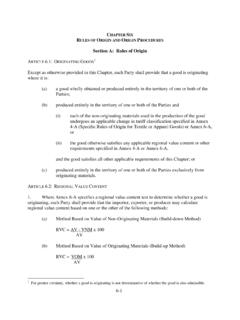
6 (j) Articles collected there which can no longer perform their original purpose nor are capable of being restored or repaired and are fit only for disposal or recovery of parts of raw materials, or for recycling purposes;. (k) waste and scrap resulting from manufacturing operations conducted there; and (l) Goods obtained or produced in a Party solely from products referred to in paragraphs (a) to (k) above. Rule 4: Not wholly Produced or Obtained Products (a) For the purposes of Rule 2(b), a product shall be deemed to be originating if not less than 40% of its content originates from a Party. (b) For the purposes of calculating local value added content the following method shall apply: Value of Non-originating materials _____ x 100 60%. FOB Price (c) The value of the non-originating materials shall be: (i) the CIF value at the time of importation of the materials; or 4.
7 (ii) the earliest ascertained price paid for the materials of undetermined origin in the territory of the Party where the working or processing takes place. Rule 5: Cumulative Rule of origin Unless otherwise provided for, products which comply with origin requirements provided for in Rule 2 and which are used in the territory of a Party as materials for a finished product eligible for preferential treatment under the Agreement shall be considered as products originating in the territory of the Party where working or processing of the finished product has taken place provided that the aggregate China-Pakistan originating content on the final product is not less than 40%. Rule 6: Product Specific Rules Products which have undergone sufficient transformation in a Party shall be treated as originating goods of that Party. Products which satisfy the Product Specific Criteria as annexed to these Rules shall be considered as goods to which sufficient transformation has been carried out in a Party.
8 ]. Rule 7: Minimal Operations and Processes The following operations or processes shall be considered as minimal operations and shall not be taken into account in determining the origin of a product in terms of Rule 2: 5. a) Operations to ensure the preservation of products in goods condition during transport and storage (such as drying, freezing, keeping in brine, ventilation, spreading out, chilling, placing in salt, sulphur dioxide or other aqueous solutions, removal of damaged parts, and like operations);. b) Simple operations consisting of removal of dust, sifting or screening, sorting, classifying, matching (inkling the making-up of sets of articles), washing, painting, cutting;. c) Changes of packing and breaking up and assembly of consignments;. d) Simple cutting, slicing and repacking or placing in bottles, flasks, bags, boxes, fixing on cards or boards and all other simple packing operations.
9 E) Affixing of marks, labels or other like distinguishing signs on products or their packaging;. f) Simple mixing of products whether or not of different kinds, where one or more components of the mixture do not meet the conditions laid down in this Chapter to enable them to be considered as originating products;. g) Simple assembly of parts of products to constitute a complete product;. h) Disassembly;. i) Slaughter of animals;. j) Mere dilution with water or another substance that does not mater5ially alter the characteristics of the goods; and k) A combination of two or more operations referred to in paragraphs (a) to (j). Rule 8: Direct Consignment The following shall be considered as consigned directly from the exporting Party to the importing Party: (a) If the products are transported without passing through the territory other than China and Pakistan.
10 6. (b) The products whose transport involves transit through one or more intermediate non- CPFTA countries with or without transshipment or temporary storage in such countries, provided that: (i) the transit entry is justified for geographical reason or by consideration related exclusively to transport requirements;. (ii) the products have not entered into trade or consumption there; and (iii) the products have not undergone any operation there other than unloading and reloading or any operation required to keep them in good condition. Rule 9: Treatment of Packing (a) Where for purposes of assessing customs duties, a Party treats products separately from their packing; it may also, in respect of its imports consigned from another Party, determine separately the origin of such packing. (b) Where paragraph (a) above is not applied, packing shall be considered as forming a whole with the products and no part of any packing required for their transport or storage shall be considered as having been imported from outside the CPFTA when determining the origin of the products as a whole.