Transcription of SABIC® HDPE M40060S - b2bPolymers.com
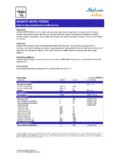
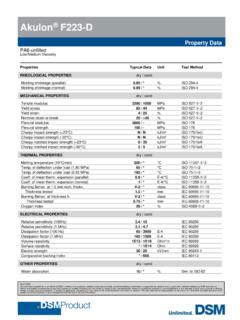
1 SABIC HDPE M40060 SHigh density polyethylene for Injection HDPE M40060S is an UV stabilized, high density polyethylene copolymer injection moulding grade with a narrow molecular weight distribution. It has improved mouldability. Articles produced from this grade exhibit excellent impact strength, low warpage, stress crack resistance (ESCR) and excellent HDPE M40060S is recommended for the manufacture of injection moulded articles such as pails, shipping containers and industrial moulding conditions for SABIC HDPE M40060S are:Melt temperature: 232 - 260 C (450 - 500 F)Mould temperature: 20 - 40 C (70 - 104 F)Injection pressure: 93 - 103 MPa (13500 - 15000)PropertiesUnits SIValuesTest methodsTypical propertiesMelt flow rate (MFR)ASTM D 1238at 190 C and kgg/10 960 ASTM D 15051)Mechanical properties1)Tensile testASTM D 638stress at yieldMPa33stress at breakMPa22strain at break%1200secant modulus at 1% elongationMPa1240 Izod impact notched at 23 CJ/m69 ASTM D 256 Hardness Shore D-69 ASTM D 2240 ESCR (100% Igepal), F50h6 ASTM D 1693 BThermal properties1)Vicat softening temperatureASTM D 1525at 10 N (VST/A)
2 C128 Brittleness temperature C< -75 ASTM D 746 All information supplied by or on behalf of the SABIC Europe companies in relation to its products, whether in the nature of data, recommendations or otherwise, is supported by research and believed reliable, but the relevant SABIC Europe company assumes no liability whatsoever in respect of application, processing or use made of the afore-mentioned information or products, or any consequence thereof. The user undertakes all liability in respect of the application, processing or use of the afore-mentioned information or product, whose quality and other properties he shall verify, or any consequence thereof. No liability whatsoever shall attach to any of the SABIC Europe companies for any infringement of the rights owned or controlled by a third party in intellectual, industrial or other property by reason of the application, processing or use of the afore-mentioned information or products by the )Test specimens are prepared from compression moulded sheet made according to ASTM D 1928 Procedure HDPE M40060 SHigh density polyethylene for Injection mouldingGeneral information.
3 The SABIC HDPE product range for injection moulding is produced in a slurry- or gasphase process using a Ziegler/Natta catalyst. As a result, the primary characteristic of the SABIC HDPE grades is a narrow molecular weight distribution enabling the production of articles with high flow-path to wall-thickness ratios without the risk of characteristics are a high purity of the polymer, high stability during processing and a good natural colour. These properties are directly linked with the unique production process of these , Safety and Food Contact regulations. Detailed information is provided in the relevant Material Safety Datasheet and or Standard Food Declaration, available on the Internet ( ). Additional specific information can be requested via your local Sales SABIC Europe is fully certified in accordance with the internationally accepted quality standard ISO 9001-2000.
4 It is SABIC Europe's policy to supply materials that meet customers specifications and needs and to keep up its reputation as a pre-eminent, reliable supplier of and handling. Polyethylenes resins (in pelletised or powder form) should be stored in such a way that it prevents exposure to direct sunlight and/or heat, as this may lead to quality deterioration. The storage location should also be dry, dust free and the ambient temperature should not exceed 50 C. Not complying with these precautionary measures can lead to a degradation of the product which can result in colour changes, bad smell and inadequate product performance. It is also advisable to process polyethylene resins (in pelletised or powder form) within 6 months after delivery, this because also excessive aging of polyethylene can lead to a deterioration in and recycling.
5 The environmental aspects of any packaging material do not only imply waste issues but have to be considered in relation with the use of natural resources, the preservations of foodstuffs, etc. SABIC Europe considers polyethylene to be an environmentally efficient packaging material. Its low specific energy consumption and insignificant emissions to air and water designate polyethylene as the ecological alternative in comparison with the traditional packaging materials. Recycling of packaging materials is supported by SABIC Europe whenever ecological and social benefits are achieved and where a social infrastructure for selective collecting and sorting of packaging is fostered. Whenever 'thermal' recycling of packaging ( incineration with energy recovery) is carried out, polyethylene -with its fairly simple molecular structure and low amount of additives- is considered to be a trouble-free