Transcription of SAE steel grades - Wikipedia, the free encyclopedia
1 From wikipedia , the free encyclopediaThe Society of Automotive Engineers (SAE) designates SAE steel grades . These are four digit numbers whichrepresent chemical composition standards for steel specifications. The American Iron and steel Institute (AISI)originally started a very similar system. Over time they used the same numbers to refer to the same alloy, but the AISI system used a letter prefix to denote the steelmaking process. The prefix "C" denoted open-hearth furnace, electric arcfurnace or basic oxygen furnace, while "E" denotes electric arc furnace steel .[1][2]Prior to 1995 the AISI was also involved, and the standard was designated the AISI/SAE steel grades . The AISI stopped being involved because it never wrote any of the specifications.[3]1 Carbon and alloy steel2 Stainless steel3 High-strength low-alloy steel4 See also5 BibliographyMain articles: Carbon steel and Alloy steelCarbon steels and alloy steels are designated by a four digit number, where the first digit indicates the main alloyingelement(s), the second digit indicates the secondary alloying element(s), and the last two digits indicate the amount ofcarbon, in hundredths of a percent by weight.
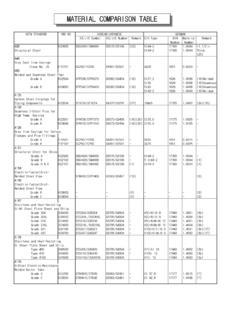
2 For example, a 1060 steel is a plain-carbon steel containing wt%C.[4]An "H" suffix can be added to any designation to denote hardenability is a major requirement. The chemicalrequirements are loosened but hardness values defined for various distances on a Jominy test.[2]Major classifications of steel [1]SAE designationType1xxxCarbon steels2xxxNickel steels3xxxNickel-chromium steels4xxxMolybdenum steels5xxxChromium steels6xxxChromium-vanadium steels7xxxTungsten steels8xxxNickel-chromium-vanadium steels9xxxSilicon-manganese steelsSAE steel grades - wikipedia , the free of 810/23/2012 5:01 AMCarbon and alloy steel grades [5]SAE designationTypeCarbon steels10xx Plain carbon (Mn max)11xx Resulfurized12xx Resulfurized and rephosphorized15xx Plain carbon (Mn to )Manganese steels13xx Mn steels23xx Ni Ni steels31xx Ni , Cr or Ni , Cr Ni , Cr or Ni , Cr steels40xxMo or or Mo & S[3]44xx Mo or (Chromoly) steels41xx Cr or or , Mo or or or steels43xx Ni , Cr to , Mo Ni , Cr , Mo or , V min47xx Ni , Cr , Mo or Ni , Cr , Mo , Cr , Mo [3]86xx Ni , Cr , Mo Ni , Cr , Mo Ni , Cr , Mo Ni , Cr , Mo Ni , Cr , Mo Ni , Cr , Mo Ni , Cr , Mo steels46xx Ni or , Mo or Ni , Mo steelsSAE steel grades - wikipedia , the free of 810/23/2012 5.
3 01 AM50xx Cr or or or Cr , C min50 BxxCr or [3]51xx Cr or or or or Cr , C min51 BxxCr [3]52xxx Cr , C minChromium-vanadium steels61xx Cr or or , V or minTungsten-chromium steels72xx W , Cr steels92xx Si or , Mn or or , Cr or low-alloy steels9xx Various SAE gradesxxBxx Boron steelsxxLxx Leaded steelsMain article: Stainless steelType 102 austenitic general purpose stainless steel working for furniture200 Series austenitic chromium-nickel-manganese alloysType 201 austenitic that is hardenable through cold workingType 202 austenitic general purpose stainless steel300 Series austenitic chromium-nickel alloysType 301 highly ductile, for formed products. Also hardens rapidly during mechanical working. Goodweldability. Better wear resistance and fatigue strength than 302 same corrosion resistance as 304, with slightly higher strength due to additional 303 free machining version of 304 via addition of sulfur and phosphorus.
4 Also referred to as "A1" inaccordance with ISO 3506.[6]Type 304 the most common grade; the classic 18/8 stainless steel . Outside of the US it is commonlyknown as "A2 stainless steel ", in accordance with ISO 3506 (not to be confused with A2 tool steel ).[6]Type 304L same as the 304 grade but lower carbon content to increase weldability. Is slightly weaker 304LN same as 304L, but also nitrogen is added to obtain a much higher yield and tensile strengththan 308 used as the filler metal when welding 309 better temperature resistance than 304, also sometimes used as filler metal when weldingdissimilar steels, along with 316 the second most common grade (after 304); for food and surgical stainless steel uses; alloyaddition of molybdenum prevents specific forms of corrosion. It is also known as marine grade stainlesssteel due to its increased resistance to chloride corrosion compared to type 304.
5 316 is often used forbuilding nuclear reprocessing plants. 316L is an extra low carbon grade of 316, generally used in stainlesssteel watches and marine applications, as well exclusively in the fabrication of reactor pressure vessels forboiling water reactors, due to its high resistance to corrosion. Also referred to as "A4" in accordance withSAE steel grades - wikipedia , the free of 810/23/2012 5:01 AMISO 3506.[6] 316Ti includes titanium for heat resistance, therefore it is used in flexible chimney 321 similar to 304 but lower risk of weld decay due to addition of titanium. See also 347 withaddition of niobium for desensitization during Series ferritic and martensitic chromium alloysType 405 ferritic for welding applicationsType 408 heat-resistant; poor corrosion resistance; 11% chromium, 8% 409 cheapest type; used for automobile exhausts; ferritic (iron/chromium only).
6 Type 410 martensitic (high-strength iron/chromium). Wear-resistant, but less 416 easy to machine due to additional sulfurType 420 Cutlery Grade martensitic; similar to the Brearley's original rustless steel . 430 decorative, , for automotive trim; ferritic. Good formability, but with reduced temperatureand corrosion 439 ferritic grade, a higher grade version of 409 used for catalytic converter exhaust chromium for improved high temperature corrosion/oxidation 440 a higher grade of cutlery steel , with more carbon, allowing for much better edge retention whenproperly heat-treated. It can be hardened to approximately Rockwell 58 hardness, making it one of thehardest stainless steels. Due to its toughness and relatively low cost, most display-only and replica swordsor knives are made of 440 stainless. Available in four grades : 440A, 440B, 440C, and the uncommon 440F( free machinable).
7 440A, having the least amount of carbon in it, is the most stain-resistant; 440C, havingthe most, is the strongest and is usually considered more desirable in knifemaking than 440A[citation needed],except for diving or other salt-water 446 For elevated temperature service500 Series heat-resisting chromium alloys600 Series martensitic precipitation hardening alloys601 through 604: Martensitic low-alloy through 613: Martensitic secondary hardening through 619: Martensitic chromium through 635: Semiaustenitic and martensitic precipitation-hardening stainless 630 is most common PH stainless, better known as 17-4; 17% chromium, 4% through 653: Austenitic steels strengthened by hot/cold through 665: Austenitic superalloys; all grades except alloy 661 are strengthened by 2205 the most widely used duplex (ferritic/austenitic) stainless steel grade.
8 It has both excellent corrosionresistance and high 2304 lean duplex stainless steel . Similar to 2205 for strength but with lower pitting corrosion resistancedue to low steel designations[7]SAEdesignationUNSdesignat ion % Cr % Ni % C % Mn % Si % P % S % NOtherAustenitic201S2010016 194 181 14 -254[8] max Mo; ; "Superaustenitic";All valuesnominal301S3010016 186 --SAE steel grades - wikipedia , the free of 810/23/2012 5:01 AM302S3020017 198 198 --303S3030017 198 (optional)303 SeS3032317 198 Se min304S3040018 208 208 198 -3 4 Cu304NS3045118 208 -305S3050017 13 --308S3080019 2110 --309S3090022 2412 --309SS3090822 2412 --310S3100024 2619 --310SS3100824 2619 --314S3140023 2619 --316S3160016 1810 Mo316LS3160316 1810 Mo316FS3162016 1810 1810 Mo317S3170018 2011 max Mo317LS3170318 2011 max Mo321S3210017 199 maxTi 5(C+ N)min, -1 2 Mo330N0833017 2034 --347S3470017 199 -Nb + Ta,10 x C min,1 max348S3480017 199 -Nb + Ta,10 x C min,1 max, Tamax.
9 1717 --SAEdesignationUNSdesignation % Cr % Ni % C % Mn % Si % P % S % Al, maxSAE steel grades - wikipedia , the free of 810/23/2012 5:01 -Ti 6 x C,but --430S4300016 --430FS4302016 Mo(optional)430 FSeS4302316 Se min434S4340016 ; Nb+Ta5 x C min, max442S4420018 --446S4460023 --SAEdesignationUNSdesignation % Cr % Ni % C % Mn % Si % P % S % --416S4160012 Mo(optional)416 SeS4162312 Se min420S4200012 min --420FS4202012 min Momax(optional) ; ; --440AS4400216 Mo440BS4400316 Mo440CS4400416 MoSAEdesignationUNSdesignation % Cr % Ni % C % Mn % Si % P % S % NOtherHeat resisting501S501004 min steel grades - wikipedia , the free of 810/23/2012 5:01 AM502S502004 [8] max Mo; max duplex2507[8] max Mo; AllvaluesnominalMartensitic precipitation -Cu 3-5, [9]Main article: HSLA steelASTM InternationalEN standardSteel gradesUnified numbering systemNotes^ a b Jeffus, p.
10 ^ a b Degarmo, p. ^ a b c d e Bringas, John E. (2004). Handbook of Comparative World steel Standards: Third Edition ( ) (3rd ed.). ASTMI nternational. p. 14. ISBN 0-8031-3362-6. Archived from the original ( ) on January 27, 2007. ^ Degarmo, p. 1134.^ Oberg, p. ^ a b c "Stainless steel Fasteners" ( ) . Australian Stainless steel Development Association. Archived from the original( ) on 2007-09-29. Retrieved ^ Oberg, pp. ^ a b c "What is Stainless steel ?" ( ) . Nickel Retrieved ^ "Precipitation-Hardening Stainless steel Type 17-4PH (S17400)" ( ) (PDF). steel grades - wikipedia , the free of 810/23/2012 5:01 AMBibliographyDegarmo, E. Paul; Black, J T.; Kohser, Ronald A. (2003). Materials and Processes in Manufacturing (9th ed.).Wiley. ISBN , Larry F. (2002). Welding: Principles and Applications ( ) .Cengage Learning.