Transcription of Safe Work Method Statement – Work in or near excavation ...
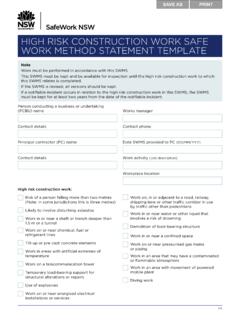
1 safe work Method Statement work in or near excavation deeper than This safe work Method Statement is generic in nature can be used as a guide in developing your SWMS All PCBU s when undertaking high risk construction work are to have in place a safe work Method Statement (SWMS). Where there are differences in the control measures to employed between your and this SWMS the higher of the two control measures are to be implemented this or your own SWMS. This SWMS needs to be reviewed against site conditions upon commencing work .
2 Where site conditions prevent works to be carried out in accordance with this SWMS than another is to be written and Site Supervisor notified. Name of PCBU/Principal Builder Name of Principal Contractor Bay Building Services work Activity: work on or near excavation deep work Location: High Risk Construction work : Trench collapse Fall from height Site Supervisor: Mobile equipment Emergency Contact: 1399 766 216 Contact No: Date of SWMS 02/04/2018 Review Date Have workers been consulted about the SWMS?
3 All workers are required to be consulted with regards to the SWMS and control measures contained in the SW MS. Person Responsible for ensuring compliance with SW MS Different PCBU s/Employers and Contractors will encounter different High Risk activities. All PCBU s/Employers are responsible for reviewing this SWMS against site conditions and ensure work occurs in accordance with the SWMS. Person(s) Responsible (for reviewing the SWMS) PCBU s/Employers should review this SWMS and apply the control measures outlined for the various High Risk activities that they may undertake.
4 Where works cannot occur in accordance with this or your own SWMS contact is to be made with the Site Supervisor. work Step Hazard for Works Control Measures for the Hazards Pre-Start Check at Site Site hazards may impair works Undertake pre-site inspection verify conditions on site will enable works to be carried out in accordance with the SWMS. Discuss site specific works with the Site Supervisor reviewing site signage, Safety Management Plan, for site specific hazards Ensure all employees are made aware of any site specific hazards to works If SWMS are to be changed copy is to be provided to site supervisor Construction Inducted employees and contractors are only allowed to undertake construction works Only certified and/or licensed personnel are to operate mobile equipment Prepare work Area for installation Slip, trips& falls.
5 Other workers in the area Electrocution Collapse of work area Unload vehicles in area clear of traffic, plant & equipment. Inspect and clear area of any obstructing material or debris Use team lifting techniques or mechanical means for manual handling Stabilise/compact ground where required Identify any underground services gas, water, electrical. Plan showing location of underground power located in site meter box. Identify all electrical lines in work area and overhead cables and remain outside overhead power no-go zones.
6 Contact site supervisor if works will penetrate the no-go zone work near trenches > m deep Trench collapse, slips, trips, falls & engulfment. Trench Shoring & Battering Trenching in excess of in depth must reduce the risk of the trench collapsing by ensuring that all sides of the trench are adequately supported by one or more of the following means: - shoring by shielding or other comparable means - benching - battering No trades are permitted to enter into a trench and penetrations in excess of deep (eg sewer connections) unless they have been safely battered back (preferred Method ), or it has been properly shored, or the workers are fully protected within a trench shield.
7 Shoring should be positioned and fixed from above; never from below. All timber used in ground support should be at least F8 grade hardwood. Trench shoring should not be softwood because this can fail suddenly without warning, whereas hardwood will start to creak loudly when it is becoming overloaded, warning workers to leave the trench immediately. Trades entering into excavations must always wear safety helmets. If Trench shoring is to be employed contact must be made with the Site Supervisor to prepare a JSA for the works to be undertaken.
8 All access and egress to excavations and trenching shall be in the form of a ladder or pre-formed stairs to minimise the risk of injury. excavation , trenching and penetrations shall be backfilled and stabilised on completion of the task to minimise the risk of injury. Securing trench > deep Falls, slips & trips. Trench work should be completed and back filled or concreted on the day of operations. If this is not possible the trench is to be secured. In securing the trench, you must consider: risks to health and safety arising from unauthorised access to the work area, and the likelihood of unauthorised access occurring.
9 methods employed to secure the trench from unauthorised access include: - back filling the trench, screw pile, footing - cover the trench with a trench cover - Erect fencing around the trench preventing immediate access - If leaving a trench open overnight or when absent from the site ensure site fencing is in place and site secure from entry. This may include locking the gates to prevent entry. Contact is to be made with the site supervisor if works cannot be completed in the allocated day requiring the trench to be exposed whilst the site is unattended.
10 Plant operating near trenches > deep Trench collapse, plant overturning, Engulfment Mechanical plant, vehicles, storage of materials (including excavated material) or any other heavy loads should not be operated or located in the zone of influence of an excavation unless the ground support system installed has been designed by a competent person, for example, a geotechnical engineer, to carry such loads. The zone of influence is determined by a competent person (for example, a geotechnical engineer) and will depend on the ground conditions.