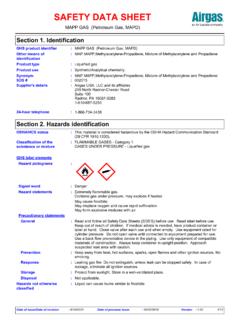
Transcription of SAFETY DATA SHEET
1 UN2037 Butane SDS August 2017 Page 1 of 8 SAFETY data SHEET 1. IDENTIFICATION OF THE MATERIAL AND SUPPLIER Brand Gasmate/Gasmaster/Jackeroo/Buyright Product (Material) Name Butane Other Names Butyl hydride Methylethylmethane/Propanol Manufacturer s Product Codes G210, G3210, G4210, G6210, G4210SV, GM040-002/3 Recommended Use Used as a fuel in gas camping and leisure products Supplier Name Sitro Group Australia Supplier Address 33-35 Lionel Road, Mt Waverley VIC 3149 Supplier Telephone Number (03)
2 9543 9533 Emergency Contact Number AU - 1300 174 876 NZ - 0800 474 876 2. HAZARDS INFORMATION Hazard Classification Classified as a highly flammable, liquefied gas for transport (ADG). Hazardous according to Work Safe Victoria. Proper Shipping Name AEROSOLS GHS Label Elements H220 Extremely Flammable Gas Flammable gases Danger Hazard Category 1. H280 Contains Gas under pressure may explode if heated. Gases Under Pressure Warning Liquefied gas. Prevention: Keep away from heat/sparks/open flames/hot surfaces No Smoking.
3 Response: Leaking gas fire Do not extinguish unless leak can be stopped safely. Eliminate all ignition sources if safe to do so. Storage: Store in a well-ventilated place, protect from sunlight. UN2037 Butane SDS August 2017 Page 2 of 8 3. COMPOSITION / INFORMATION ON INGREDIENTS Pure Substances C4 H10 (Butane) C3H8 (Propane) Common Name Butane Gas CAS Number Butane 106-97-8 Propane 74-98-6 Mixtures or Composite Materials N/A Chemical Identity of the Substance(s) C4H10 (Butane) C3H8 (Propane)
4 Contains < 1,3 butadiene Hazardous Components No component is present at sufficient concentration to require a hazardous classification Proportion of Ingredients Butane 80 95% Propane 5 20 % Confidentiality Provisions N/A Disclosure of Ingredients N/A 4. FIRST AID MEASURES Inhalation If exposure to vapour, mists or fumes causes drowsiness, headache, blurred vision or irritation of the eyes, nose or throat, remove immediately to fresh air. Keep patient warm and at rest. If any symptoms persist, obtain medical advice.
5 Unconscious causalities must be placed in the recovery position. Monitor breathing and pulse rate and if breathing has failed, or is deemed inadequate, respiration must be assisted, preferable by the mouth to mouth method. Administer external cardiac massage if necessary. Seek medical attention immediately. Skin If cold burns are present drench with water and obtain immediate medical advice. Keep contaminated clothes away from ignition sources. Eye Wash eye thoroughly with copious quantities of luke warm water.
6 Obtain immediate medical attention. Advice to Doctor Treatment should in general be symptomatic and directed to relieving any effects. Additional Information N/A 5. FIRE FIGHTING MEASURES Suitable Extinguishing Media Smaller LP Gas fires may be extinguished using dry chemical powder type extinguishers or carbon dioxide. Larger LP Gas fires are controlled with use of water via hose reel, hydrants or automated deluge type systems. UN2037 Butane SDS August 2017 Page 3 of 8 Hazards from Combustion Products Carbon Dioxide, Water Vapour, traces if Carbon Monoxide and Nitrogen Oxides.
7 Fumes, smoke Carbon Monoxide and Aldehydes can be formed during incomplete combustion. Fire fighters may need self-contained breathing apparatus. Precautions for Fire Fighters & Special Protective Equipment Evacuate area, remove ignition sources. Cut off gas supply if safe to do so do not endanger life. DO NOT EXTINGUISH FIRE allow gas to burn out. Use a water mist to keep the container cool. NOTE: if ignition has occurred and water is not available, the storage container metal may weaken from the heat and may result in an explosion.
8 The area should be evacuated immediately. From a safe location, notify emergency services. Hazchem Code 2WE (in accordance with 7th edition of ADG code) Additional Information Butane is delivered, stored and used at temperatures above its flash point. Avoid all naked flames, sparks, cigarettes etc. In case of fire, immediately alert the fire brigade. Ensure an escape path is always available from any fire. Fires in confined spaces should be dealt with by trained personnel wearing approved breathing apparatus.
9 If gas has ignited, do not attempt to extinguish but stop gas flow and allow to burn out. Use water spray to cool heat-exposed bulk tanks, and to protect surrounding areas and personnel effecting shut-off. DO NOT USE water jets. Every precaution must be taken to keep containers cool to avoid the possibility of a boiling liquid expanding vapour explosion (BLEVE). Pressured bulk tanks are liable to explode violently when subjected to high temperatures. 6. ACCIDENTAL RELEASE MEASURES Emergency Procedures As this product has a very low flash point any spillage or leak is a severe fire and/or explosion hazard.
10 If a leak has not ignited, stop gas flow, isolate sources of ignition and evacuate personnel. Ensure good ventilation. Liquid leaks generate large volumes of flammable vapour which is heavier than air, this may travel to remote sources of ignition (eg along drainage systems). Where appropriate, use water spray to disperse the gas or vapour and to protect personnel attempting to stop leakage Vapour may collect in any confined space Methods and Materials for containment and clean up procedures If spillage has occurred in a confined space, ensure adequate ventilation and check that a safe, breathable atmosphere is present before entry.