Transcription of Safety Data Sheet - advgas.com
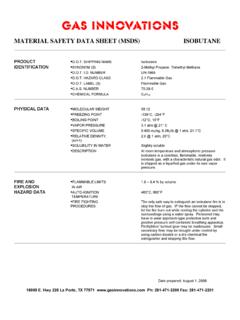
1 Safety data Sheet material Name: N- butane SDS ID: 00233324 _____ Page 1 of 6 Issue Date: 09/13/2009 Revision: Print Date: 9/16/2009 * * * Section 1 - PRODUCT AND COMPANY IDENTIFICATION * * * material Name: N- butane Manufacturer Information ADVANCED GAS TECHNOLOGIES Phone: 1-800-416-2505 1401 Stauffer Road Palm, PA 18070-0035 Emergency # 1-800-424-9300 (CHEMTREC Mfg Contact: Outside the US: 703-572-3887 (Collect Calls Accepted) Chemical Family hydrocarbons, aliphatic Synonyms Mtg msds 11; butane ; Liquified petroleum gas; Normal butane ; Butyl hydride; Lpg; UN 1011; C4H10; RTECS: EJ4200000 * * * Section 2 - HAZARDS IDENTIFICATION * * * EMERGENCY OVERVIEW Color: colorless Physical Form: gas Odor: unpleasant odor Health Hazards: central nervous system depression, difficulty breathing Physical Hazards: Flammable gas.)
2 May cause flash fire. POTENTIAL HEALTH EFFECTS Inhalation Short Term: irritation, nausea, vomiting, headache, drowsiness, symptoms of drunkenness, tingling sensation, suffocation, convulsions, coma Long Term: no information on significant adverse effects Skin Short Term: blisters, frostbite Long Term: no information on significant adverse effects Eye Short Term: frostbite, blurred vision Long Term: no information is available Ingestion Short Term: frostbite Long Term: no information is available * * * Section 3 - COMPOSITION / INFORMATION ON INGREDIENTS * * * CAS Component Percent 106-97-8 n- butane Component Related Regulatory Information This product may be regulated, have exposure limits or other information identified as the following: Aliphatic hydrocarbon gases (Alkane [C1-C4]).
3 Safety data Sheet material Name: N- butane SDS ID: 00233324 _____ Page 2 of 6 Issue Date: 09/13/2009 Revision: Print Date: 9/16/2009 * * * Section 4 - FIRST AID MEASURES * * * Inhalation If adverse effects occur, remove to uncontaminated area. Give artificial respiration if not breathing. If breathing is difficult, oxygen should be administered by qualified personnel. Get immediate medical attention. Skin If frostbite or freezing occur, immediately flush with plenty of lukewarm water (105-115 F; 41-46 C). DO NOT USE HOT WATER. If warm water is not available, gently wrap affected parts in blankets. Get immediate medical attention.
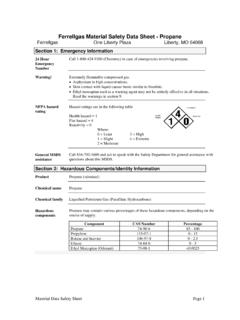
4 Eyes Contact with liquid: Immediately flush eyes with plenty of water for at least 15 minutes. Then get immediate medical attention. Ingestion If a large amount is swallowed, get medical attention. Note to Physicians For inhalation, consider oxygen. * * * Section 5 - FIRE FIGHTING MEASURES * * * See Section 9 for Flammability Properties NFPA Ratings: Health: 1 Fire: 4 Reactivity: 0 Hazard Scale: 0 = Minimal 1 = Slight 2 = Moderate 3 = Serious 4 = Severe Flammable Properties Severe explosion hazard. Severe fire hazard. Vapor/air mixtures are explosive. The vapor is heavier than air. Vapors or gases may ignite at distant ignition sources and flash back.
5 Extinguishing Media carbon dioxide regular dry chemical Large fires: Flood with fine water spray. Fire Fighting Measures Move container from fire area if it can be done without risk. Cool containers with water spray until well after the fire is out. Stay away from the ends of tanks. For fires in cargo or storage area: Cool containers with water from unmanned hose holder or monitor nozzles until well after fire is out. If this is impossible then take the following precautions: Keep unnecessary people away, isolate hazard area and deny entry. Let the fire burn. Withdraw immediately in case of rising sound from venting Safety device or any discoloration of tanks due to fire.
6 For tank, rail car or tank truck: Stop leak if possible without personal risk. Let burn unless leak can be stopped immediately. For smaller tanks or cylinders, extinguish and isolate from other flammables. Evacuation radius: 800 meters (1/2 mile). Stop flow of gas. * * * Section 6 - ACCIDENTAL RELEASE MEASURES * * * Occupational spill/release Avoid heat, flames, sparks and other sources of ignition. Do not touch spilled material . Stop leak if possible without personal risk. Reduce vapors with water spray. Keep unnecessary people away, isolate hazard area and deny entry. Remove sources of ignition. Ventilate closed spaces before entering.
7 Safety data Sheet material Name: N- butane SDS ID: 00233324 _____ Page 3 of 6 Issue Date: 09/13/2009 Revision: Print Date: 9/16/2009 * * * Section 7 - HANDLING AND STORAGE * * * Storage Procedures Store and handle in accordance with all current regulations and standards. Subject to storage regulations: OSHA 29 CFR Grounding and bonding required. OSHA 29 CFR Keep separated from incompatible substances. * * * Section 8 - EXPOSURE CONTROLS / PERSONAL PROTECTION * * * Component Analysis n- butane (106-97-8) ACGIH: 1000 ppm TW A OSHA (vacated): 800 ppm TW A; 1900 mg/m3 TWA NIOSH: 800 ppm TW A; 1900 mg/m3 TWA Ventilation Ventilation equipment should be explosion-resistant if explosive concentrations of material are present.
8 Provide local exhaust ventilation system. Ensure compliance with applicable exposure limits. PERSONAL PROTECTIVE EQUIPMENT Eyes/Face For the gas: Eye protection not required, but recommended. For the liquid: Wear splash resistant Safety goggles. Contact lenses should not be worn. Provide an emergency eye wash fountain and quick drench shower in the immediate work area. Protective Clothing For the gas: Protective clothing is not required. For the liquid: Wear appropriate protective, cold insulating clothing. Glove Recommendations Wear insulated gloves. Respiratory Protection The following respirators and maximum use concentrations are drawn from NIOSH and/or OSHA.
9 2000 ppm Any supplied-air respirator. Any self-contained breathing apparatus with a full facepiece. Emergency or planned entry into unknown concentrations or IDLH conditions - Any self-contained breathing apparatus that has a full facepiece and is operated in a pressure-demand or other positive-pressure mode. Any supplied-air respirator with a full facepiece that is operated in a pressure-demand or other positive-pressure mode in combination with an auxiliary self-contained breathing apparatus operated in pressure-demand or other positive-pressure mode. Escape - Any appropriate escape-type, self-contained breathing apparatus.
10 For Unknown Concentrations or Immediately Dangerous to Life or Health - Any supplied-air respirator with a full facepiece that is operated in a pressure-demand or other positive-pressure mode in combination with an auxiliary self-contained breathing apparatus operated in pressure-demand or other positive-pressure mode. Any self-contained breathing apparatus that has a full facepiece and is operated in a pressure-demand or other positive-pressure mode. Safety data Sheet material Name: N- butane SDS ID: 00233324 _____ Page 4 of 6 Issue Date: 09/13/2009 Revision: Print Date: 9/16/2009 * * * Section 9 - PHYSICAL AND CHEMICAL PROPERTIES * * * Physical State: Gas Appearance: Not available Color: colorless Physical Form: gas Odor: unpleasant odor Odor Threshold: ppm Melting Point: -138 C Boiling Point: -1 C Flash Point: -60 C (CC) LEL: % UEL: % Vapor Pressure: 1557 mmHg @ 20 C Henry's Law Constant: atm-m3/mol Vapor Density (air = 1): Specific Gravity (water = 1): @ 0 C Water Solubility: 15 % KOW: (estimated from water solubility) KOC.