Transcription of Safety Data Sheet - Airgas
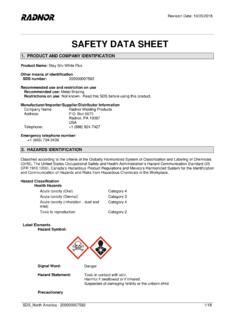
1 Department of Labor Occupational Safety and Health Administration (Non-Mandatory Form). Format meets ANSI. , OSHA and WHMIS. requirements. Safety data Sheet May be used to comply with OSHA's Hazard Communication Standard, 29 CFR Section 1: Product and Company Identification Product Name: Radnor Solvent Based Anti-Spatter (Aerosol). Product Identifier: Anti-Spatter Product Use: Prevents Spatter Build Up in Welding Operations Item Code(s): 64000100, 64000102. SDS Code: 001R. Supplier: Radnor Physical Address: 259 North Radnor - Chester Road - Suite 100. Radnor, PA, 19087-5283. Emergency Phone: 866-734-3438.
2 Date of Preparation: August 24, 2007 (Revised May 10, 2015). OSHA Regulatory Status: Regulated WHMIS Classification: D1B, D2A, D2B, A. Section 2: Hazards Identification CLASSIFICATION OF THE SUBSTANCE OR MIXTURE: CLP/GHS Classification (1272/2008): Physical Health Environmental None Eye Irritation Category 2A None Skin Irritation Category 2. Specific Target Organ Toxicity - Single Exposure Category 3 (H335, H336). Carcinogen Category 2. EU CLASSIFICATION (67/548/EEC): Xn R40 (Carcinogen Category 2). Label Elements WARNING! Contains methylene chloride Hazard Phrases H315 Causes skin irritation.
3 H319 Causes serious eye irritation. H335 May cause respiratory irritation. H336 May cause drowsiness or dizziness. H351 Suspected of causing cancer. Revised May 10, 2015 Radnor Solvent Based Anti-Spatter Aerosol SDS Page 1 of 6. Precautionary Phrases P201 Obtain special instructions before use. P261 Avoid breathing dust/fume/gas/mist/vapors/spray. P264 Wash thoroughly after handling. P271 Use only outdoors or in a well-ventilated area. P280 Wear protective gloves/protective clothing/eye protection/face protection. P305 + IF IN EYES: Rinse cautiously with water for several minutes.
4 Remove contact lenses, if present and P351 + easy to do. Continue rinsing. P338. P337 + IF EYE IRRITATION PERSISTS: Get medical advice/attention. P313. P302 + IF ON SKIN: Wash with plenty of soap and water. P352. P332 + IF SKIN IRRITATION OCCURS: Get medical advice/attention. P313. P362 Take off contaminated clothing and wash before reuse. P304 + IF INHALED: Remove to fresh air and keep at rest in a position comfortable for breathing. P340. P312 Call a POISON CENTER or doctor/physician if you feel unwell. P308 + IF EXPOSED OR CONCERNED: Get medical advice/attention. P313. P403 + Store in a well-ventilated place.
5 Keep container tightly closed. P233. P405 Store locked up. P501 Dispose of contents/container in accordance with local or national regulations. OTHER IMPORTANT HAZARDS: N/Av SUGGESTED HMIS RATING: Health | 2 | Flammability | 1 | Reactivity | 1 | Personal Protection | C |. SUGGESTED NATIONAL FIRE PROTECTION ASSOCIATION: Health | 2 | Flammability | 1 | Reactivity | 1 |. Section 3: Composition and Information on Ingredients SUBSTANCES: Chemical Name CAS# EINECS# EU Classification GHS Classification %. (67/548/EEC) Regulation (EC) No 1272/2008. Methylene Chloride 75-09-2 200-838-9 Xn (Carc Cat 2) R40 Eye Irritation Category >90.
6 (Dichloromethane) 2A (H319), Skin Irritation Category 2 (H315), Specific Target Organ Toxicity Single Exposure Category 3. (H335, H336), Carcinogen Category 2. (H351). Carbon Dioxide 124-38-9. See Section 16 for further information on EU and GHS Classification. Revised May 10, 2015 Radnor Solvent Based Anti-Spatter Aerosol SDS Page 2 of 6. Section 4: First Aid Measures INHALATION: Remove to fresh air. If not breathing, give artificial respiration. If breathing is difficult, give oxygen. Seek medical attention if symptoms persist or if unconscious. INGESTION: Unlikely due to being in aerosol form.
7 Should actual ingestion occur, do not induce vomiting! Drink a glass of water or milk to dilute. Call a physician or poison control center immediately. Never give anything by mouth to an unconscious person. EYE CONTACT: Immediately flush with plenty of clear water for at least 15 minutes. Make sure to flush under the eyelids. Consult a physician for definitive treatment. SKIN CONTACT: Remove with soap and water. Continue flushing with water for several minutes. Use skin cream to counter resulting dryness. Consult a physician if irritation continues or if large skin area is affected.
8 Section 5: Fire Fighting Measures MEANS OF EXTINCTION: For warehouse and storage conditions, use NFPA Class B extinguishers (CO2, dry chemical or universal aqueous film forming foam). SPECIAL FIRE FIGHTING PROCEDURES: Wear self-contained breathing apparatus pressure demand. Use water spray to cool fire exposed aerosol containers for containers can rupture violently from heat developed pressure. UNUSUAL FIRE AND EXPLOSION HAZARDS: Contents under pressure. In addition, when liquid or vapor comes into contact with flames or red hot metal, products of combustion will be created. Firemen should wear self-contained breathing apparatus.
9 FLASH POINT / DETERMINATION: None to boiling UPPER FLAMMABLE LIMIT: N/Av LOWER FLAMMABLE LIMIT: N/Av AUTO-IGNITION TEMPERATURE: N/Av HAZARDOUS COMBUSTION PRODUCTS: N/Av EXPLOSION data - SENSITIVITY TO MECHANICAL IMPACT: N/Av EXPLOSION data - SENSITIVITY TO STATIC DISCHARGE: N/Av Section 6: Accidental Release Measures LEAK / SPILL RESPONSE: Product is an aerosol, therefore spills and leaks are unlikely. In case of rupture, released content should be contained as any other solvent spill. Spills from aerosol cans are unlikely and are generally of small volume. Large spills are therefore not normally considered a problem.
10 In case of actual rupture, avoid breathing vapors and ventilate area well. Remove all sources of ignition and use non-sparking equipment. Soak up material with inert absorbent. Flush area with water. All rinsate should be placed in Safety containers and labeled for proper disposal. SPECIAL INSTRUCTIONS: Aerosol products represent a limited hazard and will not spill or leak unless ruptured. In case of rupture contents are generally evacuated from the can rapidly. Area should be ventilated immediately and continuous ventilation provided until all fumes and vapors have been removed.