Transcription of Safety Data Sheet - Caltex
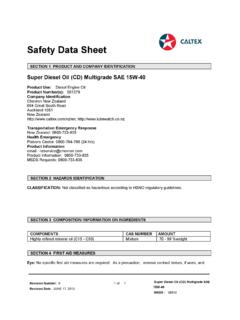
1 _____ Revision Number: 3 Revision Date: NOVEMBER 20, 20151 of 8 Havoline Motor Oil SAE 5W-30,10W-30, 15W-40, 20W-50 SDS : 31003 Safety data Sheet SECTION 1 PRODUCT AND COMPANY IDENTIFICATIONH avoline Motor Oil SAE 5W-30, 10W-30, 15W-40, 20W-50 Product Use: Automotive Engine OilProduct Number(s): 500013, 500014, 500015, 500016 Company IdentificationChevron New Zealand604 Great South RoadAuckland 1051 New ; Emergency ResponseNew Zealand: 0800-733-835 Health EmergencyPoisons Centre: 0800-764-766 (24 hrs)Product Informationemail : Information: 0800-733-835 SDS Requests: 0800-733-835 SECTION 2 HAZARDS IDENTIFICATIONHSNO New Zealand Approval Code: Not RequiredCLASSIFICATION: Not classified as hazardous according to HSNO regulatory guidelines.
2 SECTION 3 COMPOSITION/ INFORMATION ON INGREDIENTS _____ Revision Number: 3 Revision Date: NOVEMBER 20, 20152 of 8 Havoline Motor Oil SAE 5W-30,10W-30, 15W-40, 20W-50 SDS : 31003 COMPONENTS CAS NUMBERAMOUNT Highly refined mineral oil (C15 - C50) Mixture 70 - 99 %weight Zinc dialkyldithiophosphate 68649-42-3 - < %weight SECTION 4 FIRST AID MEASURESEye: No specific first aid measures are required. As a precaution, remove contact lenses, if worn, andflush eyes with : No specific first aid measures are required. As a precaution, remove clothing and shoes ifcontaminated. To remove the material from skin, use soap and water. Discard contaminated clothing andshoes or thoroughly clean before : No specific first aid measures are required.
3 Do not induce vomiting. As a precaution, getmedical : No specific first aid measures are required. If exposed to excessive levels of material in the air,move the exposed person to fresh air. Get medical attention if coughing or respiratory discomfort occurs. SECTION 5 FIRE FIGHTING MEASURESEXTINGUISHING MEDIA: Use water fog, foam, dry chemical or carbon dioxide (CO2) to extinguishflames. PROTECTION OF FIRE FIGHTERS:Fire Fighting Instructions: This material will burn although it is not easily ignited. See Section 7 for properhandling and storage. For fires involving this material, do not enter any enclosed or confined fire spacewithout proper protective equipment, including self-contained breathing Products: Highly dependent on combustion conditions.
4 A complex mixture of airbornesolids, liquids, and gases including carbon monoxide, carbon dioxide, and unidentified organic compoundswill be evolved when this material undergoes combustion. SECTION 6 ACCIDENTAL RELEASE MEASURESP rotective Measures: Eliminate all sources of ignition in vicinity of spilled Management: Stop the source of the release if you can do it without risk. Contain release to preventfurther contamination of soil, surface water or groundwater. Clean up spill as soon as possible, observingprecautions in Exposure Controls/Personal Protection. Use appropriate techniques such as applyingnon-combustible absorbent materials or pumping. Where feasible and appropriate, remove contaminatedsoil. Place contaminated materials in disposable containers and dispose of in a manner consistent withapplicable : Report spills to local authorities as appropriate or required.
5 SECTION 7 HANDLING AND STORAGE _____ Revision Number: 3 Revision Date: NOVEMBER 20, 20153 of 8 Havoline Motor Oil SAE 5W-30,10W-30, 15W-40, 20W-50 SDS : 31003 General Handling Information: Avoid contaminating soil or releasing this material into sewage anddrainage systems and bodies of Measures: Keep out of the reach of children. Static Hazard: Electrostatic charge may accumulate and create a hazardous condition when handling thismaterial. To minimize this hazard, bonding and grounding may be necessary but may not, by themselves,be sufficient. Review all operations which have the potential of generating and accumulating anelectrostatic charge and/or a flammable atmosphere (including tank and container filling, splash filling, tankcleaning, sampling, gauging, switch loading, filtering, mixing, agitation, and vacuum truck operations) anduse appropriate mitigating Warnings: Container is not designed to contain pressure.
6 Do not use pressure to emptycontainer or it may rupture with explosive force. Empty containers retain product residue (solid, liquid,and/or vapor) and can be dangerous. Do not pressurize, cut, weld, braze, solder, drill, grind, or exposesuch containers to heat, flame, sparks, static electricity, or other sources of ignition. They may explode andcause injury or death. Empty containers should be completely drained, properly closed, and promptlyreturned to a drum reconditioner or disposed of properly. SECTION 8 EXPOSURE CONTROLS/PERSONAL PROTECTIONGENERAL CONSIDERATIONS:Consider the potential hazards of this material (see Section 2), applicable exposure limits, job activities,and other substances in the work place when designing engineering controls and selecting personalprotective equipment.
7 If engineering controls or work practices are not adequate to prevent exposure toharmful levels of this material, the personal protective equipment listed below is recommended. The usershould read and understand all instructions and limitations supplied with the equipment since protection isusually provided for a limited time or under certain CONTROLS:Use in a well-ventilated PROTECTIVE EQUIPMENTEye/Face Protection: No special eye protection is normally required. Where splashing is possible, wearsafety glasses with side shields as a good Safety Protection: No special protective clothing is normally required. Where splashing is possible, selectprotective clothing depending on operations conducted, physical requirements and other substances in theworkplace.
8 Suggested materials for protective gloves include: 4H (PE/EVAL), Nitrile Rubber, SilverShield, Viton. Respiratory Protection: No respiratory protection is normally required. If user operations generate an oilmist, determine if airborne concentrations are below the occupational exposure limit for mineral oil mist. Ifnot, wear an approved respirator that provides adequate protection from the measured concentrations ofthis material. For air-purifying respirators use a particulate a positive pressure air-supplying respirator in circumstances where air-purifying respirators may notprovide adequate Exposure Limits: _____ Revision Number: 3 Revision Date: NOVEMBER 20, 20154 of 8 Havoline Motor Oil SAE 5W-30,10W-30, 15W-40, 20W-50 SDS : 31003 Component Country/Agency TWA STEL Ceiling Notation Highly refined mineral oil (C15 -C50) ACGIH 5 mg/m3 10 mg/m3 -- -- Highly refined mineral oil (C15 -C50) New Zealand 5 mg/m3 10 mg/m3 -- -- Consult local authorities for appropriate values.
9 SECTION 9 PHYSICAL AND CHEMICAL PROPERTIESA ttention: the data below are typical values and do not constitute a : AmberPhysical State: LiquidOdor: Petroleum odorOdor Threshold: No data availablepH: Not ApplicableVapor Pressure: < mmHg @ C (100 F)Vapor Density (Air = 1): >1 Boiling Point: 315 C (599 F)Solubility: Soluble in hydrocarbons; insoluble in water Freezing Point: Not Applicable Melting Point: No data available Density: No data available Viscosity: mm2/s @ 100 C (212 F) MinimumCoefficient of Therm. Expansion / F: Not Applicable Evaporation Rate: No data availableOctanol/Water Partition Coefficient:No data availableFLAMMABLE PROPERTIES:Flashpoint: (ASTM D92) 200 C (392 F) MinimumAutoignition: No data availableFlammability (Explosive) Limits (% by volume in air): Lower: Not Applicable Upper: Not Applicable SECTION 10 STABILITY AND REACTIVITYR eactivity:May react with strong acids or strong oxidizing agents, such as chlorates, nitrates, peroxides, Stability: This material is considered stable under normal ambient and anticipated storage andhandling conditions of temperature and With Other Materials: Not applicableHazardous Decomposition Products: None known (None expected)Hazardous Polymerization.
10 Hazardous polymerization will not occur. _____ Revision Number: 3 Revision Date: NOVEMBER 20, 20155 of 8 Havoline Motor Oil SAE 5W-30,10W-30, 15W-40, 20W-50 SDS : 31003 SECTION 11 TOXICOLOGICAL INFORMATIONIMMEDIATE HEALTH EFFECTSEye: Not expected to cause prolonged or significant eye Irritation: The eye irritation hazard is based on evaluation of data for similar materials or productcomponents. Skin: Contact with the skin is not expected to cause prolonged or significant irritation. Contact with the skinis not expected to cause an allergic skin response. Not expected to be harmful to internal organs ifabsorbed through the Dermal Toxicity: The acute dermal toxicity hazard is based on evaluation of data for similarmaterials or product components.