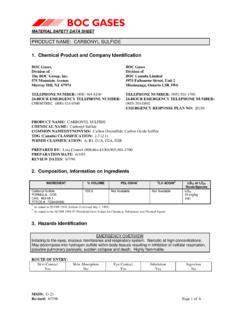
Transcription of Safety Data Sheet - cleanfit.com
1 Safety Data Sheet SDS ID: Stock Code 76020, 76022. Revision date: February 8, 2018. Section 1. CHEMICAL product AND COMPANY identification . product name: Blue Monster nickel Anti-Seize Lubricant and Thread Sealant Synonyms: None Chemical family: N/A. Producer: The Mill-Rose Company 7310 Corporate Blvd. Mentor, OH 44060. Telephone: 800-321-3598 Available during normal business hours Emergency: 800-321-3598 Available during normal business hours Section 2. HAZARD identification . GHS Classification (Hazcom 2012): Skin Sensitizer Category 1. Carcinogen Category 2. Specific Target Organ Toxicity Single Exposure Category 1 (Inhalation).
2 Label Elements: Danger Hazard Phrases: H317 May cause an allergic skin reaction H370 Causes damage to respiratory tract through inhalation H351 Suspected of causing cancer through inhalation Precautionary Phrases: P201 Obtain special instructions before use. P202 Do not handle until all Safety precautions have been read and understood. P260 Do not breathe mist or vapor. P264 Wash thoroughly after handling. P270 Do not eat, drink or smoke when using this product . P272 Contaminated work clothing should not be allowed out of the workplace. P280 Wear protective gloves.
3 P302+P352 IF ON SKIN: Wash with plenty of water. P333+P313 If skin irritation or rash occurs: Get medical attention. P362+P364 Take off contaminated clothing and wash it before reuse. P308+P311 IF exposed or concerned: Call a POISON CENTER or doctor. P405 Store locked up. P308+P313 IF exposed or concerned: Get medical attention. P501 Dispose of contents in accordance with local, regional and national regulations. Blue Monster nickel Anti-Seize Lubricant and Thread Sealant Page 1 of 6. Section 3. COMPOSITION / INFORMATION ON INGREDIENTS. Material information: Name CAS No.
4 Weight %. nickel Powder 7440-02-0 20-30. Graphite 7782-42-5 15-25. Distillates (petroleum), hydrotreated heavy 64742-52-5 40-60. naphthenic Rust inhibitor Mixture 1-5. Aluminum Powder 7429-90-5 1-5. *Note: The above weight percentages are represented in ranges as estimates. Due to variation among production batches, component percentages may vary. Section 4. FIRST AID MEASURES. Inhalation: Not likely under normal conditions of use. If using in high temperature applications where thermal decomposition is likely, use a local exhaust to remove fumes. If dizziness or irritation occurs, seek fresh air.
5 Skin contact: Wash thoroughly with plenty of water. Get medical attention if irritation persists. Ingestion: If large amounts ingested, seek medical attention. Eye contact: Flush eyes with water, holding the eyelids apart. Get medical attention if irritation develops or persists. Most Important symptoms and effects, both acute and delayed: Skin contact may cause an allergic reaction. Inhalation of vapors or mist may cause respiratory irritation. Suspected of causing cancer. Risk of cancer depends on duration and level of exposure. Indication of any immediate medical attention and special treatment needed: Immediate medical attention generally not required.
6 Section 5. FIREFIGHTING MEASURES. Suitable Use foam, carbon dioxide or dry chemical. extinguishing media: Specific hazards: This compound will not burn unless it is pre-heated. Water fog may be used to cool the containers but do not spray directly into large containers of burning liquids as frothing may occur. Dense smoke and noxious or toxic fumes may be generated in a fire. The thermal decomposition products are highly dependent on the combustion conditions and may yield oxides of nickel , aluminum and carbon. Noxious or toxic fumes may be generated, some of which may be toxic or irritating.
7 Special protective equipment and precautions for firefighters: Wear NIOSH approved positive pressure, self-contained breathing apparatus and full protective clothing. Cool fire exposed containers with water. Talon nickel Anti-Seize Lubricant and Thread Sealant Page 2 of 6. FIRE. R. NFPA rating: HMIS rating: 3. 1 E Slightly Hazardous Hazardous Health: 1 1 H A. C. E FP. FP- -above Below200 . 73 FF. Flammability: 1 1. 2. 1 0. A T. L I. Instability/reactivity: 0 0 T V Stable H I. Other: N/A A (PPE) T. N/A. Y. SPECIAL. Section 6. ACCIDENTAL RELEASE MEASURES. Personal Wear appropriate personal protective equipment.
8 Use caution: slip hazard. Precautions: Large Spill: Report spills and releases as required to appropriate Methods for Because of its viscous nature, this product is not expected to leak or spill. Containment Collect liquid spill with an inert absorbent material and place into a suitable and Clean up container for disposal. Clean area thoroughly with mineral spirits. Section 7. HANDLING AND STORAGE. Handling: Avoid contact with eyes. Avoid prolonged skin contact. Do not inhale. Do not transfer to unlabeled containers. Storage: Store away from extreme heat and open flames.
9 Store away from oxidizers. Section 8. EXPOSURE CONTROLS / PERSONAL PROTECTION. Occupational Exposure Limits: Name CAS No. Exposure Limits: nickel Powder 7440-02-0 mg/m3 TWA ACGIH TLV (inhalable). 1 mg/m3 TWA OSHA PEL. Graphite 7782-42-5 2 mg/m3 TWA ACGIH TLV (respirable). 15 mg/m3 TWA OSHA PEL (total dust). 5 mg/m3 TWA OSHA PEL (respirable fraction). Distillates (petroleum), 64742-52-5. hydrotreated heavy naphthenic 5 mg/m3 TWA ACGIH TLV (inhalable). 5 mg/m3 TWA OSHA PEL. Rust inhibitor Mixture None Established Aluminum Powder 7429-90-5 1 mg/m3 TWA ACGIH TLV (respirable).
10 15 mg/m3 TWA OSHA PEL (total dust). 5 mg/m3 TWA OSHA PEL (respirable fraction). All exposure limits listed are 8-hour time weighted average (TWA) except where noted otherwise. Time Weighted Average (TWA) is an average exposure over the course of an 8-hour work shift. A Short Term Exposure Limit TWA over the course of 15 minutes. PEL Permissible Exposure Limit is the maximum 8-hour TWA concentration of a chemical that a worker may be exposed to under Occupational Safety and Health Administration (OSHA) regulations. Engineering measures: Use with adequate general or local exhaust ventilation to maintain exposure levels below the exposure limits.