Transcription of Safety Data Sheet - dlra.org.au
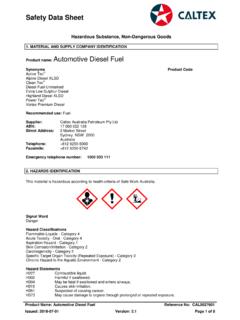
1 Safety Data Sheet Product Name: UNLEADED PETROL Reference No: CAL0037001 Issued: 2014-05-06 Version: Page 1 of 8 Hazardous Substance, Dangerous Goods 1. MATERIAL AND SUPPLY COMPANY IDENTIFICATION Product name: UNLEADED PETROL Synonyms Product Code Gasoline Unleaded Petrol 200 Recommended use: Fuel. Supplier: Caltex Australia Petroleum Pty Ltd ABN: 17 000 032 128 Street Address: 2 Market Street Sydney NSW 2000 Australia Telephone: +612 9250-5000 Facsimile: +612 9250-5742 Emergency telephone number: 1800 033 111 2. HAZARDS IDENTIFICATION This material is hazardous according to health criteria of Safe Work Australia. Signal Word Danger Hazard Classifications Flammable Liquids - Category 1 Aspiration Hazard - Category 1 Skin Corrosion/Irritation - Category 2 Germ Cell Mutagenicity - Category 1B Carcinogenicity - Category 1B Specific Target Organ Toxicity (Single Exposure) - Category 3 Narcotic Effects Chronic Hazard to the Aquatic Environment - Category 2 Hazard Statements H224 Extremely flammable liquid and vapour.
2 H304 May be fatal if swallowed and enters airways. H315 Causes skin irritation. H336 May cause drowsiness or dizziness. H340 May cause genetic defects . H350 May cause cancer . H411 Toxic to aquatic life with long lasting effects. Prevention Precautionary Statements P102 Keep out of reach of children. P103 Read label before use. P201 Obtain special instructions before use. Safety Data Sheet Product Name: UNLEADED PETROL Reference No: CAL0037001 Issued: 2014-05-06 Version: Page 2 of 8 P202 Do not handle until all Safety precautions have been read and understood. P210 Keep away from heat/sparks/open flames/hot surfaces. No smoking. P233 Keep container tightly closed. P240 Ground/bond container and receiving equipment. P241 Use explosion-proof electrical, ventilating, lighting and all other equipment. P242 Use only non-sparking tools. P243 Take precautionary measures against static discharge.
3 P261 Avoid breathing dust, fume, gas, mist, vapours or P264 Wash hands, face and all exposed skin thoroughly after handling. P271 Use only outdoors or in a well-ventilated area. P281 Use personal protective equipment as required. Response Precautionary Statements P101 If medical advice is needed, have product container or label at hand. P301+P310 IF SWALLOWED: Immediately call a POISON CENTER or doctor/physician. P303+P361+P353 IF ON SKIN (or hair): Remove/Take off immediately all contaminated clothing. Rinse skin with water/shower. P304+P340 IF INHALED: Remove victim to fresh air and keep at rest in a position comfortable for breathing. P312 Call a POISON CENTER or doctor/physician if you feel unwell. P331 Do NOT induce vomiting. P332+P313 If skin irritation occurs: Get medical advice/attention. P362 Take off contaminated clothing and wash before reuse. Storage Precautionary Statements P403+P233 Store in a well-ventilated place.
4 Keep container tightly closed. P403+P235 Store in a well-ventilated place. Keep cool. P405 Store locked up. Disposal Precautionary Statement P501 Dispose of contents/container in accordance with local, regional, national and international regulations. Poison Schedule: Not Applicable DANGEROUS GOOD CLASSIFICATION Classified as Dangerous Goods by the criteria of the Australian Code for the Transport of Dangerous Goods by Road & Rail and the New Zealand NZS5433: Transport of Dangerous Goods on Land . Dangerous Goods Class: 3 3. COMPOSITION INFORMATION CHEMICAL ENTITY CAS NO PROPORTION Benzene 71-43-2 % Gasoline, natural 8006-61-9 90-100 % Ingredients determined to be non-hazardous Balance 100 % 4. FIRST AID MEASURES If poisoning occurs, contact a doctor or Poisons Information Centre (Phone Australia 131 126, New Zealand 0800 764 766). Inhalation: Remove victim from exposure - avoid becoming a casualty.
5 Remove contaminated clothing and loosen remaining clothing. Allow patient to assume most comfortable position and keep warm. Keep at rest until Safety Data Sheet Product Name: UNLEADED PETROL Reference No: CAL0037001 Issued: 2014-05-06 Version: Page 3 of 8 fully recovered. Seek medical advice if effects persist. Skin Contact: If skin or hair contact occurs, immediately remove contaminated clothing and flush skin and hair with running water. Continue flushing with water until advised to stop by the Poisons Information Centre or a Doctor; or for 15 minutes and transport to Doctor or Hospital. For gross contamination, immediately drench with water and remove clothing. Continue to flush skin and hair with plenty of water (and soap if material is insoluble). For skin burns, cover with a clean, dry dressing until medical help is available. If blistering occurs, do NOT break blisters.
6 If swelling, redness, blistering, or irritation occurs seek medical assistance. Eye contact: If in eyes wash out immediately with water. In all cases of eye contamination it is a sensible precaution to seek medical advice. Ingestion: Immediately rinse mouth with water. If swallowed, do NOT induce vomiting. Give a glass of water to drink. Never give anything by the mouth to an unconscious patient. If vomiting occurs give further water. Immediately call Poisons Centre or Doctor. Notes to physician: Treat symptomatically. 5. FIRE FIGHTING MEASURES Hazchem Code: 3YE Suitable extinguishing media: If material is involved in a fire use alcohol resistant foam, standard foam or dry agent (carbon dioxide, dry chemical powder). Specific hazards: Extremely flammable liquid and vapour. May form flammable vapour mixtures with air. Flameproof equipment necessary in area where this chemical is being used.
7 Nearby equipment must be earthed. Electrical requirements for work area should be assessed according to AS3000. Vapour may travel a considerable distance to source of ignition and flash back. Avoid all ignition sources. All potential sources of ignition (open flames, pilot lights, furnaces, spark producing switches and electrical equipment etc) must be eliminated both in and near the work area. Do NOT smoke. Fire fighting further advice: Heating can cause expansion or decomposition leading to violent rupture of containers. If safe to do so, remove containers from path of fire. Keep containers cool with water spray. On burning or decomposing may emit toxic fumes. Fire fighters to wear self-contained breathing apparatus and suitable protective clothing if risk of exposure to vapour or products of combustion or decomposition. 6. ACCIDENTAL RELEASE MEASURES SMALL SPILLS Wear protective equipment to prevent skin and eye contamination.
8 Avoid inhalation of vapours or dust. Wipe up with absorbent (clean rag or paper towels). Collect and seal in properly labelled containers or drums for disposal. LARGE SPILLS If safe to do so, shut off all possible sources of ignition. Clear area of all unprotected personnel. Slippery when spilt. Avoid accidents, clean up immediately. Wear protective equipment to prevent skin and eye contamination and the inhalation of vapours. Work up wind or increase ventilation. Contain - prevent run off into drains and waterways. Use absorbent (soil, sand or other inert material). Use a spark-free shovel. Collect and seal in properly labelled containers or drums for disposal. If contamination of crops, sewers or waterways has occurred advise local emergency services. Dangerous Goods Initial Emergency Response Guide No: 14 7. HANDLING AND STORAGE Handling: Avoid eye contact and skin contact.
9 Avoid inhalation of vapour, mist or aerosols. Safety Data Sheet Product Name: UNLEADED PETROL Reference No: CAL0037001 Issued: 2014-05-06 Version: Page 4 of 8 Storage: Store in a cool, dry, well-ventilated place and out of direct sunlight. Store away from foodstuffs. Store away from incompatible materials described in Section 10. Store away from sources of heat and/or ignition. Store locked up. Keep container standing upright. Keep containers closed when not in use - check regularly for leaks. This material is classified as a Class 3 Flammable Liquid as per the criteria of the Australian Code for the Transport of Dangerous Goods by Road & Rail and/or the New Zealand NZS5433: Transport of Dangerous Goods on Land and must be stored in accordance with the relevant regulations. 8. EXPOSURE CONTROLS / PERSONAL PROTECTION National occupational exposure limits: TWA STEL NOTICES ppm mg/m3 ppm mg/m3 Benzene 71-43-2 1 - - - Petrol (gasoline) - 900 - - - As published by Safe Work Australia.
10 TWA - The time-weighted average airborne concentration over an eight-hour working day, for a five-day working week over an entire working life. STEL (Short Term Exposure Limit) - the average airborne concentration over a 15 minute period which should not be exceeded at any time during a normal eight-hour workday. These Exposure Standards are guides to be used in the control of occupational health hazards. All atmospheric contamination should be kept too as low a level as is workable. These exposure standards should not be used as fine dividing lines between safe and dangerous concentrations of chemicals. They are not a measure of relative toxicity. If the directions for use on the product label are followed, exposure of individuals using the product should not exceed the above standard. The standard was created for workers who are routinely, potentially exposed during product manufacture.