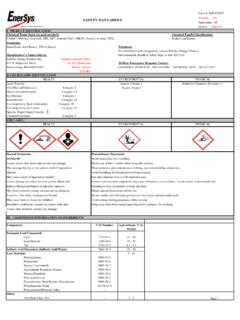
Transcription of SAFETY DATA SHEET – ELECTROLYTE / BATTERY ACID
1 SAFETY data SHEET ELECTROLYTE / BATTERY acid . 1. IDENTIFICATION. Product Identifier: Supplier Name & Address: ELECTROLYTE , BATTERY acid , sulfuric acid (dilute) Surrette BATTERY Company Limited Manufacturer: PO Box 2020, 1 Station Road Surrette BATTERY Company Limited Springhill, Nova Scotia, Canada B0M 1X0. Prepared By: Tel: 902-597-3767. Surrette BATTERY Company Limited Preparation Date: Revision Date: January 21, 2010 August 10, 2016 Emergency Phone #: CANUTEC 1-613-996-6666. 2. HAZARD IDENTIFICATION. HEALTH PHYSICAL. Skin Corrosion / Irritation Category 1A Corrosive to metals Category 1.
2 Eye Damage Category 1 Corrosive to metals Category 1. Carcinogenicity ( acid mist) Category 1A Corrosive to metals Category 1. HAZARD STATEMENTS. DANGER! Causes severe skin burns and eye damage May cause cancer from inhalation of mists May cause respiratory irritation Harmful if swallowed, inhaled or in contact with skin May be corrosive to metals SAFETY data SHEET ELECTROLYTE / BATTERY acid . SIGNAL WORD: DANGER! PRECAUTIONARY STATEMENTS. Obtain special instructions before use If swallowed: rinse mouth; do NOT induce vomiting Do not handle until all SAFETY precautions If inhaled: remove person to fresh air and keep have been read and understood comfortable for breathing; contact poison center Do not breathe vapor or mist or doctor Wash thoroughly after handling If on skin (or hair): take off immediately all contaminated clothing; rinse skin with water/shower.
3 Wash contaminated Wear protective gloves/protective clothing, clothing before reuse eye protection and face protection If in eyes: rinse cautiously with water for several minutes, If exposed or concerned: get medical remove contact lenses if present and easy to do;. advice / attention continue rinsing, contact poison center or doctor 3. COMPOSITION / INFORMATION ON INGREDIENTS. INGREDIENTS. CAS # % BY WEIGHT. (CHEMICAL / COMMON NAME). sulfuric acid ( ELECTROLYTE ) 7664-93-9 30-40. 4. FIRST-AID MEASURES. Inhalation: Skin: ELECTROLYTE ( sulfuric acid ) Remove to fresh air ELECTROLYTE ( sulfuric acid ) Flush with large amounts immediately.
4 If not breathing give artificial respiration. of water for at least 15 minutes. Remove contaminated If breathing is difficult, give oxygen. If breathing difficulty clothing, including shoes. Wash contaminated clothing does not improve rapidly, transport to doctor. Consult before reuse, discard contaminated shoes. Seek medical a doctor or poison control for treatment advice. attention if symptoms/irritation persists. Ingestion: Eyes: ELECTROLYTE ( sulfuric acid ) Give large quantities of ELECTROLYTE ( sulfuric acid ) Flush immediately with large water, do NOT induce vomiting or aspiration into the amounts of water for at least 20 minutes while lifting lids.
5 Lungs may occur and can cause permanent injury or Remove contact lenses if present and easy to do, continue death. If vomiting does occur, keep head low to avoid rinsing. Seek immediate medical attention. stomach content entering the lungs. Get immediate medical attention. 02. SAFETY data SHEET ELECTROLYTE / BATTERY acid . 5. FIRE-FIGHTING MEASURES. Extinguishing Media / Agents CO2 , foam, dry chemical; Water applied to sulfuric acid generates heat and causes acid to splatter, wear full-cover protective, acid -resistant clothing and self-contained breathing apparatus.
6 Fire Fighting Procedures: Use self-contained breathing apparatus and standard firefighting procedures, considering hazards of other involved materials. Hazardous Combustion products: reacts violently with metals, nitrates, chlorates, carbides and other organic materials; reacts with most metals to yield explosive and ammable hydrogen gas. 6. ACCIDENTAL RELEASE MEASURES. Wear acid -resistant clothing, boots, gloves and face shield. Stop ow of material, contain/absorb small spills with dry sand, earth or vermiculite; do not use combustible materials. If possible, carefully neutralize spilled ELECTROLYTE with suitable alkali such as lime, soda ash or sodium bicarbonate.
7 Do not allow discharge of un-neutralized acid to sewer. Flush with water in accordance with applicable regulations. Consult federal, provincial/state and local requirements for allowed means of disposal. 7. HANDLING AND STORAGE. Handling: Storage: Wear protective clothing and equipment during handling Store in cool, dry, well-ventilated areas with impervious and avoid contact with skin, eyes and clothing. Wash after surfaces and adequate containment in the event of a spill. handling. Storage and handling areas should be equipped Storage and handling areas should be equipped with with proper containment to capture and neutralize spills.
8 Proper containment to capture and neutralize spills. In In addition, these areas should be equipped eyewash stations addition, these areas should be equipped eyewash stations and SAFETY showers. Do not breathe in vapor, provide and SAFETY showers. Avoid damage to containers, store adequate ventilation and avoid prolonged exposure. away from incompatible materials, keep away from metallic objects, heat, sparks and open ame. 8. EXPOSURE CONTROLS / PERSONAL PROTECTION. Exposure Limits (mg/m3). CHEMICAL OSHA PEL NIOSH (US) ACGIH QUEBEC PEV ONTARIO OEL OEL (EU).
9 sulfuric acid 1 1 1 (a). ( ELECTROLYTE ). (a) Thoracic fraction 03. SAFETY data SHEET ELECTROLYTE / BATTERY acid . 8. EXPOSURE CONTROLS / PERSONAL PROTECTION CONT'D. Engineering Controls: Eye Protection: Store and handle in a well-ventilated area; if mechanical Use chemical splash goggles or face shield. ventilation is used, components must be acid -resistant. Other Protection: Respiratory Protection: In areas where sulfuric acid solutions are handled in None required under normal conditions. Depending concentrations greater than 1%, and depending on on exposure, or sulfuric acid concentrations, use exposure and workplace standards, emergency eyewash NIOSH or MSHA approved respiratory protection.
10 Stations and showers should be provided, with unlimited Skin Protection: water supply; wash hands after handling. Use rubber or plastic acid -resistant gloves with elbow length gauntlet, acid -resistant clothing, apron and boots. 9. PHYSICAL AND CHEMICAL PROPERTIES. The following information is relevant to ingredients only and is only valid when contents are exposed. ELECTROLYTE ( sulfuric acid ) ELECTROLYTE ( sulfuric acid ). Physical state, odor Liquid, sharp, pungent Specific Gravity (H2O = 1) to and appearance odor, colorless Solubility in water (w/w) 100% Vapor Pressure (mm Hg) 10.