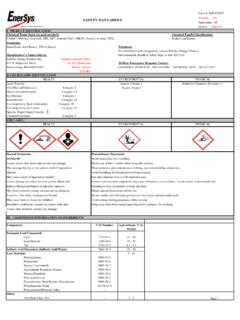
Transcription of SAFETY DATA SHEET - EnerSys
1 Form #: SDS 853020 Revised: AF Supersedes: AEECO #: 1002195I. PRODUCT IDENTIFICATIONC hemical Trade Name (as used on label):Chemical Family/Classification:Lead-Acid Battery, WetElectric Storage BatterySynonyms:Industrial Battery, Traction Battery, Stationary Battery,Telephone:Deep Cycle BatteryFor information and emergencies, contact EnerSys 'Manufacturer's Name/Address:Environmental, Health & SAFETY Dept. at 610-208-1996 EnerSys Canada Corporate Box 141453-61 Parr Boulevard24-Hour Emergency Response Contact:2366 Bernville RoadBolton, OntarioCHEMTREC DOMESTIC: 800-424-9300 CHEMTREC INT'L: 703-527-3877 Reading, PA 19612-4145L7E 4E3II GHS HAZARDS IDENTIFICATIONA cute Toxicity(Oral/Dermal/Inhalation)Category 4 Skin Corrosion/IrritationCategory 1 AEye DamageCategory 1 ReproductiveCategory 1 ACarcinogenicity (lead compounds) Category 1 BCarcinogenicity (arsenic)Category 1 ACarcinogenicity (acid mist)Category 1 ASpecific Target OrganCategory 2 Toxicity (repeated exposure)GHS LABEL:Hazard StatementsPrecautionary StatementsDANGER!
2 Wash thoroughly after severe skin burns and serious eye not eat, drink or smoke when using this damage fertility or the unborn child if ingested or Wear protective gloves/protective clothing, eye protection/face breathing dust/fume/gas/mist/ cause cancer if ingested or only outdoors or in a well-ventilated damage to central nervous system, blood andContact with internal components may cause irritation or severe burns. Avoid contact with internal through prolonged or repeated to eyes, respiratory system, and form explosive air/gas mixture during special instructions before , fire, blast, or projection not handle until all SAFETY precautions have been read and understoodMay cause harm to breast-fed childrenAvoid contact during pregnancy/while nursingHarmful if swallowed, inhaled, or contact with skinKeep away from flames/hot surfaces.
3 No smokingCauses skin irritation, serious eye COMPOSITION/INFORMATION ON INGREDIENTS CAS NumberApproximate % by Lead Compound:Lead7439-92-160-70* Antimony7440-36-02* * * (Sulfuric Acid (H2SO4/H2O))7664-93-910-30 Case Material:5-10 Polypropylene9003-07-0 Polystyrene9003-53-6 Styrene Acrylonitrile9003-54-7 Acrylonitrile Butadiene Styrene9003-56-9 Styrene Butadiene9003-55-8 Polyvinylchloride9002-86-2 Polycarbonate, Hard Rubber, Polyethylene9002-88-4 SAFETY data SHEETC omponentsHEALTHENVIRONMENTALPHYSICALA quatic Chronic 1 Aquatic Acute 1 Explosive Chemical, Division 1 Form #: SDS 853020 Revised: AF Supersedes: AEECO #: 1002195 SAFETY data SHEETO ther:Silicon Dioxide (Gel batteries only)7631-86-91-5 SHEET Molding Compound--(Glass reinforced polyester)Inorganic lead and electrolyte (sulfuric acid) are the primary components of every battery manufactured by EnerSys .
4 Other ingredients may be present dependent upon battery type. Contact your EnerSys representative for additional FIRST AID MEASURESI nhalation:Sulfuric Acid: Remove to fresh air immediately. If breathing is difficult, give oxygen. Consult a : Remove from exposure, gargle, wash nose and lips; consult :Sulfuric Acid: Give large quantities of water; do not induce vomiting or aspiration into the lungs may occur and can cause permanent injury or death;consult a : Consult physician :Sulfuric Acid: Flush with large amounts of water for at least 15 minutes; remove contaminated clothing completely, including symptoms persist, seek medical attention. Wash contaminated clothing before reuse. Discard contaminated : Wash immediately with soap and :Sulfuric Acid and Lead: Flush immediately with large amounts of water for a least 15 minutes while lifting immediate medical attention if eyes have been exposed directly to FIRE FIGHTING MEASURESF lash Point: N/AFlammable Limits: LEL = (Hydrogen Gas)UEL = Media: CO2; foam; dry chemical.
5 Do not use carbon dioxide directly on cells. Avoid breathing vapors. Use appropriate media for surrounding Fire Fighting Procedures: If batteries are on charge, shut off power. Use positive pressure, self-contained breathing apparatus. Water applied to electrolyte generatesheat and causes it to spatter. Wear acid-resistant clothing, gloves, face and eye note that strings of series connected batteries may still pose risk of electric shock even when charging equipment is shut Fire and Explosion Hazards:Highly flammable hydrogen gas is generated during charging and operation of batteries. To avoid risk of fire or explosion, keep sparks or othersources of ignition away from batteries. Do not allow metallic materials to simultaneously contact negative and positive terminals of cells andbatteries.
6 Follow manufacturer's instructions for installation and ACCIDENTAL RELEASE MEASURESS pill or Leak Procedures:Stop flow of material, contain/absorb small spills with dry sand, earth, and vermiculite. Do not use combustible materials. If possible, carefullyneutralize spilled electrolyte with soda ash, sodium bicarbonate, lime, etc. Wear acid-resistant clothing, boots, gloves, and face shield. Do notallow discharge of unneutralized acid to sewer. Acid must be managed in accordance with local, state, and federal state environmental agency and/or federal HANDLING AND STORAGEH andling:Unless involved in recycling operations, do not breach the casing or empty the contents of the battery. Handle carefully and avoid tipping, which may allow electrolyte leakage.
7 There may be increasing risk of electric shock from strings of connected containers tightly closed when not in use. If battery case is broken, avoid contact with internal vent caps on and cover terminals to prevent short circuits. Place cardboard between layers of stacked automotive batteries to avoid damage and short away from combustible materials, organic chemicals, reducing substances, metals, strong oxidizers and water. Use banding or stretch wrap to secure items :Store batteries in cool, dry, well-ventilated areas with impervious surfaces and adequate containment in the event of spills. Batteries should also be stored under roof for protection against adverse weather conditions. Separate from incompatible materials.
8 Store and handle only in areas with adequate water supply and spill control. Avoid damage to containers. Keep away from fire, sparks and heat. Keep away from metallic objects couldbridge the terminals on a battery and create a dangerous :There is a possible risk of electric shock from charging equipment and from strings of series connected batteries, whether or not being charged. Shut-off power to chargers whenever not in use and before detachment of any circuit connections. Batteries being charged will generate and release flammable hydrogen gas. Charging space should be ventilated. Keep battery vent caps in position. Prohibit smoking and avoid creation of flames and sparks face and eye protection when near batteries being 2 Form #: SDS 853020 Revised: AF Supersedes: AEECO #: 1002195 SAFETY data SHEETVIII.
9 EXPOSURE CONTROLS/PERSONAL PROTECTIONE xposure Limits (mg/m3) Note: Not EstablishedOSHA PELACGIHUS NIOSHQ uebec PEVO ntario OELEU (b) (b,e) (c) :(c) Thoracic fraction (e) Based on OEL;s Of Austria, Belgium, Denmark, France, Netherlands, Switzerland, & Controls (Ventilation):Store and handle in well-ventilated area. If mechanical ventilation is used, components must be batteries cautiously to avoid spills. Make certain vent caps are on securely. Avoid contact with internal components. Wear protectiveclothing, eye and face protection when filling, charging or handling batteries. Do not allow metallic materials to simultaneously contact both thepositive and negative terminals of the batteries.
10 Charge the batteries in areas with adequate ventilation. General dilution ventilation is Protection (NIOSH/MSHA approved):None required under normal conditions. When concentrations of sulfuric acid mist are known to exceed the PEL, use NIOSH or MSHA-approvedrespiratory Protection:If battery case is damaged, use rubber or plastic acid-resistant gloves with elbow-length gauntlet, acid-resistant apron, clothing and Protection:If battery case is damaged, use chemical goggles or face Protection:In areas where sulfuric acid is handled in concentrations greater than 1%, emergency eyewash stations and showers should be provided,with unlimited water supply. Acid-resistant apron. Under severe exposure emergency conditions, wear acid-resistant clothing and shield recommended when adding water or electrolyte to batteries, wash hands after PHYSICAL AND CHEMICAL PROPERTIESP roperties Listed Below are for Electrolyte:Boiling Point:203 - 240 FSpecific Gravity (H2O = 1) to Point:N/AVapor Pressure (mm Hg):10 Solubility in Water:100%Vapor Density (AIR = 1):Greater than 1 Evaporation Rate: (Butyl Acetate = 1)Less than 1% Volatile by Weight:N/ApH:~1 to 2 Below room temperature (as hydrogen gas) (Hydrogen) (Hydrogen)Appearance and Odor:Manufactured article; no apparent odor.