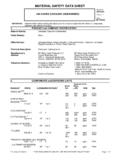
Transcription of SAFETY DATA SHEET General-purpose solvent 1505
1 Printed : 8 Aug 2000 SAFETY data SHEETG eneral-purpose solvent 15051 IDENTIFICATION OF THE SUBSTANCE/PREPARATION AND THE COMPANYPRODUCT NAME: General-purpose solvent 1505 PART No.:1505 APPLICATIONS: solvent for Linx CIJ printersSUPPLIER:Linx Printing Technologies plc Burrel Road ST IVES Cambridgeshire PE27 3LA UKTEL:+44 (0)1480 302100 FAX:+44 (0)1480 302116 EMERGENCY TELEPHONE(S):USA only: 1-800-535-5053 (24 HOUR SERVICE)2 COMPOSITION/INFORMATION ON INGREDIENTSINGREDIENT NAMECAS (class)(R No.)BUTANONE78-93-360-100 %Xi36, 66, 67 COMPOSITION COMMENTS:A blend of one or more solvents and, optionally, colourants and HAZARDS IDENTIFICATIONH ighly flammable.
2 Irritating to eyes. Repeated exposure may cause skin dryness or cracking. Vapours may cause drowsiness and FIRST AID MEASURESGENERAL:Get medical attention if any discomfort continues. Do not give victim anything to drink if he is :Move the exposed person to fresh air at once. If breathing stops, provide artificial respiration. Keep the affected person warm and at rest. Get prompt medical :DO NOT INDUCE VOMITING! Rinse mouth thoroughly with water and give large amounts of milk or water to people not unconscious. Provide rest, warmth and fresh air. Get medical attention immediately!SKIN:Remove contaminated clothing.
3 Wash the skin immediately with soap and water. Get medical attention if irritation persists after :Make sure to remove any contact lenses from the eyes before rinsing. Continue to rinse for at least 15 minutes and get medical 1 / 5>>> General-purpose solvent 15055 FIRE FIGHTING MEASURESEXTINGUISHING MEDIA:Fire can be extinguished using: Alcohol resistant foam. Carbon dioxide (CO2). Water spray, fog or mist. FIRE FIGHTING PROCEDURES:Avoid water in straight hose stream; will scatter and spread fire. Keep run-off water out of sewers and water sources. Dike for water control. Containers close to fire should be removed or cooled with FIRE & EXPLOSION HAZARDS:HIGHLY FLAMMABLE!
4 Vapours may form explosive mixture with air at room temperature. Vapours are heavier than air and may spread near ground to sources of ignition. May travel considerable distance to source of ignition and flash ACCIDENTAL RELEASE MEASURESSPILL CLEANUP METHODS:Extinguish all ignition sources. Avoid sparks, flames, heat and smoking. Ventilate. Clean-up personnel should use respiratory and/or liquid contact protection. Absorb in vermiculite, dry sand or earth and place into containers. Flush with plenty of water to clean spillage HANDLING AND STORAGEUSAGE PRECAUTIONS:Keep away from heat, sparks and open flame.
5 Static electricity and formation of sparks must be prevented. Avoid spilling, skin and eye contact. Ventilate well, avoid breathing vapours. Use approved respirator if air contamination is above accepted level. Risk of vapour concentration on the floor and in low lying areas. Contaminated rags and cloths must be put in fire proof containers for PRECAUTIONS:Flammable/combustible - Keep away from oxidizers, heat and flames. Keep in cool, dry, ventilated storage and closed containers. May attack some plastics, rubber and CRITERIA:Flammable liquid EXPOSURE CONTROLS AND PERSONAL PROTECTIONINGREDIENT NAMECAS NoSTDLT EXPST EXP(8 hrs)(15 min) ppm(Sk)300 ppm(Sk)INGREDIENT COMMENTS:OES = Occupational Exposure EQUIPMENT:VENTILATION:Provide adequate general and local exhaust :No specific recommendation made, but respiratory protection must be used if the general level exceeds the Occupational Exposure Level (OEL).
6 PROTECTIVE GLOVES:Protective gloves must be used if there is a risk of direct contact or splash. Use protective gloves made of: Impermeable PROTECTION:Wear approved SAFETY PROTECTION:Wear appropriate clothing to prevent any possibility of skin 2 / 5>>> General-purpose solvent 1505 HYGIENIC WORK ROUTINES:DO NOT SMOKE IN WORK AREA! Wash at the end of each work shift and before eating, smoking and using the toilet. No eating or drinking while working with this PHYSICAL AND CHEMICAL PROPERTIESAPPEARANCE:Mobile. :Characteristic. Pungent. DESCRIPTION:Appreciably soluble in POINT ( C) @ 760mmHgMELTING POINT ( C) GRAVITY (Water=1) - @ 20 CVAPOUR DENSITY (air=1) @ 20 CVOLATILITY DESCRIPTION:Highly RATE:>BuAc(BuAc=1)pH-VALUE,CONC:N/ - mPas @ 25 CFLASH POINT ( C) POINT METHOD:CC (Closed cup).
7 AUTO IGNITION TEMPERATURE ( C) LIMIT (lower %):ca. (%v/v)FLAMMABILITY LIMIT (upper %):ca. (%v/v)10 STABILITY AND REACTIVITYSTABILITY:No particular stability TO AVOID:Avoid heat. Avoid contact with oxidisers or reducing agents. Avoid contact with acids and POLYMERIZATION:Will not DECOMPOSITION PRODUCTS:Fire creates: Asphyxiating gases/vapours/fumes of: Carbon dioxide (CO2). Carbon monoxide (CO). Nitrous gases (NOx).11 TOXICOLOGICAL INFORMATIONINHALATION:High concentrations of vapours may irritate respiratory system and lead to headache, fatigue, nausea and vomiting. Drowsiness, dizziness, disorientation, :Liquid irritates mucous membranes and may cause abdominal pain if swallowed.
8 Nausea, vomiting. :Product has a defatting effect on :May cause severe irritation to eyes. Vapour or spray may cause temporary (reversible) eye ECOLOGICAL INFORMATIONENVIRONMENTAL HAZARDS:Not regarded as dangerous for the environment (with reference to EU Directive 99/45/EC).13 DISPOSAL CONSIDERATIONSDISPOSAL METHODS:Dispose of in accordance with Local Authority requirements. Absorb in vermiculite or dry sand, dispose in licensed special waste. Make sure containers are empty before discarding (explosion risk).Page 3 / 5>>> General-purpose solvent 150514 TRANSPORT INFORMATIONLABEL FOR CONVEYANCE:ROAD:UN No:1193 HAZARD CLASS (ADR):Class 3: Flammable CLASS No:3 ADR ITEM No:3 (b)HAZARD No.
9 (ADR):33 MARGINAL:2301 ADR LABEL No:3 HAZCHEM CODE:2 YECEFIC TEC(R) No:30G30 PROPER SHIPPING NAME I:METHYL ETHYL KETONERAIL:RAIL TRANSPORT CLASS No:3 RAILROAD PT:3 (b)SEA:UN SEA:1193 SEA TRANSPORT CLASS Page No:3226 SEA PACK GR:IIEmS No.:3-06 MFAG Table No:300 MARINE :UN AIR:1193 AIR TRANSPORT CLASS No:3 AIR PACK GR:II15 REGULATORY INFORMATIONLABEL FOR SUPPLY:RISK PHRASES:R-11 Highly flammable. R-36 Irritating to eyes. R-66 Repeated exposure may cause skin dryness or cracking. R-67 Vapours may cause drowsiness and PHRASES:S-9 Keep container in a well ventilated place. S-16 Keep away from sources of ignition - No Smoking.
10 S-25 Avoid contact with eyes. S-26In case of contact with eyes, rinse immediately with plenty of water and seek medical advice. S-37 Wear suitable gloves. S-51 Use only in well ventilated areas. S-60 This material and its container must be disposed of as hazardous Page 4 / 5>>> General-purpose solvent REGULATORY REFERENCES:Classification, Packaging and Labelling Regulations 1984. The Control of Substances Hazardous to Health Regulations 1988. Chemicals (Hazard Information & Packaging) Regulations INSTRUMENTS:Chemicals (Hazard Information and Packaging) Regulations. Control of Substances Hazardous to CODE OF PRACTICE: SAFETY data Sheets for Substances and Preparations L62.