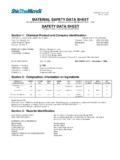
Transcription of SAFETY DATA SHEET - HB Chemical
1 SAFETY data SHEET Product Name: zinc oxide Effective Date: 29 October2012 Scope: This SDS is valid for USZ s zinc oxide in commerce within European Economic Authority (EEA) member countries only. This SDS is not valid outside the EEA. 1. IDENTIFICATION OF THE SUBSTANCE/MIXTURE AND OF THE COMPANY/UNDERTAKING Product Identifier Trade name: zinc oxide Synonyms: ZINKOXID, OXYDE DE zinc , OSSIDO DI ZINCO, ZINKOXIDE, ZINK OXID, OXIDO DEL CINC, TLENED CYNKU CAS number: 1314-13-2, EINECS Number: 215-222-5 REACH Registration number: 01-2119463881-32-0075 (Tonnage Band >1000 t/yr) Relevant identified uses of the substance/mixture and uses advised against: In EEA member countries, use is restricted to only uses registered under REACH. Details of the supplier of the SAFETY data SHEET zinc Corporation 6020 Navigation Blvd Houston, Texas 77011 USA Tel.
2 001 713 9261705 fax 001 713 9244829 Competent person responsible for this SAFETY data Emergency phone number: +1 713 924 4628 (24h answering service: +1 888 464 2958) REACH Only Representative (OR): Votorantim GmbH OR address: Huber Sattler Gasse 01, 4th floor, 5020 Salzburg, Austria. OR contact person: Savio J. Ce, +43 699 171 727 55, email: Note, OR is zinc s affiliate company. 2. HAZARDS IDENTIFICATION Classification of the substance or mixture A. : Not Regulated. B. EEA member countries: Regulated Labeling in EEA countries: i. zinc oxide . Signal word: Warning. H410: Very toxic to aquatic life with long lasting effects. P273: Avoid release to the environment. P391: Collect spillage. P501: Dispose of contents/container as hazardous or special waste in accordance with applicable law.
3 Ii. Risk phrases R50/53: Very toxic to aquatic organisms, may cause long-term adverse effects in the aquatic environment. S60: This material and its container must be disposed of as hazardous waste. S61 : Avoid release to the environment. iii. Preparations containing more than 25% of this material, under EU law, will also need to be classified as Dangerous for the Environment. 3. COMPOSITION/INFORMATION ON INGREDIENTS Constituent Range CAS no. EC/EINECS Other zinc oxide (ZnO) > 1314-13-2 215-222-5 Index: 030-013-00-7 (1) Lead (as PbO) < 1317-36-8 215-267-8 Impurity (1) Cadmium (as CdO) < 1306-19-0 215-146-2 Imputity (1) Moisture (as H2O) < 7732-18-5 213-791-2 Post manufacturing (2) zinc Carbonate (ZnCO3) <1% 5970-47-8 222-477-6 Post manufacturing (3) Processing Aid < Customer request additive (4) (1) This SDS is not a TDS (Technical data SHEET ) or Speficification, and covers a range of product grades and customer specificaitions where the hazards and controls are substantually similar and covered by the same SDS.
4 -> See the specific grade TDS or specification covering the tender for specific ZnO minimum assay and maximum Pb and Cd naturally occuring impurity levels. (2) Moisture is a post manufacturing degradation impurity. The product is maufactured in a high temperature distallation process, absent of volitles. After finished product is manufactured, due to zinc oxide s hygroscopic crystal size, zinc oxide has a natural affinity to attract and hold some moiture from humidity in the air. This occurs post manufacturing and is beyond the manufacturers control. Product is manufacturing and sold dry basis. However, since some moisture will be present at point of end use, it is mentioned as information for the end user in this SDS. (3) zinc oxide naturally degradates by reacting with carbon dioxide (CO2) in ambient air, and is the basis for a shelf life expiration of the product (ZnO + CO2 = ZnCO3).
5 This occurs post manufacturing. As with moisture, product is manufactured and sold dry basis, and this item is listed on this SDS as information only for the end user information only as it may be present at end user, and is not a constituent of the product as manufactured. ZnCO3 is a volitile decomposing around 260C (500F) to CO2 gas and ZnO powder. (4) Treatment. Some rubber industry customers request a processing aid additive which is either propionic acid (as zinc propionate), capryllic acid (as zinc caprylate), and/or light process oil. The specific order must be reviewed to determined if the grade has an S or T indicating Surface Treated. Treatment would not be present on any material unless specifly requested by the customer. 4. FIRST AID MEASURES Description of first aid measures In case of skin contact: Wash with plenty of water and soap.
6 In case of eye contact: Rinse immediately with plenty of water and seek medical advice. In case of Ingestion: Drink plenty of water; do not induce vomiting; call a physician. In case of Inhalation: Remove casualty to fresh air and keep warm and at rest. Most important symptomes and effects, both acute and delayed: Acute: Dry cough, headache. Chronic: None. Overexposure has no lasting effects. Indication of any immediate medical attention and special treatment needed: Bad caugh and/or headache. Move person to fresh air. No special treatment known, excess dust must naturally purge or absob to expel. 5. FIRE-FIGHTING MEASURES zinc oxide will not burn. Hazardous decomposition product(s): None. Use extinguishing media appropriate for the surrounding fire. Avoid release of fire control water containing zinc oxide to environment.
7 6. ACCIDENTAL RELEASE MEASURES Personal precautions, protective equipment and emergency procedures If spilled, shovel or sweep spills into suitable labeled container. Vacuum small spills. Spills not mixed with other chemicals may be recyclable. Remove persons to SAFETY . See protective measures under points 7 and 8. Environmental precautions Do not allow to enter into soil/subsoil. Do not allow to enter into surface water or drains. Retain contaminated washing water and dispose it. In case of escape or of entry into waterways, soil or drains, inform the responsible authorities as required. Suitable material for taking up wet product: absorbing material, organic, sand Methods and material for containment and cleaning up Recover the product with a vacuum cleaner or a damp cloth. Do not sweep up to avoid unnessary creation of airborne dust.
8 Reference to other sections See also section 8 and 13 7. HANDLING AND STORAGE Precautions for safe handling: Wear protective clothing and dust respirator in bulk dust conditions. See also section 8 for recomened protective equipment. Conditions for safe storage, including any incompatibilities: Keep dry. Preferred storage is in a cool and dry place to minimize potency degradation. Keep dry. Once product is opened, consume within a month to minimize potency adverse degradation effects or poor flow and hard particulate (ZnCO3). 8. EXPOSURE CONTROLS/PERSONAL PROTECTION Control parameters Country/organisation 8 hour-TWA 15 min-STEL mg/m3 Germany (MAK) 5 mg/m3 (fumes) 6 mg/m3 (dust) Einatembarer Staub (Dust) = 10 mg/m3 Alveolengangiger Staub = 3 mg/m3 France (INRS) 5 mg/m3 (fume) 10 mg/m3 (dust) UK (OEL) 5 mg/m3 (fumes) 10 mg/m3 (dust) TWA 8 hour: 5 mg/m3 (nuisance dust) STEL 15 minutes: 10 mg/m3 (nuisance dust) The Netherlands 5 mg/m3 (fumes) Sweden 5 mg/m3 (fumes) Denmark 4 mg/m3 (fumes) 10 (dust) USA ( zinc oxide ) 5 mg/m3 (fumes) 15 mg/m3 (dust; total) 5 mg/m3 (dust; respirable) USA (Lead) 5 ug/m3 USA (Cadmium) 5 ug/m3 Exposure controls Eye protection: SAFETY glasses or goggles recommended if risk of excess dust in face Protection for skin: Recommended in bulk dust conditions.
9 Protection for hands: Recommended to reduce drying of skin Respiratory protection: In bulk dust conditions or when at or above OEL or PEL Local exhaust ventalation: Yes. Thermal Hazards: None Environmental exposure controls: None Other Route(s) Of Entry: 1. Inhalation. 2. Mechanical irritation to skin and eyes. Carcinogens: Not a NTP/IARC carcinogen. Signs & Symptoms of Exposure: Dry throat, cough, dry itching skin. Human: Excess bulk exposure may cause acute respiratory irritant or dry skin. 9. PHYSICAL AND Chemical PROPERTIES Information on basic physical and Chemical properties Boiling Point: Not applicable Vapor Pressure: @1500C = 12mm Hg Melting Point: 1975 C Evaporation Rate: N/A (Butyl Acetate = 1) Specific Gravity: Solubility In Water: Insoluble (negligible, Zn mg/l) Molecular Weight: (ZnO) Soluble: In bases and acids Oxidation qualities: Not applicable Fire qualities: Will not burn Odor, smell: Odorless.
10 PH: Neutral, to 8 ( nominal) Vapor Density: Not applicable Physical State: Powder or pellets Typical particle size: to 1 micron Appearance: White, cream, or yellowish color Explosive: Not explosive Volatile: nominal (due to loss of H2O or CO2 10. STABILITY AND REACTIVITY Reactivity: Stable under normal dry air conditions Chemical stability: Product is stable. Decompositon. Product decomposes in bases and acids, neutralizing pH. Shelf life: zinc oxide (ZnO) slowly reacts with carbon dioxide (CO2) in ambient air forming zinc carbonate (ZnCO3). After a year, carbonate may be up to 1% which raises concern of ZnO assay reduction and small hard ZnCO3 particulates up to 500 to 800 micron size causing grit in product which does not effect its SAFETY , but may effect the product s quality for some applications/uses.)