Transcription of Safety Data Sheet - James Alexander
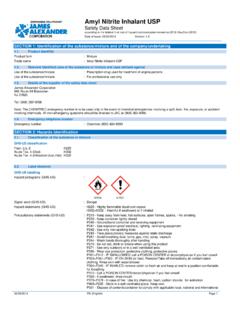
1 Ammonia Inhalant Solution Safety data Sheet according to the federal final rule of hazard communication revised on 2012 (HazCom 2012) Date of issue: 06/02/2014 Version: 06/06/2014 EN (English) Page 1 SECTION 1: Identification of the substance/mixture and of the company/undertaking Product identifier Product form : Mixture Trade name : Ammonia Inhalant Solution Relevant identified uses of the substance or mixture and uses advised against Use of the substance/mixture : OTC drug used to treat or prevent fainting Use of the substance/mixture : For professional use only Details of the supplier of the Safety data Sheet James Alexander Corporation 845 Route 94 Blairstown NJ 07825 Tel: (908) 362-9266 Note: The CHEMTREC emergency number is to be used only in the event of chemical emergencies involving a spill, leak, fire, exposure, or accident involving chemicals. All non-emergency questions should be directed to JAC at (908) 362-9266. Emergency telephone number Emergency number : Chemtrec (800) 424-9300 SECTION 2: Hazards identification Classification of the substance or mixture GHS-US classification Flam.
2 Liq. 2 H225 Skin Corr. 1B H314 Eye Dam. 1 H318 Carc. 1A H350 Label elements GHS-US labelling Hazard pictograms (GHS-US) : GHS02 GHS05 GHS08 Signal word (GHS-US) : Danger Hazard statements (GHS-US) : H225 - Highly flammable liquid and vapour H314 - Causes severe skin burns and eye damage H318 - Causes serious eye damage H350 - May cause cancer Precautionary statements (GHS-US) : P201 - Obtain special instructions before use P202 - Do not handle until all Safety precautions have been read and understood P210 - Keep away from heat, hot surfaces, open flames, sparks. - No smoking P233 - Keep container tightly closed P240 - Ground/bond container and receiving equipment P241 - Use explosion-proof electrical, lighting, ventilating equipment P242 - Use only non-sparking tools P243 - Take precautionary measures against static discharge P260 - Do not breathe dust, fume, gas, mist, spray, vapours P264 - Wash hands thoroughly after handling P280 - Wear eye protection, protective clothing, protective gloves P301+P330+P331 - IF SWALLOWED: rinse mouth.
3 Do NOT induce vomiting P303+P361+P353 - IF ON SKIN (or hair): Remove/Take off immediately all contaminated clothing. Rinse skin with water/shower P304+P340 - IF INHALED: Remove victim to fresh air and keep at rest in a position comfortable for breathing P305+P351+P338 - If in eyes: Rinse cautiously with water for several minutes. Remove contact lenses, if present and easy to do. Continue rinsing Ammonia Inhalant Solution Safety data Sheet according to the federal final rule of hazard communication revised on 2012 (HazCom 2012) 06/06/2014 EN (English) 2/10 P308+P313 - IF exposed or concerned: Get medical advice/attention P310 - Immediately call a POISON CENTER or doctor/physician P321 - Specific treatment (see on this label) P363 - Wash contaminated clothing before reuse P370+P378 - In case of fire: Use dry chemical powder, alcohol-resistant foam, carbon dioxide (CO2), water spray, sand, earth for extinction P403+P235 - Store in a well-ventilated place. Keep cool P405 - Store locked up P501 - Dispose of contents/container to comply with applicable local, national and international regulation.
4 Other hazards No additional information available Unknown acute toxicity (GHS-US) No data available SECTION 3: Composition/information on ingredients Substance Not applicable Full text of H-phrases: see section 16 Mixture Name Product identifier % GHS-US classification Ethyl alcohol (CAS No) 64-17-5 30 - 40 Flam. Liq. 2, H225 Carc. 1A, H350 Ammonia (CAS No) 7664-41-7 15 - 20 Flam. Gas 2, H221 Compressed gas, H280 Acute Tox. 3 (Inhalation:gas), H331 Skin Corr. 1B, H314 SECTION 4: First aid measures Description of first aid measures First-aid measures general : Never give anything by mouth to an unconscious person. If you feel unwell, seek medical advice (show the label where possible). First-aid measures after inhalation : Remove to fresh air and keep at rest in a position comfortable for breathing. If breathing stops, give artificial respiration. In case of breathing difficulties administer oxygen. by trained personnel. Seek medical attention immediately.
5 First-aid measures after skin contact : Immediately flush skin with plenty of water for at least 15 minutes. Remove/Take off immediately all contaminated clothing. Do not rub the skin and eyes after direct contact with the product. Seek medical attention immediately. Wash contaminated clothing before reuse. First-aid measures after eye contact : In case of contact with eyes flush immediately with plenty of flowing water for 10 to 15 minutes holding eyelids apart and consult an ophthalmologist. Remove contact lenses, if present and easy to do. Continue rinsing. Immediately get medical attention. First-aid measures after ingestion : If the person is fully conscious, make him/her drink water. Never give an unconscious person anything to drink. Do NOT induce vomiting. Immediately call a POISON CENTER or doctor/physician. If swallowed, rinse mouth with water (only if the person is conscious). Most important symptoms and effects, both acute and delayed Symptoms/injuries : Causes severe skin burns and eye damage.
6 This material or its emissions may affect the central nervous system and/or aggravate pre-existing disorders. Symptoms/injuries after inhalation : May cause cancer by inhalation. Prolonged and repeated inhalation of decomposition products may cause a pulmonary oedema. Depression of the central nervous system, headaches, dizziness, drowsiness, loss of coordination. Irritating to the respiratory system, may cause throat pain and cough. Difficulty in breathing. Symptoms/injuries after skin contact : May cause severe burns. Symptoms/injuries after eye contact : Causes serious eye damage. Can cause blindness. Symptoms/injuries after ingestion : May cause burns or irritation of the linings of the mouth, throat, and gastrointestinal tract. Ingestion may cause nausea, vomiting and diarrhea. Indication of any immediate medical attention and special treatment needed No additional information available Ammonia Inhalant Solution Safety data Sheet according to the federal final rule of hazard communication revised on 2012 (HazCom 2012) 06/06/2014 EN (English) 3/10 SECTION 5: Firefighting measures Extinguishing media Suitable extinguishing media : Alcohol resistant foam.
7 Dry powder. Carbon dioxide. Sand. Unsuitable extinguishing media : Do not use a heavy water stream. Special hazards arising from the substance or mixture Fire hazard : Highly flammable liquid and vapour. Explosion hazard : May form flammable/explosive vapour-air mixture. Reactivity : Thermal decomposition generates : Corrosive vapours. Reacts violently with acids. An exothermic reaction may occur. Advice for firefighters Firefighting instructions : Use water spray or fog for cooling exposed containers. Exercise caution when fighting any chemical fire. Prevent fire-fighting water from entering environment. Protective equipment for firefighters : Do not enter fire area without proper protective equipment, including respiratory protection. Other information : Containers may swell and Burst during a fire due to internal pressure caused by heat. Vapours are heavier than air and may travel considerable distance to an ignition source and flash back to source of vapours.
8 Alcohols burn with a pale blue flame which may be extremely hard to see under normal lighting conditions. Personnel may be able to feel the heat of the fire without seeing flames. Extreme caution must be exercised in fighting alcohol fires. SECTION 6: Accidental release measures Personal precautions, protective equipment and emergency procedures General measures : Eliminate all ignition sources if safe to do so. Use special care to avoid static electric charges. No naked lights. No smoking. Stop leak if safe to do so. No action shall be taken involving any personal risk or without suitable training. Wear protective clothing. For further information refer to section 8 : Exposure-controls/personal protection. For non-emergency personnel Emergency procedures : Evacuate unnecessary personnel. For emergency responders Protective equipment : Equip cleanup crew with proper protection. Emergency procedures : Ventilate area. Environmental precautions Prevent entry to sewers and public waters.
9 Notify authorities if liquid enters sewers or public waters. Methods and material for containment and cleaning up Methods for cleaning up : Soak up spills with inert solids, such as clay or diatomaceous earth as soon as possible. Collect spillage. Store away from other materials. Contain any spills with dikes or absorbents to prevent migration and entry into sewers or streams. Consult the appropriate authorities about waste disposal. Ensure all national/local regulations are observed. Reference to other sections See Heading 8. Exposure controls and personal protection. SECTION 7: Handling and storage Precautions for safe handling Additional hazards when processed : Handle empty containers with care because residual vapours are flammable. Precautions for safe handling : Obtain special instructions before use. Do not handle until all Safety precautions have been read and understood. Personal protective equipment should be selected based upon the conditions under which this product is handled or used.
10 Use personal protective equipment as required. Provide good ventilation in process area to prevent formation of vapour. Do not breathe gas, fumes, vapour or spray. No naked lights. No smoking. Use only non-sparking tools. Never use pressure to empty container. Ground/bond container and receiving equipment. Take care to allow internal pressure to escape from container before releasing closures. Remove closure carefully; internal pressure may be present. Keep closure up to prevent leakage. Wash hands and other exposed areas with mild soap and water before eating, drinking or smoking and when leaving work. Hygiene measures : Wash hands and other exposed areas with mild soap and water before eating, drinking or smoking and when leaving work. Wash contaminated clothing before reuse. Do not eat, drink or smoke when using this product. Ammonia Inhalant Solution Safety data Sheet according to the federal final rule of hazard communication revised on 2012 (HazCom 2012) 06/06/2014 EN (English) 4/10 Conditions for safe storage, including any incompatibilities Technical measures : Use explosion-proof machinery, apparatus, ventilation facilities, tools etc.