Transcription of SAFETY DATA SHEET - Kleen-Flo
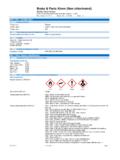
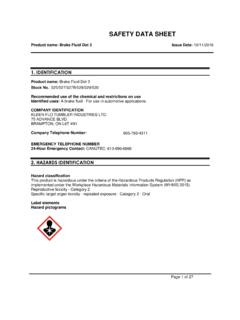
1 SAFETY DATA SHEET . Product name: Premium Brake Fluid Dot 4 Issue Date: 10/19/2016. 1. IDENTIFICATION. Product name: Premium Brake Fluid Dot 4. Stock No. : 532/534. Recommended use of the chemical and restrictions on use Identified uses: Brake fluid formulations. For use in automotive applications. COMPANY IDENTIFICATION. Kleen-Flo Tumbler Industries Limited 75 Advance Blvd. Brampton, ON, L6T 4N1. Company Telephone Number: 905-793-4311. EMERGENCY TELEPHONE NUMBER. Emergency Contact: CANUTEC: 613-996-6666. Guidelines for SDS Use: The product described in this SDS is a consumer product. It is safe for use by consumers as described on the product label under normal foreseeable conditions. This SDS. is designed to provide additional valuable SAFETY and handling information. 2. HAZARDS IDENTIFICATION. Hazard classification This product is hazardous under the criteria of the Hazardous Products Regulation (HPR) as implemented under the Workplace Hazardous Materials Information System (WHMIS 2015).
2 Serious eye damage - Category 1. Reproductive toxicity - Category 2. Label elements Hazard pictograms Page 1 of 21. Product name: Premium Brake Fluid Dot 4 Issue Date: 10/19/2016. Signal word: DANGER! Hazards Causes serious eye damage. Suspected of damaging fertility or the unborn child. Precautionary statements Prevention Obtain special instructions before use. Do not handle until all SAFETY precautions have been read and understood. Wear protective gloves/ protective clothing/ eye protection/ face protection. Response IF IN EYES: Rinse cautiously with water for several minutes. Remove contact lenses, if present and easy to do. Continue rinsing. Immediately call a POISON CENTER/doctor. IF exposed or concerned: Get medical advice/ attention. Storage Store locked up. Disposal Dispose of contents/ container to an approved waste disposal plant. Other hazards No data available 3. COMPOSITION/INFORMATION ON INGREDIENTS.
3 This product is a mixture. Component CASRN Concentration Triethylene glycol monomethyl 30989-05-0 > - < %. ether borate ester Triethylene glycol monomethyl 112-35-6 > - < %. ether Polyethylene glycol monomethyl 9004-74-4 > - < %. ether Triethylene glycol monobutyl 143-22-6 > - < %. ether Polyethylene glycol monobutyl 9004-77-7 > - < %. ether Tetraethylene Glycol 112-60-7 > - < %. Pentaethylene glycol 4792-15-8 > - < %. Page 2 of 21. Product name: Premium Brake Fluid Dot 4 Issue Date: 10/19/2016. Triethylene glycol 112-27-6 > - < %. Diisopropanolamine 110-97-4 > - < %. Di-t-butyl-p-cresol 128-37-0 > - < %. Diethylene glycol monomethyl 111-77-3 > - < %. ether 4. FIRST AID MEASURES. Description of first aid measures General advice: First Aid responders should pay attention to self-protection and use the recommended protective clothing (chemical resistant gloves, splash protection).
4 If potential for exposure exists refer to Section 8 for specific personal protective equipment. Inhalation: Move person to fresh air; if effects occur, consult a physician. Skin contact: Wash off with plenty of water. Eye contact: Immediately flush eyes with water; remove contact lenses, if present, after the first 5. minutes, then continue flushing eyes for at least 15 minutes. Obtain medical attention without delay, preferably from an ophthalmologist. Suitable emergency eye wash facility should be immediately available. Ingestion: If swallowed, seek medical attention. Do not induce vomiting unless directed to do so by medical personnel. Most important symptoms and effects, both acute and delayed: Aside from the information found under Description of first aid measures (above) and Indication of immediate medical attention and special treatment needed (below), any additional important symptoms and effects are described in Section 11: Toxicology Information.
5 Indication of any immediate medical attention and special treatment needed Notes to physician: No specific antidote. Treatment of exposure should be directed at the control of symptoms and the clinical condition of the patient. 5. FIREFIGHTING MEASURES. Suitable extinguishing media: Water fog or fine spray. Dry chemical fire extinguishers. Carbon dioxide fire extinguishers. Foam. Alcohol resistant foams (ATC type) are preferred. General purpose synthetic foams (including AFFF) or protein foams may function, but will be less effective. Unsuitable extinguishing media: Do not use direct water stream. May spread fire. Special hazards arising from the substance or mixture Hazardous combustion products: During a fire, smoke may contain the original material in addition to combustion products of varying composition which may be toxic and/or irritating. Combustion Page 3 of 21. Product name: Premium Brake Fluid Dot 4 Issue Date: 10/19/2016.
6 Products may include and are not limited to: Carbon monoxide. Carbon dioxide. Combustion products may include trace amounts of: Nitrogen oxides. Unusual Fire and Explosion Hazards: Container may rupture from gas generation in a fire situation. Violent steam generation or eruption may occur upon application of direct water stream to hot liquids. Advice for firefighters Fire Fighting Procedures: Keep people away. Isolate fire and deny unnecessary entry. Use water spray to cool fire exposed containers and fire affected zone until fire is out and danger of reignition has passed. Fight fire from protected location or safe distance. Consider the use of unmanned hose holders or monitor nozzles. Immediately withdraw all personnel from the area in case of rising sound from venting SAFETY device or discoloration of the container. Burning liquids may be extinguished by dilution with water.
7 Do not use direct water stream. May spread fire. Move container from fire area if this is possible without hazard. Burning liquids may be moved by flushing with water to protect personnel and minimize property damage. Special protective equipment for firefighters: Wear positive-pressure self-contained breathing apparatus (SCBA) and protective fire fighting clothing (includes fire fighting helmet, coat, trousers, boots, and gloves). If protective equipment is not available or not used, fight fire from a protected location or safe distance. 6. ACCIDENTAL RELEASE MEASURES. Personal precautions, protective equipment and emergency procedures: Isolate area. Keep unnecessary and unprotected personnel from entering the area. Refer to section 7, Handling, for additional precautionary measures. Use appropriate SAFETY equipment. For additional information, refer to Section 8, Exposure Controls and Personal Protection.
8 Environmental precautions: Spills or discharge to natural waterways is likely to kill aquatic organisms. Prevent from entering into soil, ditches, sewers, waterways and/or groundwater. See Section 12, Ecological Information. Methods and materials for containment and cleaning up: Small spills: Absorb with materials such as: Sand. Vermiculite. Collect in suitable and properly labeled containers. Large spills: Contain spilled material if possible. Pump into suitable and properly labeled containers. See Section 13, Disposal Considerations, for additional information. 7. HANDLING AND STORAGE. Precautions for safe handling: Avoid contact with eyes, skin, and clothing. Wash thoroughly after handling. Spills of these organic materials on hot fibrous insulations may lead to lowering of the autoignition temperatures possibly resulting in spontaneous combustion. See Section 8, EXPOSURE. CONTROLS AND PERSONAL PROTECTION.
9 Conditions for safe storage: Store in the following material(s): Carbon steel. Stainless steel. Phenolic lined steel drums. Do not store in: Aluminum. Copper. Galvanized iron. Galvanized steel. Storage stability Storage temperature: > 5 - < 35 C. Page 4 of 21. Product name: Premium Brake Fluid Dot 4 Issue Date: 10/19/2016. 8. EXPOSURE CONTROLS/PERSONAL PROTECTION. Control parameters Exposure limits are listed below, if they exist. Component Regulation Type of listing Value/Notation Triethylene glycol CAD ON OEL TWA 2 mg/m3. monomethyl ether borate ester CAD ON OEL STEL 6 mg/m3. Triethylene glycol Dow IHG TWA Total 100 mg/m3. Diisopropanolamine Dow IHG TWA 10 ppm Di-t-butyl-p-cresol ACGIH TWA Inhalable 2 mg/m3. fraction and vapor CA AB OEL TWA 10 mg/m3. CA BC OEL TWA Inhalable 2 mg/m3. vapour and aerosols CA QC OEL TWAEV 10 mg/m3. Diethylene glycol Dow IHG TWA 10 ppm monomethyl ether Dow IHG TWA SKIN.
10 Consult local authorities for recommended exposure limits. Exposure controls Engineering controls: Use local exhaust ventilation, or other engineering controls to maintain airborne levels below exposure limit requirements or guidelines. If there are no applicable exposure limit requirements or guidelines, general ventilation should be sufficient for most operations. Local exhaust ventilation may be necessary for some operations. Individual protection measures Eye/face protection: Use chemical goggles. Skin protection Hand protection: Use gloves chemically resistant to this material. Examples of preferred glove barrier materials include: Butyl rubber. Chlorinated polyethylene. Polyethylene. Ethyl vinyl alcohol laminate ("EVAL"). Examples of acceptable glove barrier materials include: Natural rubber ("latex"). Nitrile/butadiene rubber ("nitrile" or "NBR"). Polyvinyl chloride ("PVC" or "vinyl").