Transcription of SAFETY DATA SHEET <####> - lidorr.com
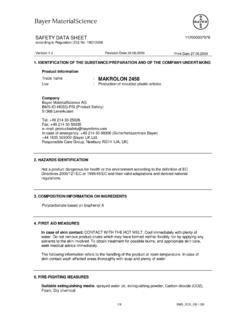
1 SAFETY data SHEET according to Regulation (EU) No. 1907/2006 <####>112000023189 Version Revision Date Print Date > 1/6 BMS_SDS_GB / GB 1. IDENTIFICATION OF THE SUBSTANCE/PREPARATION AND OF THE COMPANY/UNDERTAKING Product information Trade name : MAKROLON 2407 Use : Production of moulded plastic articles Company Bayer MaterialScience AG BMS-IO-HSEQ-PSI (Product SAFETY ) 51368 Leverkusen Tel: +49 214 30 25026 Fax: +49 214 30 50035 e mail: In case of emergency: +49 214 30 99300 (Sicherheitszentrale Bayer) +44 1635 563000 (Bayer UK Ltd, Responsible Care Group, Newbury RG14 1JA, UK) 2. HAZARDS IDENTIFICATION Not a product dangerous for health or the environment according to the definition of EC Directives 2006/121/EC or 1999/45/EC and their valid adaptations and derived national regulations.
2 3. COMPOSITION/INFORMATION ON INGREDIENTS Polycarbonate based on bisphenol A 4. FIRST AID MEASURES In case of skin contact: CONTACT WITH THE HOT MELT: Cool immediately with plenty of water. Do not remove product crusts which may have formed neither forcibly nor by applying any solvents to the skin involved. To obtain treatment for possible burns, and appropriate skin care, seek medical advice immediately. The following information refers to the handling of the product at room temperature. In case of skin contact wash affected areas thoroughly with soap and plenty of water. 5. FIRE-FIGHTING MEASURES Suitable extinguishing media: sprayed water jet, extinguishing powder, Carbon dioxide (CO2), Foam, Dry chemical SAFETY data SHEET according to Regulation (EU) No.
3 1907/2006 <####>112000023189 MAKROLON 2407 Version Revision Date Print Date > 2/6 BMS_SDS_GB / GB Burning releases carbon monoxide, carbon dioxide, oxides of nitrogen and traces of hydrogen cyanide. In the event of fire and/or explosion do not breathe fumes. Firemen must wear self-contained breathing apparatus. Do not allow contaminated extinguishing water to enter the soil, ground-water or surface waters. 6. ACCIDENTAL RELEASE MEASURES Personal precautions: slip hazard! Methods for cleaning up: Use mechanical handling equipment. Avoid dust formation. Additional advice: For further disposal measures see chapter 13. 7. HANDLING AND STORAGE HandlingUnder recommended processing conditions small amounts of residues of monomers and residual solvent may be emitted.
4 Provided good ventilation and/or local exhaust systems are used, the Workplace Exposure Limit(s) stated in Chapter 8 should not be exceeded. Dust must be removed by effective exhaust ventilation. StorageNo special storage conditions required. VCI storage class (VCI = German Association of the Chemical Industry): 11 8. EXPOSURE CONTROLS/PERSONAL PROTECTION The regulations for the substances listed below must be observed when processing this product, particularly if processing takes place at elevated temperatures. In our experience the provision of effective fresh-air and exhaust ventilation equipment at the points where vapors may be generated will ensure compliance with the tolerance limits quoted below. UK Workplace Exposure Limits (WEL), per EH40 document (Health & SAFETY Executive).
5 If no UK value exists, EU exposure limits given where available. Substance CAS-No. Basis Type Value Ceiling Limit Value Remarks phenol 108-95-2 EH40 WEL TWA 2 ppm Dermal absorption possible SAFETY data SHEET according to Regulation (EU) No. 1907/2006 <####>112000023189 MAKROLON 2407 Version Revision Date Print Date > 3/6 BMS_SDS_GB / GB phenol 108-95-2 EU ELV TWA 2 ppm mg/m3 Dermal absorption possible chlorobenzene 108-90-7 EH40 WEL TWA 1 ppm Dermal absorption possible chlorobenzene 108-90-7 EH40 WEL STEL 3 ppm chlorobenzene 108-90-7 EU ELV TWA 5 ppm 23 mg/m3 chlorobenzene 108-90-7 EU ELV STEL 15 ppm 70 mg/m3 General limiting value of dust
6 EH40 WEL TWA 10 mg/m3 inhalable fraction General limiting value of dust EH40 WEL TWA 4 mg/m3 alveolar fraction Respiratory protection: In case of dust formation use respiratory equipment with filter type particle filter P1 according to EN 143. Hand protection: Suitable materials for SAFETY gloves; EN 374-3: Polyvinyl chloride - PVC (>= mm) Contaminated and/or damaged gloves must be changed. Eye protection: Wear eye/face protection. Skin and body protection: Wear suitable protective clothing. Hygiene measures: Keep away from foodstuffs, drinks and tobacco. Wash hands before breaks and at end of work and use skin-protecting ointment.
7 Change contaminated clothing. 9. PHYSICAL AND CHEMICAL PROPERTIES Colour: different according to colouration Form: granular Odour: odourless Softening point: > 130 - 160 C Decomposition temperature: >= 380 C Density: ca. - g/cm Bulk density: 600 - 700 kg/m3 Vapour pressure: not applicable Viscosity, dynamic: not applicable Water solubility: practically insoluble pH: not applicable Ignition temperature: > 450 C Autoignition temperature: not applicable SAFETY data SHEET according to Regulation (EU) No. 1907/2006 <####>112000023189 MAKROLON 2407 Version Revision Date Print Date > 4/6 BMS_SDS_GB / GB Explosion limits: not applicable 10.
8 STABILITY AND REACTIVITY Hazardous reactions: No hazardous reactions observed. Hazardous decomposition products: Caused by smouldering and incomplete combustion toxic fumes mainly consisting of CO and CO2 may be developed. Thermal decomposition: Fumes evolved by overheating during improperly processing or by burning may be injurious to health. 11. TOXICOLOGICAL INFORMATION Under recommended processing conditions small amounts of emissions may occur. The regulations for the substances listed below must be observed when processing this product, particularly if processing takes place at elevated temperatures. Substance CAS-No. R-phrase(s) phenol 108-95-2 R68 Possible risk of irreversible effects. R23/24/25 Toxic by inhalation, in contact with skin and if swallowed.
9 R48/20/21/22 Harmful: danger of serious damage to health by prolonged exposure through inhalation, in contact with skin and if swallowed. R34 Causes burns. chlorobenzene 108-90-7 R20 Harmful by inhalation. 4-tert-butylphenol 98-54-4 R36/37/38 Irritating to eyes, respiratory system and skin. bisphenol A; 4,4'-isopropylidenediphenol 80-05-7 R62 Possible risk of impaired fertility. R37 Irritating to respiratory system. R41 Risk of serious damage to eyes. R43 May cause sensitization by skin contact. Additional information: According to our experience and information the product has no harmful effects on health if properly handled. 12. ECOLOGICAL INFORMATION Do not allow to escape into waterways, wastewater or soil. Additional information on ecotoxicology: The product is practically insoluble in water.
10 In view of its consistency and insolubility in water, SAFETY data SHEET according to Regulation (EU) No. 1907/2006 <####>112000023189 MAKROLON 2407 Version Revision Date Print Date > 5/6 BMS_SDS_GB / GB no ecological problems are to be expected if the product is properly handled. The product is not readily biodegradable. 13. DISPOSAL CONSIDERATIONS Dispose in accordance with applicable international, national and local laws, ordinances and statutes. For disposal within the EC, the appropriate code according to the European Waste Catalogue (EWC) should be used. After containers have been emptied as thoroughly as possible ( by pouring, scraping or draining until "drip-dry"), they can be sent to an appropriate collection point set up within the framework of the existing take-back scheme of the chemical industry.