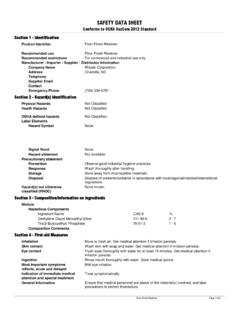
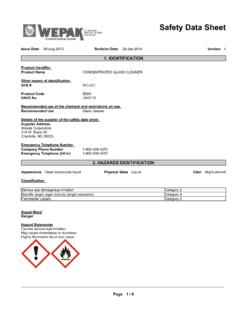
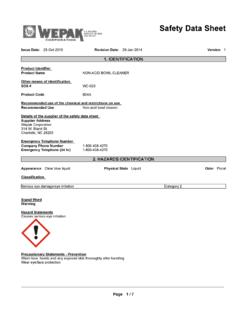
Transcription of Safety Data Sheet Mint Disinfectant - …
1 Safety data Sheet mint Disinfectant Safety data Sheet mint Disinfectant Section 1: Product & Company Identification Trade Name: mint Disinfectant EPA Reg. No. 10324-157-39272 Product Class: Quaternary Ammonium CompoundProduct Use: Disinfectant /SanitizerManufacturer: Wepak Corporation314 West Bland StreetCharlotte, NC 28203 Telephone Numbers: 24 hr. Emergency Assistance: Wepak Corp. 1-800-438-4270 or 1-704-334-5781 Product or Company Information: 1-704-334-5781 (Mon Fri) Section 2: Composition/Information on Ingredients Ingredient CAS # Wt. % Alkyl dimethyl benzyl ammonium chloride (C12-16) 68424-85-1 Didecyl dimethyl ammonium chloride 7173-51-5 - Ethanol 64-17-5 < Section 3: Hazards Identification Emergency Overview Green liquid.
2 Corrosive to the eyes, skin, gastrointestinal tract, and respiratory Health Effects: Skin: Causes corrosive burns. Brief exposures may cause irritation and defatting of the skin. Exposures not promptly washed off may lead to toxic effects similar to ingestion. Harmful if absorbed through the skin. Eyes: Causes burns and may result in permanent injury to eyes including blindness. Inhalation: Mists and vapors can irritate the throat and respiratory tract. High vapor concentrations may cause central nervous system effects. Symptoms may include headaches, dizziness, and drowsiness. Harmful if inhaled. Ingestion: Ingestion can cause gastrointestinal irritation, swelling of the larynx, difficulty in breathing, circulatory shock, convulsions and possibly death.
3 Chronic: Ingestion of ethanol by pregnant women can cause reproductive toxicity to the fetus. Section 4: First Aid Measures Eyes: Immediately flush eyes with water for 15-20 minutes, while holding eyelids open. Remove contact lenses, if present, after the first 5 minutes, then continue rinsing eye. Seek medical attention at or Clothing: Take off contaminated clothing. Rinse skin immediately with plenty of water for 15-20 minutes. Call a poison control center or doctor for treatment : If symptoms are experienced, move victim to fresh air. If person is not breathing, call 911 or an ambulance, then give artificial respiration, preferably mouth-to-mouth if possible.
4 Call a poison control center or doctor for further treatment : Call a poison control center or doctor immediately for treatment advice. Have person sip a glass of water if able to swallow. Do not induce vomiting unless told to do so by a poison control center or doctor. Do not give anything by mouth to an unconscious to Physician: Probable mucosal damage may contraindicate the use of gastric lavage. Section 5: Fire Fighting Measures Flash Point: None when heated to boiling - Tag Closed CupUpper & Lower Flame Limits Not determined Extinguishing Media: Dry chemical, foam, carbon dioxide, water fog or any other agent suitable for surrounding fire.
5 Wepak Corporation Trade Name: mint Disinfectant January 2009 Revision date: 4/15/14 Page 1 of 4 Safety data Sheet mint DisinfectantFire Fighting Equipment & Instructions: Firefighters should wear full protective clothing including self-contained breathing apparatus. Cool fire exposed containers with spray. Hazardous Combustion Products: Irritating and toxic gases or fumes may be released during a fire. Unusual Fire Explosion Hazards Combustion products are toxic. Section 6: Accidental Release Measures Spill and Leak Procedures Emergency Action: Isolate spill or leak area immediately. Keep unauthorized personnel away.
6 Stay upwind. Keep out of low areas where vapors may accumulate. Eliminate all ignition sources (no smoking, flares, sparks or flames in immediate area).Spill Cleanup: Ventilate closed spaces before entering. All equipment used when handling the product must be grounded. Floor will be slippery. Do not touch or walk through spilled material. Stop leak if you can do it without risk. Prevent entry into waterways, sewers, basements or confined areas. Absorb or cover with dry earth, sand or other non-combustible material and transfer to containers. Large Spills: Dike far ahead of liquid spill for later disposal. Pump into containers for disposal.
7 Section 7: Handling & Storage Handling Procedures: Avoid contact with skin and eyes. Use good personal hygiene practices. Wash hands before eating, drinking, smoking, or using toilet facilities. Wash thoroughly after work using soap and Procedures: Keep the container tightly closed and in a cool, well-ventilated place. Keep from freezing. Do not handle or store near an open flame, heat or other sources of ignition. Prevent electrostatic charge buildup by using common bonding and grounding techniques. Section 8: Exposure Controls/Personal Protection Engineering Controls: Provide adequate local exhaust ventilation (explosion proof) to maintain worker exposure below exposure Protective Equipment: Eyes/Face: Wear chemical goggles.
8 Use a face shield if splashing is : Use impervious gloves (rubber or neoprene). Wear suitable protective clothing. Respiratory: If exposure limits are exceeded or if irritation is experienced, a NIOSH/MSNA approved respirator or an organic/vapor removing cartridge respirator protection device should be worn. Ventilation and other forms of engineering controls are often the preferred means for controlling chemical exposures. Respiratory protection may be needed for non-routine or emergency : Eye wash fountain and emergency showers are following ingredients have established exposure guidelines: Ingredient Exposure Guideline Guideline Value Ethanol 64-17-5 ACGIH TLV (2005), OSHA PEL & NIOSH REL 1000 ppm (TWA) Alberta, British Columbia, Manitoba, New Brunswick, Northwest Territories, (Canada) 1000 ppm (TWA) Ontario, Quebec (Canada) 1000 ppm (TWAEV) Saskatchewan (Canada) 1000 ppm (TWA), 1250 ppm (STEL) Yukon (Canada) 1000 ppm (TWA), 1000 ppm (STEL) Mexico 1000 ppm (TWA) ACGIH TLV (2005), OSHA PEL & NIOSH REL 1000 ppm (TWA) All TWAs are for an 8-hour period and all STELs are for 15 minutes unless specifically noted as being for another time period.
9 Section 9: Physical & Chemical Properties Flash Point: None when heated to boiling -Tag Closed Cup Wepak Corporation Trade Name: mint Disinfectant January 2009 Revision Date: 4/15/14 Page 2 of 4 Safety data Sheet mint Disinfectant Specific Gravity: ( )Percent Volatiles: Not determinedVapor Pressure: Not determinedVOC Content ~ Density: Estimated to be heavier than : mm2/s (cSt) @ 22oCEvaporation Rate: Not determined Pour Point: Not determinedpH : 6-8 Appearance and Odor: Green liquid, mint odor. Section 10: Stability & Reactivity Chemical Stability: Material is stable. Conditions to Avoid: Keep away from heat and strong oxidizing : Strong oxidizing agents (may result in fire.)
10 , reducing agentsHazardous Decomposition: Carbon monoxide, carbon dioxide and toxic hydrogen chloride Polymerization: Will not occur. Section 11: Toxicological Information Carcinogenicity No Carcinogenicity data available for this Oral LD50 > 5 g/kg body weight Category IV Acute Dermal > 2 g/kg (male and female rabbits combined).Primary Skin Category III Primary Eye Corrosive. Category IChemicals Ingredients Listed as Potential or Known Carcinogens Ingredient OSHA NTP IARC No ingredients listed in this section. Section 12: Ecological Information Ecotoxicity Very Toxic to aquatic organisms Information available upon request.