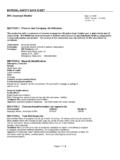
Transcription of SAFETY DATA SHEET - mws-d.com
1 Product CodeN/AManufacturerCompany nameWaveform phone number404-935-2134 Physical hazardsHealth hazardsN/AOSHA defined hazardsNot ClassifiedLabel elementsN/ASignal wordN/AHazard statementPrevention -Response -Storage -Disposal -None data SHEET1. IdentificationProduct IdentifierCorona Veterinary LinimentOther means of identification101016 CRecommended useRecommended restrictionsManufacturer/Importer/Suppli er/Distributor informationFor temporary relief of sore muscles and joints for Veterinary Liniment does not contain any hazardous components. It is intended for topical use on animals, and should be used as directed. See label for statementDo not swallow. Avoid prolonged contact with skin and eyes. Keep out of reach of children. For external use only. Follow directions on product Hazard(s) identificationEnvironmental hazardsIf ingested: Seek medical assistance or contact local poison control center. Contact with Skin and Eyes: Flush eyes with water for least 15 minutes.
2 Wash skin thoroughly with soap and water. If irritation persiest, consult a physician. Store in original containers, under normal conditions and avoid excessive federal, state and local (s) not otherwise classified - (HNOC)Supplemental information839 Pickens Industrial Dr. Marietta, GA 30062 Page 1 MixturesChemical NameCommon name and synonymsCAS NumberWater or Hydrogen OxidePurified Water7732-18-5 Aloe Powder85507-69-31,2-propanediol; 1,2-dihydroxypropane; methyl glycol; methylethylene glycolPropylene Glycol57-55-6(2,5-Dioxo-4-imidazolidinyl )urea; 5-ureidohydantoinAllantoin97-59-6 Vitamin C; L-3-Ketothreohexuronic acid lactoneAscorbic Acid50-81-7 Carbopol Ultrez 10 Ultrez-10 Powder195739-91-4 Isopropyl PalmitateLexol IPP NF142-91-6 Polysorbate 80 Ritabate 809005-65-6 Eucalyptus OilCR. Eucalyptus Oil RM-6708000-48-4, 84625-32-1 Camphor OilCR. Camphor Oil White RM-3558008-51-3, 91745-89-0 IsopropanolIsopropyl Alcohol 99%67-63-0 Hexahydrothymol, CyclohexanolCR.
3 Menthol RM-9251490-04-64-Hydroxybenzoic acid methyl ester; methyl p-hydroxybenzoateMethlyparaben99-76-3 Benzoic acid; Propyl p-hydroxybenzoatePropylparaben94-13-3 TrolamineTEA, 99%102-71-6 InhalationN/ASkin contactEye contactIngestion3. Composition/information on ingredientsChemical percentages have been withheld as a trade First-aid measuresIf ingested: Seek medical assistance or contact local poison control eye contact occurs rinse with copious amounts of skin irritation occur rinse affected area with copious amounts of Rash. Direct contact with eyes may cause temporary irritation. Skin irritation. May cause an allergic skin reaction. May cause redness and of immediate medical attention and special treatment usage of the product and seek medical important symptoms/effects, acute and delayedPage 2 General informationN/ASuitable extinguishingNot KnownNot KnownNot KnownSpecific methodsNot KnownGeneral fire hazardsNot KnownN/AN/AComponentsTypeValueN/AN/AN/A Biological limit valuesNot availableEye/face protectionSkin protection NoneHand protectionOtherNoneRespiratory protectionNoneThermal hazardsNoneSplash rsistant goggles are advised for persons continuously exposed to this , vinyl, or nitrile gloves are advised for persons continuously exposed to this exposure Workplace Environmental Exposure Level (WEEL) GuidesAppropriate engineering controlIndividual protection measures, such as personal protective equipmentNo biological exposure limits noted for the ingredient(s).
4 8. Exposure controls/personal protectionNot KnownAvoid contact with oxidizing agents, freezing and excessive spill: Absorb spill with an inert material ( sand, earth) or other absorbent material, then place in a chemical waste container. Large spill: Stop spill at source, dike area of spill to prevent spreading, and pump liquid into chemical waste Fire-fighting measuresUnsuitable extinguishing mediaSpecific hazards arising from the chemicalSpecial protective equipment and precautions for firefightersFire-fighting equipment/instructions6. Accidental release measuresPersonal precautions, protective equipment and emergency proceduresMethods and materials for containment and cleaning upEnvironmental precautionsCarbon Nomoxide and Carbon DioxideWear a self-contained breathing apparatus with a full face-piece operated in the positive pressure demand mode with appropriate turn-out gear and chemical resistant personal protective product does not contain an environmentally hazardous substance as per 49 CFR Appendix Handling and storagePrecautions for safe handlingConditions for safe storage, including any incompatibilitiesPage 3 AppearancePhysical stateSolidFormColorWhiteOdorMentholOdor thresholdNot - point/freezing pointInitial boiling point and boiling rangeNot KnownFlash pointEvaporation rateNot KnownFlammability (solid, gas)N/AFlammability limit lower (%)N/AFlammability limit upper (%)N/AVapor pressureNot KnownVapor densityNot KnownRelative densityNot availableSolubility(ies)Solubility (water)
5 Partition coefficient (in octanol/water)Not availableAuto ignition temperatureNot availableDecomposition temperatureNot availableViscosityNot availableOther information Specific (Weight %)Not availableReactivityChemical stabilityPossibility of hazardous reactionsConditions to avoidMaterial is stable under normal dangerous reaction known under conditions of normal (Not Flammable)Upper/lower flammability or explosive limits10. Stability and reactivityThis product is stable and non-reactive under normal conditions of use, storage and hygiene considerationsNone9. Physical and chemical propertiesNot KnownCreamDispersesPage 4 IngestionNot availableInhalationNot availableSkin contactNot toxicEye contactNot availableNot availableAcute toxicityNot availableComponentsSpeciesTest ResultsN/AN/AN/ASkin corrosion/irritationNot corrosiveNot availableNot availableSkin sensitizationNot availableGerm cell mutagenicityNot availableCarcinogenicityNot availableNot availableNot availableReproductive toxicityNot availableNot availableNot availableAspiration hazardNot availableChronic effectsNot availableEcotoxicityNot availableComponentsSpeciesTest ResultsN/AN/AN/ANot availableNot available11.
6 Toxicological informationInformation on likely routes of exposureSymptoms related to the physical, chemical and toxicological characteristicsInformation on toxicological effectsSerious eye damage/eye irritationNo hazardous decomposition products are decomposition productsIncompatible materialsSpecific target organ toxicity repeated exposure12. Ecological informationPersistence and degradabilityBioaccumulative potentialRespiratory or skin sensitizationRespiratory sensitization IARC Monographs. Overall Evaluation of CarcinogenicityOSHA Specifically Regulated Substances (29 CFR )Specific target organ toxicity single exposurePage 5 Not availableMobility in soilNot availableOther adverse effectsNot availableDisposal instructionsHazardous waste codeN/AWaste from residues / unused productsContaminated packagingDOTIATAIMDGUS federal regulationsNot categoriesNot regulatedNot coefficient n octanol / water (log Kow)Empty containers should be taken to an approved solid waste handling site for recycling or Transport informationNot regulated as dangerous regulated as dangerous regulated as dangerous Disposal considerationsDispose in sealed containers at licensed solid waste disposal site.
7 Dispose of contents in accordance with local/regional/national/international in accordance to local disposal disposal regulationsResidue and/or unused product can safely disposed of in landfill. CERCLA Hazardous Substance List (40 CFR )SARA 304 Emergency release notificationOSHA Specifically Regulated Substances (29 CFR )Superfund Amendments and Reauthorization Act of 1986 (SARA)Transport in bulk according to Annex II of MARPOL 73/78 and the IBC CodeThis product is not intended to be transported in bulk15. Regulatory informationThis product is not a hazardous chemical as defined by the OSHA Hazard Communication Standard, 29 CFR Section 12(b) Export Notification (40 CFR 707,Subpt. D)Clean Air Act (CAA) Section 112 Hazardous Air Pollutants (HAPs) ListClean Air Act (CAA) Section 112(r) Accidental Release Prevention (40 CFR )SARA 302 Extremely hazardous substanceSARA 311/312 Hazardous chemicalSARA 313 (TRI reporting)Other federal regulationsImmediate Hazard - NoDelayed Hazard - NoFire Hazard - NoPressure Hazard - NoReactivity Hazard - NoPage 6 Not state regulationsNot Rhode Island RTKNot (s) or regionOn inventory (yes/no)AustraliaNoCanadaNoCanadaNoChina NoEuropeNoEuropeNoJapanNoKoreaNoNew ZealandNoPhilippinesNoUnited States & Puerto RicoNoIssue date6/10/2015 Version #1 Existing Chemical List (ECL)New Zealand InventoryPhilippine Inventory of Chemicals and Chemical Substances (PICCS)Toxic Substances Control Act (TSCA) Inventory16.
8 Other information, including date of preparation or last Substances (NDSL)Inventory of Existing Chemical Substances in China (IECSC)European Inventory of Existing Commercial Chemical Substances (EINECS)European List of Notified Chemical Substances (ELINCS)Inventory of Existing and New Chemical Substances (ENCS)Inventory nameAustralian Inventory of Chemical Substances (AICS)Domestic Substances List (DSL)US. Pennsylvania Worker and Community Right-to-Know LawUS. California Proposition 65 International InventoriesUS. Massachusetts RTK Substance ListUS. New Jersey Worker and Community Right-to-Know ActCalifornia Safe Drinking Water and Toxic enforcement Act of 1986 (Proposition 65): This material is not known to contain any chemicals currently listed as carcinogens or reproductive toxins. Drug Enforcement Administration (DEA). List 1 & 2 Exempt Chemical Mixtures (21 CFR )DEA Exempt Chemical Mixtures Code NumberSafe Drinking Water Act (SDWA)Page 7 HMIS ratingsHealth: 0 Flammability: 0 Physical hazard: 0 DisclaimerThe information in the SHEET was written based on the best knowledge and experience currently 8