Transcription of SAFETY DATA SHEET - Rustoleum Direct
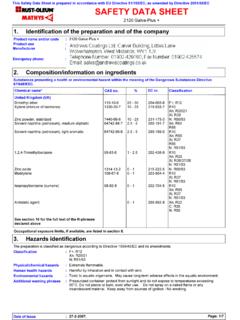
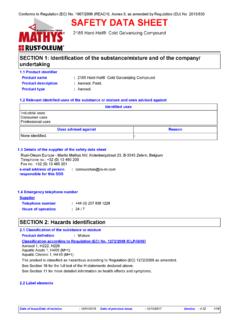
1 2185 Hard-Hat cold galvanizing CompoundIdentification of the preparation and of the companySAFETY data SHEETP roduct name and/or code2185 Hard-Hat cold galvanizing CompoundThis SAFETY data SHEET is prepared in accordance with EU Directive 91/155/EC, as amended by Directive 2001/58/EC1.:Product usePaint.:Manufacturer:Rust-Oleum Netherlands BV, PO. Box 138, NL-4700 AC Roosendaal, The NetherlandsNV Martin Mathys, Kolenbergstraat 23, B-3545 Zelem, BelgiumEmergency phone::Rust-Oleum: (+31)165-593636; Fax (+31)165-593600 Martin Mathys: (+32)13-460200; Fax (+32)13-460201 Composition/information on presenting a health or environmental hazard within the meaning of the Dangerous Substances Directive67/548 name*Dimethyl ether115-10-625 - 50204-065-8 F+; R12 Zinc powder, stabilized7440-66-6 25 - 50231-175-3 N; R50/53 Xylene (mixture of isomeres)1330-20-7 10 - 25215-535-7 R10Xn; R20/21Xi; R38 Zinc oxide1314-13-2 1 - N; R50/53 Solvent naphtha (petroleum), light aromatic64742-95-6 1 - R10Xn; R65Xi.
2 R37R66N; R51/531,2,4-Trimethylbenzene95-63-61 - R10Xn; R20Xi; R36/37/38N; R51/53 Antistatic - 1269-662-8 Xn; R22C; R35N; R50 Mesitylene108-67-80 - 1203-604-4 R10Xi; R37N; R51/53 Isopropylbenzene (cumene)98-82-80 - 1202-704-5 R10Xn; R65Xi; R37N; R51/53 United Kingdom (UK)See section 16 for the full text of the R-phrasesdeclared aboveOccupational exposure limits, if available, are listed in section preparation is classified as dangerous according to Directive 1999/45/EC and its hazards:Very toxic to aquatic organisms, may cause long-term adverse effects in the hazards :Extremely :F+; R12N; R50/53 Additional warning phrases :Pressurized container: protect from sunlight and do not expose to temperature exceeding 50 not pierce or burn, even after use.
3 Do not spray on a naked flame or any incandescentmaterial. Keep away from sources of ignition - No of : 1/72185 Hard-Hat cold galvanizing CompoundIf swallowed, seek medical advice immediately and show this container or label. Keep personwarm and at rest. Do not induce contactCheck for and remove any contact lenses. Immediately flush eyes with running water for at least15 minutes, keeping eyelids contaminated clothing and shoes. Wash skin thoroughly with soap and water or userecognized skin cleanser. Do not use solvents or aid measuresRemove to fresh air. Keep person warm and at rest. If not breathing, if breathing is irregular or ifrespiratory arrest occurs, provide artificial respiration or oxygen by trained personnel.
4 Givenothing by mouth. If unconscious, place in recovery position and seek medical contact::::First aid measuresGeneralIn all cases of doubt, or when symptoms persist, seek medical attention. Never give anything bymouth to an unconscious person.:Fire-fighting : alcohol-resistant foam, CO2, powders, water to be used : water media:Recommendations:Fire will produce dense black smoke. Exposure to decomposition products may cause a healthhazard. Appropriate breathing apparatus may be required. Bursting aerosol containers may bepropelled from a fire at high speed. Cool closed containers exposed to fire with water. Do notrelease runoff from fire to sewers or combustionproducts:Decomposition products may include the following materials:carbon oxidesmetal oxide/oxidesPersonal precautionsExclude sources of ignition and ventilate the area.
5 Avoid breathing vapor or mist. Refer toprotective measures listed in sections 7 and Accidental release measures::SpillContain and collect spillage with non-combustible, absorbent material sand, earth,vermiculite or diatomaceous earth and place in container for disposal according to localregulations (see section 13). Do not allow to enter drains or watercourses. Preferably clean witha detergent. Avoid using solvents. If the product contaminates lakes, rivers, or sewers, informthe appropriate authorities in accordance with local : see section 8 for personal protective equipment and section 13 for waste and are heavier than air and may spread along floors. Vapors may form explosive mixtureswith air.
6 Prevent the creation of flammable or explosive concentrations of vapors in air and avoidvapor concentrations higher than the occupational exposure container tightly closed. Keep away from heat, sparks and flame. No sparking tools shouldbe addition, the product should only be used in areas from which all naked lights and othersources of ignition have been excluded. Electrical equipment should be protected to theappropriate contact with skin and eyes. Avoid the inhalation of dust, particulates, spray or mist arisingfrom the application of this preparation. Avoid inhalation of dust from , drinking and smoking should be prohibited in area where this material is handled, storedand processed.
7 Workers should wash hands and face before eating, drinking and on appropriate personal protective equipment (see section 8).Comply with the health and SAFETY at work in accordance with local regulations. Observe label precautions. Do not store above thefollowing temperature: 35 C (95 F). Store in a cool, well-ventilated area away from incompatiblematerials and ignition away from: oxidizing agents, strong alkalis, strong smoking. Prevent unauthorized access. Containers that have been opened must be carefullyresealed and kept upright to prevent not empty into drains.::Date of : 2/72185 Hard-Hat cold galvanizing CompoundEngineering measuresProvide adequate ventilation.
8 Where reasonably practicable, this should be achieved by the useof local exhaust ventilation and good general extraction. If these are not sufficient to maintainconcentrations of particulates and solvent vapors below the OEL, suitable respiratory protectionmust be Exposure controls/personal protection:Ingredient nameOccupational exposure limitsDimethyl etherEH40-WEL (United Kingdom (UK), 1/2005). STEL: 958 mg/m3 15 minute(s). Form: All forms STEL: 500 ppm 15 minute(s). Form: All forms TWA: 766 mg/m3 8 hour(s). Form: All forms TWA: 400 ppm 8 hour(s). Form: All formsXylene (mixture of isomeres)EH40-WEL (United Kingdom (UK), 1/2005). Skin STEL: 441 mg/m3 15 minute(s).
9 Form: All forms STEL: 100 ppm 15 minute(s). Form: All forms TWA: 220 mg/m3 8 hour(s). Form: All forms TWA: 50 ppm 8 hour(s). Form: All formsSolvent naphtha (petroleum), lightaromaticEH40-WEL (United Kingdom (UK), 2005). Notes: Trimethylbenzene, all isomers TWA: 125 mg/m3 8 hour(s). TWA: 25 ppm 8 hour(s).1,2,4-TrimethylbenzeneEH40-WEL (United Kingdom (UK), 1/2005). TWA: 125 mg/m3 8 hour(s). Form: All forms TWA: 25 ppm 8 hour(s). Form: All formsMesityleneEH40-WEL (United Kingdom (UK), 1/2005). TWA: 125 mg/m3 8 hour(s). Form: All forms TWA: 25 ppm 8 hour(s). Form: All formsIsopropylbenzene (cumene)EH40-WEL (United Kingdom (UK), 1/2005). Skin STEL: 250 mg/m3 15 minute(s).
10 Form: All forms STEL: 50 ppm 15 minute(s). Form: All forms TWA: 125 mg/m3 8 hour(s). Form: All forms TWA: 25 ppm 8 hour(s). Form: All formsUnited Kingdom (UK)Environmental exposure controlsDo not allow to enter drains or controlsOccupational exposurecontrols:Use only with adequate ventilation. If user operations generate dust, fumes, gas, vapor or mist,use process enclosures, local exhaust ventilation or other engineering controls to keep workerexposure to airborne contaminants below any recommended or statutory limits. Theengineering controls also need to keep gas, vapor or dust concentrations below any lowerexplosive limits. Use explosion-proof ventilation hands, forearms and face thoroughly after handling chemical products, before eating,smoking and using the lavatory and at the end of the working period.