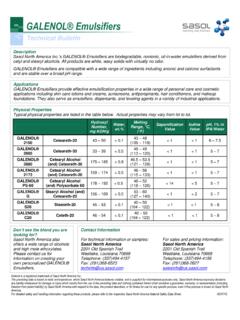
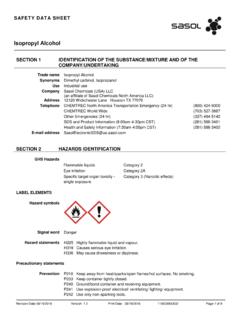
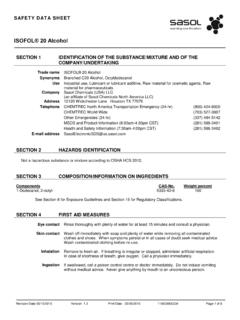
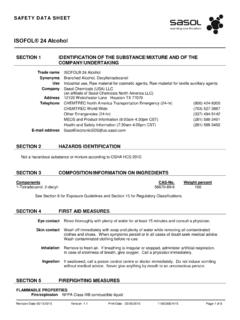
Transcription of SAFETY DATA SHEET - SasolTechData.com
1 By Product Ethoxylate SAFETY DATA SHEET section 1 IDENTIFICATION OF THE SUBSTANCE/MIXTURE AND OF THE COMPANY/UNDERTAKING Trade name By Product Ethoxylate Synonyms Ethoxylated Alcohol Use Agricultural Company Sasol Chemicals (USA) LLC (an affiliate of Sasol Chemicals North America LLC) Address 12120 Wickchester Lane Houston TX 77079 Telephone CHEMTREC North America Transportation Emergency (24-hr) (800) 424-9300 CHEMTREC World Wide (703) 527-3887 Other Emergencies (24-hr) (337) 494-5142 SDS and Product Information (8:00am-4:30pm CST) (281) 588-3491 Health and SAFETY Information (7:30am-4:00pm CST) (281) 588-3492 E-mail address section 2 HAZARDS IDENTIFICATION OSHA/GHS Hazards Acute toxicity (Oral) Category 4 Acute toxicity (Dermal) Category 4 Serious eye damage Category 1 Skin irritation Category 2 Acute aquatic toxicity Category 1 Chronic aquatic toxicity Category 3 Hazard symbols Signal word Danger Hazard statements H302 Harmful if swallowed.
2 H312 Harmful in contact with skin. H315 Causes skin irritation. H318 Causes serious eye damage. H400 Very toxic to aquatic life. H412 Harmful to aquatic life with long lasting effects. LABEL ELEMENTS Revision Date 09/11/2018 Version Print Date 09/11/2018 110000000112 Page 1 of 11 By Product Ethoxylate SAFETY DATA SHEET Precautionary statements Prevention P264 Wash skin thoroughly after handling. P270 Do not eat, drink or smoke when using this product. P280 Wear protective gloves/ eye protection/ face protection. P273 Avoid release to the environment. Response P301 + P312 IF SWALLOWED: Call a POISON CENTER/doctor if you feel unwell. P330 Rinse mouth. P302 + P352 IF ON SKIN: Wash with plenty of soap and water. P332 + P313 If skin irritation occurs: Get medical advice/ attention. P362 Take off contaminated clothing and wash before reuse.
3 P305 + P351 + P338 IF IN EYES: Rinse cautiously with water for several minutes. Remove contact lenses, if present and easy to do. Continue rinsing. P310 Immediately call a POISON CENTER/doctor. P391 Collect spillage. Disposal P501 Dispose of contents/ container to an approved waste disposal plant. Additional advice This product may contain residual levels of alcohols which, even under normal handling conditions, may smell and irritate the eyes, nose, and throats of some individuals. section 3 COMPOSITION/INFORMATION ON INGREDIENTS Components CAS-No. Weight percent Alcohols, C6-C12, ethoxylated 68439-45-2 0 - 100 Alcohols, C10-16, ethoxylated 68002-97-1 0 - 100 Alcohols, C12-18, Ethoxylated 68213-23-0 0 - 100 Alcohols, C16-C18, ethoxylated 68439-49-6 0 - 100 Castor oil, ethoxylated 61791-12-6 0 - 10 1,4-Butanediol, ethoxylated 61886-16-6 0 - 10 Polyethylene glycol 25322-68-3 0 - 10 See section 8 for Exposure Guidelines and section 15 for Regulatory Classifications.
4 section 4 FIRST AID MEASURES Eye contact Rinse thoroughly with plenty of water for at least 15 minutes and consult a physician. Skin contact Wash off immediately with soap and plenty of water while removing all contaminated clothes and shoes. When symptoms persist or in all cases of doubt seek medical advice. Wash contaminated clothing before re-use. Revision Date 09/11/2018 Version Print Date 09/11/2018 110000000112 Page 2 of 11 By Product Ethoxylate SAFETY DATA SHEET Inhalation Remove to fresh air. If breathing is irregular or stopped, administer artificial respiration. Call a physician immediately. Ingestion If swallowed, call a poison control centre or doctor immediately. Do not induce vomiting without medical advice. Never give anything by mouth to an unconscious person. section 5 FIREFIGHTING MEASURES FLAMMABLE PROPERTIES Fire/explosion NFPA Class IIIB combustible liquid.
5 Suitable extinguishing media Water spray, Foam, Dry chemical, Carbon dioxide (CO2) Protective equipment and precautions for firefighters Wear self-contained breathing apparatus for firefighting if necessary. Further information Keep containers and surroundings cool with water spray. Do not use a solid water stream as it may scatter and spread fire. Collect contaminated fire extinguishing water separately. This must not be discharged into drains. section 6 ACCIDENTAL RELEASE MEASURES Methods and materials for containment and cleaning up Evacuate personnel to safe areas. Remove all sources of ignition. Contain spillage, and then collect with non-combustible absorbent material, ( sand, earth, diatomaceous earth, vermiculite) and place in container for disposal according to local / national regulations (see section 13).
6 Do not flush into surface water or sanitary sewer system. section 7 HANDLING AND STORAGE Safe handling advice Take precautionary measures against static discharges. Storage/Transport pressure Ambient Load/Unload temperature Above product melting point. Storage and handling materials Suitable: Carbon steel coated with baked phenolic. Any moisture may cause rusting of carbon steel. If product is moisture free, uncoated carbon steel tanks. Revision Date 09/11/2018 Version Print Date 09/11/2018 110000000112 Page 3 of 11 By Product Ethoxylate SAFETY DATA SHEET Further information on storage conditions Mix thoroughly before use. When stored in the liquid form, ethoxylates should be padded with a dry inert gas, such as nitrogen, to prevent oxygen or air from entering the tank. Prolonged storage in the presence of air or oxygen may cause product degradation.
7 Oxidation is not expected when stored under a nitrogen atmosphere. Inert gas blanket and breathing system needed to maintain color stability. Use dry inert gas having at least -40 C (-40 F) dew point. section 8 EXPOSURE CONTROLS/PERSONAL PROTECTION ENGINEERING MEASURES Ensure adequate ventilation, especially in confined areas. Trace amounts of ethylene oxide may be present in the product and could accumulate in vapor spaces of storage or transport vessels. PERSONAL PROTECTIVE EQUIPMENT Eyes Wear as appropriate: Goggles, Face-shield Skin Full protective clothing, chemical boots, and chemical gloves. High standards of skin care and personal hygiene should be exercised at all times. Inhalation Use respirator when performing operations involving potential exposure to vapour of the product. Use NIOSH approved respiratory protection.
8 EXPOSURE GUIDELINES Components Exposure limit(s) 1,2-Ethanediol ACGIH STEL (Short Term Exposure Limit) 10 mg/m3 (inhalable fraction) ACGIH TLV (8-hour) 25 ppm (vapor fraction) ACGIH STEL (Short Term Exposure Limit) 50 ppm (vapor fraction) PEL= Permissible Exposure Limits TWA= Time Weighted Average (8 hr.) TLV= Threshold Limit Value STEL= Short Term Exposure Limit (15 min.) EL= Excursion Limit WEEL= Workplace Environmental Exposure Level section 9 PHYSICAL AND CHEMICAL PROPERTIES Appearance liquid; Colour Clear to slightly hazy Form liquid Odour sweet pungent Odour Threshold No data available Flash point > 212 C, > 413 F; PM; Revision Date 09/11/2018 Version Print Date 09/11/2018 110000000112 Page 4 of 11 By Product Ethoxylate SAFETY DATA SHEET Flammability Upper explosion limit: No data available Lower explosion limit: No data available Boiling point/boiling range ca.
9 121 - 260 C, 250 - 500 F; Melting point/range -5 - 31 C, 23 - F; Auto-ignition temperature Typically > 236 C, > 457 F; Decomposition temperature No data available Flammability (solid, gas) No data available Vapour pressure negligible Vapour density > 4 Density - g/cm3 Specific gravity No data available Water solubility partly miscible Viscosity No data available pH No data available Evaporation rate No data available Partition coefficient: n-octanol/water No data available section 10 STABILITY AND REACTIVITY Reactivity Stable at normal ambient temperature and pressure. Chemical stability No decomposition if stored and applied as directed. Revision Date 09/11/2018 Version Print Date 09/11/2018 110000000112 Page 5 of 11 By Product Ethoxylate SAFETY DATA SHEET Conditions to avoid Reacts slowly with air or oxygen.
10 Storage under heated conditions in the presence of air or oxygen increases reaction rate. For example, after storing at 95 F/35 C for 30 days in the presence of air, there is measureable oxidation of the ethoxylate. Lower temperatures will allow for longer storage time and higher temperatures will shorten the storage time if stored under an air or oxygen atmosphere. Hazardous decomposition products When storing this product in air or oxygen, decomposition may occur, generating vapors which could be irritating. Ensure adequate ventilation, especially in confined areas. Oxidation is not expected when stored under a nitrogen atmosphere. Materials to avoid Can react with strong oxidizers, inorganic acids, and halogens. Hazardous polymerisation None. section 11 TOXICOLOGICAL INFORMATION Additional Remarks The product itself has not been tested.