Transcription of Safety Data Sheet (SDS) - DeconLabs
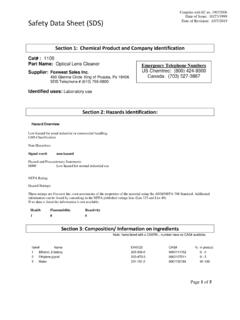
1 Date of Issue: 06/01/2000 Date of Revision: 05/01/2018 Safety data Sheet (SDS) Page 1 of 11 Section 1: Chemical Product and Company Identification Cat# : 8616, 8601 Part Name: Sanihol 70 Supplier: Decon Laboratories Inc. 460 Glennie Circle King of Prussia, Pa 19406 SDS Telephone # (610) 755-0800 Identified uses: Laboratory use Section 2: Hazards Identification: Hazard Overview GHS CLASSIFICATIONS Health: Acute Toxicity (Oral), Category 4 Flammable Liquids, Category 2 Signal Word: DANGER Hazard and Precautionary Statements H226 Flammable liquid and vapor H302 Harmful if swallowed H304: May be fatal if swallowed and enters airways H301: Toxic if swallowed H314 Causes severe skin and eye damage P260: Do not breathe dust/fume/gas/mist/vapours/spray P301+P310 IF SWALLOWED : Immediately call a POISON CENTER/doctor P270: Do not eat, drink or smoke when using this product P233: Keep container tightly closed P271 Use only outdoors or in a well ventilated area.
2 P102: Keep out of reach of children Emergency Telephone Numbers US Chemtrec: (800) 424-9300 Canada: (703) 527-3887 Date of Issue: 06/01/2000 Date of Revision: 05/01/2018 Safety data Sheet (SDS) Page 2 of 11 P210 Keep away from heat, sparks, open flames and hot surfaces - no smoking. P261 Avoid breathing dust/fume/gas/mist/vapors/spray. EMERGENCY OVERVIEW IMMEDIATE CONCERNS: Flammable. Contains methanol. Liquid and vapor harmful. May be fatal or cause blindness if swallowed. Avoid prolonged breathing of vapors. Avoid contact with eyes and skin. Use only in well ventilated areas. POTENTIAL HEALTH EFFECTS EYES: Liquid is moderately irritating to the eyes. High vapor concentrations may also be irritating. Direct contact with the liquid or exposure to its vapors or mists may cause stinging, tearing, redness, swelling and eye damage. SKIN: Liquid is moderately irritating to the skin.
3 Prolonged or repeated contact can result in defatting and drying of the skin which may result in skin irritation and dermatitis (rash). INGESTION: POISONOUS. May be fatal or cause blindness if swallowed. Ingestion may cause irritation of the digestive tract and may have a narcotic effect including signs of CNS depression such as dizziness, headache, drowsiness, loss of coordination, and fatigue. Ingestion may cause low blood pressure, rapid heartbeat and liver damage. INHALATION: Excessive exposure to this product may cause headache, CNS depression, drowsiness, dizziness, loss of appetite, irritation of the respiratory tract, drunkenness, unconsciousness, or death. MEDICAL CONDITIONS AGGRAVATED: Preexisting diseases in or history of ailments involving skin, central nervous system, liver and kidney. TARGET ORGAN STATEMENT: This product contains ethanol. Alcoholic beverage consumption has been associated with brain damage, heart damage, and pancreatitis in humans.
4 The relevance of these findings to ethanol exposure in industrial environments is uncertain. COMMENTS HEALTH: Can cause optic nerve damage (blindness). COMMENTS: None identified. Hazard Ratings: These ratings are Decon Laboratories Inc. s own assessments of the properties of the material using the ANSI/NFPA 704 Standard. Additional information can be found by consulting in the NFPA published ratings lists (List 325 and list 49). If no data is listed the information is not available Health 1 Flammability 3 Reactivity 0 Date of Issue: 06/01/2000 Date of Revision: 05/01/2018 Safety data Sheet (SDS) Page 3 of 11 Section 3: Composition/ Information on ingredients Note: Items listed with a CASRN number have no CAS# available Chemical Name Vol. % CAS Ethanol 61 - 65 64-17-5 Methanol 2 - 5 67-56-1 IPA 2 - 5 67-63-0 Water 28 - 32 7732-18-5 Section 4: First Aid Measures EYES: Immediately flush eyes with plenty of water for at least 15 minutes while holding eyelids open.
5 Get medical attention. SKIN: Flush skin with water while removing contaminated clothing. If irritation occurs, get medical attention. Do not reuse clothing or shoes until cleaned. INGESTION: Call poison control center or get medical help immediately. If patient is conscious and alert, give 8 ounces of water or juice and induce vomiting, keeping patient's head below hips to prevent aspiration of liquid into lungs. Never induce vomiting on an unconscious person. INHALATION: Remove to fresh air. If not breathing, give artificial respiration. If breathing is difficult, oxygen should be administered by qualified personnel. Seek immediate medical attention. SIGNS AND SYMPTOMS OF OVEREXPOSURE ACUTE TOXICITY: Irritation as noted above. Early to moderate CNS depression may be evidenced by giddiness, headache, dizziness, and nausea; in extreme cases, Date of Issue: 06/01/2000 Date of Revision: 05/01/2018 Safety data Sheet (SDS) Page 4 of 11 unconsciousness and death may occur.
6 Liver damage may be evidenced by loss of appetite, jaundice and sometimes pain in the upper abdomen on the right side. Shortness of breathing, redness of skin, swelling of tissues and watery eyes. CHRONIC EFFECTS: None identified. Section 5: Fire-Fighting Measures EXTINGUISHING MEDIA: Use "alcohol resistant" foam, dry chemical, or CO2. Water may be ineffective, but water applied as a spray can absorb some of the fire's heat and should be used to keep fire-exposed containers cool. HAZARDOUS COMBUSTION PRODUCTS: Carbon monoxide and unidentified organic compounds may be formed during combustion. EXPLOSION HAZARDS: When heated above the flash point, this material emits flammable vapors which, when mixed with air, can burn or be explosive. Fine mists or sprays may be flammable at temperatures below the flash point. FIRE FIGHTING PROCEDURES: WARNING. Poisonous and Flammable Liquid. Clear fire area of unprotected personnel.
7 Do not enter confined fire space without full bunker gear, including a positive pressure NIOSH approved SCBA. Cool fire exposed containers with water. FIRE FIGHTING EQUIPMENT: The use of SCBA is recommended for firefighters. Water spray may be used to cool containers exposed to heat or flame. HAZARDOUS DECOMPOSITION PRODUCTS: None identified. COMMENTS: None identified. Section 6: Accidental Release measures Any information listed below is to be considered in addition to internal guidelines for isolation of spill, containment of spill, removal of ignition sources from immediate area, and collection for disposal of spill by trained, properly protected clean up personnel. SMALL SPILL: None identified. LARGE SPILL: None identified. Date of Issue: 06/01/2000 Date of Revision: 05/01/2018 Safety data Sheet (SDS) Page 5 of 11 GENERAL PROCEDURES: WARNING. Poisonous and Flammable Liquid. Ventilate area of leak or spill.
8 Remove all sources of ignition. Clean-up personnel require protective clothing and respiratory protection from vapors. Only specially trained or qualified personnel should handle the emergency. Section 7: Handling and Storage GENERAL PROCEDURES: Keep away from heat, sparks, and flame. Surfaces that are hot may ignite even liquid product in the absence of sparks or flame. Extinguish pilot lights, cigarettes and turn off other sources of ignition prior to use and until all vapors are gone. HANDLING: Use with sufficient ventilation to keep employee exposure below recommended limits. Provide adequate ventilation for storage, handling and use, especially for enclosed or low spaces. Avoid contact of liquid with eyes and prolonged skin exposure. Do not allow product to contact open flame or electrical heating elements because dangerous decomposition products may form. Ground and bond all equipment when transferring from one container to another.
9 STORAGE: Store away from heat, sparks, and open flame. Keep containers tightly closed when not in use. Do not weld, cut, grind, solder, or drill on or near empty containers. Empty containers may contain explosive concentrations of product vapors. COMMENTS: KEEP OUT OF REACH OF CHILDREN! Empty containers retain product residue (liquid and/or vapor) and can be dangerous. Do not pressurize, cut weld, braze, solder, drill, grind, or expose such containers to heat, flame, sparks static electricity, or other sources of ignition; they may explode and cause injury or death. Section 8: Exposure Controls/ Personal Protection OSHA HAZARDOUS COMPONENTS (29 ) EXPOSURE LIMITS OSHA PEL ACGIH TLV SupplierOEL Chemical Name ppm mg/m3 ppm mg/m3 ppm mg/m3 Ethanol TWA 1000 1900 1000 1884 400 980 STEL 400 1,225 Date of Issue: 06/01/2000 Date of Revision: 05/01/2018 Safety data Sheet (SDS) Page 6 of 11 Methanol TWA 200 260 200 262 STEL 250 328 IPA TWA 400 980 200 490 NL [1] NL [1] STEL 400 960 NL NL OSHA TABLE COMMENTS: 1.
10 NL = Not Listed ENGINEERING CONTROLS: Provide exhaust ventilation sufficient to keep the airborne concentration of this product below its exposure limits. Exhaust air may need to be cleaned by scrubbers or filters to reduce environmental contamination. PERSONAL PROTECTIVE EQUIPMENT EYES AND FACE: Use chemical Safety goggles and/or full face shield where splashing is possible. Contact lenses should not be worn when working with this material. Maintain eye wash fountain and quick-drench facilities in work areas. SKIN: Wear resistant gloves (consult your Safety equipment supplier). To prevent repeated or prolonged skin contact, wear impervious clothing and boots. RESPIRATORY: If exposure may or does exceed occupational exposure limits (Sec. 8) use a NIOSH approved respirator to prevent overexposure. In accord with 29 CFR use either an atmosphere-supplying respirator or an air-purifying respirator for organic vapors.