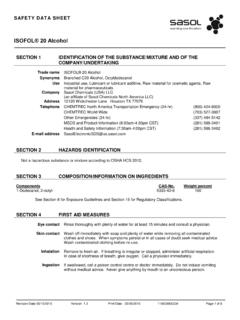
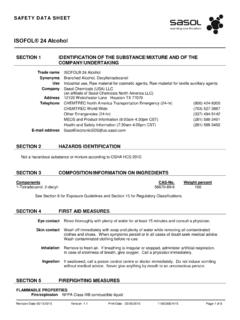
Transcription of SAFETY DATA SHEET SECTION 1: IDENTIFICATION …
1 Ureaformaldehyde resin KFS Е1 Version: Issue date: 01/12/2010 page 1 of 8 The latest version can be found on: SAFETY data SHEET In accordance with Regulation (EC) 1907/2006 (REACH), Annex II SECTION 1: IDENTIFICATION OF THE SUBSTANCE/MIXURE AND OF THE COMPANY/UNDERTAKING Product identifier Trade name Ureaformaldehyde resin KFS Е1 Synonyms Urea glue REACH registration number: KFS is exempted from Registration (article 2(9), REACH regulation) Relevant identified uses of the substance or mixture and uses advised against Uses: As an adhesive in wood and furniture industry after adding relevant hardeners Uses advised against: Not known Details of the supplier of the SAFETY data SHEET Manufacturer: Address: Tel.;fax: URL website: Email: NEOCHIM PLC East Industrial Zone, Himkombinatska Str. 6403 Dimitrovgrad, Bulgaria +359 391 65 205.
2 +359 391 60 555 http:/ / Company e-mail for SDS Emergency telephone number NEOCHIM PLC European Emergency Number National Toxicology Center - Pirogov +359 2 809 20 30 24/24 h 7/7 d 112 24/24 h 7/7 d + 359 2 915 42 33 24/24 h 7/7 d + 359 2 915 43 46 24/24 h 7/7 d SECTION 2: HAZARDS IDENTIFICATION Classification of the substance or mixture Classification according to Regulation (EC) No 1272/2008 (CLP) Product is not classified as hazardous Classification according to Directive 1999/45/EC (DPD) Product is not classified as hazardous Label elements Labelling according to Regulation 1272/2008 (CLP) Hazard pictogram(s): Not applicable Signal word Not applicable Hazard statement(s): Not applicable Precautionary statement(s): Do not heat the resin with steam.
3 Heat it using hot water only. Store in tightly covered warehouses at temperatures from 20 C to 30 C. SECTION 3: COMPOSITION/INFORMATION ON INGREDIENTS Ureaformaldehyde resin KFS Е1 Version: Issue date: 01/12/2010 page 2 of 8 The latest version can be found on: Substances Mixtures - hazardous substance Formaldehyde CAS No EО No Index No REACH registration No Content, % (w/w) Name Classification according to 67/548//EEC Classification according to Regulation (EC) No 1272/2008 (CLP) 50-00-0 200-001-8 605-001-00-5 01-2119488953-20-ХХХХ мax formaldehyde T; R23/24/25 C; R34 R43 Carc. ; R40 Acute tox. 3 ;H301 Acute tox. 3 ;H311 Acute tox. 3 ;H331 Sкin corr. 1B; H314 Skin. Sens. 1; H317 Carc. 2; H351 Specific Conc. Limits: 25 % T; R23/24/25 C; R34 5-< Xn; R20/21/22 Xi; R 36/37/38 R34 Specific Conc. Limits: 25 % Sкиn corr. 1B 5-< Skin Irrit.
4 2 Eye Irrit. 2 STOT Single Exp. 3A Skin For full text of R- phrases, H and EU statements: see SECTION 16 SECTION 4: FIRST- AID MEASURES Description of first aid measures General information Can cause sensitization after long time contact with skin. Eye contact: Rinse cautiously with water for several minutes. Remove contact lenses, if present and easy to do. Continue rinsing. If eye irritation persists: Get medical advice/attention. Skin contact: Wash affected skin area thoroughly with plenty of water and soap. If irritation appears: Consult a physician. Ingestion: Do NOT induce vomiting. Wash out mouth with plenty of water and give to victim plenty of water to drink. Consult a physician. Inhalation: Remove the victim to the fresh air. If discomfort occurs and breathing is difficult, seek medical advice. Most important symptoms and effects, both acute and delayed Acute effects Not known Delayed effects Not known Indication of any immediate medical attention and special treatment needed Treat symptomatically SECTION 5: FIRE - FIGHTING MEASURES Extinguishing media Suitable: Water spray, carbon dioxide or dry chemical.
5 Not suitable: Not known Special hazards arising from the substance or mixture Evacuate personnel not engaged in fire fighting. Keep containers cooled by spraying with large amounts of water from a safe distance. Hazardous combustion products: carbon dioxide, carbon oxide and nitrogen oxides. Ureaformaldehyde resin KFS Е1 Version: Issue date: 01/12/2010 page 3 of 8 The latest version can be found on: Advice for firefighter Self-contained breathing apparatus and a chemical protective suit. SECTION 6: ACCIDENTAL RELEASE MEASURES Personal precautions, protective equipment and emergency procedures Ensure adequate ventilation. Use personal protective equipment. Environmental precautions Do not discharge directly to a water sources. If accidental spillage or washings enter drains or watercourses contact local authority.
6 Methods and material for containment and cleaning up Small spills - absorb with inert material (eg dry sand). Collect large spills by pumping into a spare container suitably labeled. Wash spill area with water. Do not discharge into drains or watercourses. Reference to other sections See SECTION 8 for personal protective equipment and SECTION 13 for waste disposal. SECTION 7: HANDLING AND STORAGE Precautions for safe handling Ensure adequate ventilation of the stores and work areas. Handle in accordance with good industrial hygiene and SAFETY practice. Conditions for safe storage, including any incompatibilities Technical measures/ Storage conditions: Do not heat the resin with steam. Heat it using hot water only. Store in tightly covered warehouses at temperatures from 20 C to 30 C. Suitable packaging materials: Stainless steel (V2), High density polyethylene (HDPE), Low density polyethylene (LDPE), Stainless steel , aluminum Unsuitable packaging materials: Paper, board, glass SECTION 8: EXPOSURE CONTROLS / PERSONAL PROTECTION Control parameters Regulated occupational exposure limit values: Workplace exposure limits for formaldehyde according to EH40/2005 8 hours - mg/m3 15 minutes - mg/m3 Ureaformaldehyde resin KFS Е1 Version: Issue date: 01/12/2010 page 4 of 8 The latest version can be found on: Recommended occupational and consumer exposure limit values (following from the performed CSA of the formaldehyde) DNEL Derived No Effect Level worker: Short-term exposure: - local effects, Inhalation: 1 mg/m3, ppm worker: Long- term exposure: - systemic effects, Inhalation.
7 9 mg/m3 - local effects, Inhalation: mg/m3 worker: Long- term exposure: - systemic effects, dermal: 240 mg/kg bw/day - local effects, dermal: mg/cm2 consumer: Long-term exposure- systemic effects, oral: mg/kg bw/day consumer: Long-term exposure- systemic effects, dermal: 102 mg/kg bw/day consumer: Long-term exposure - local effects, dermal: mg/cm2 consumer: Long-term exposure- systemic effects, Inhalation: mg/m3 consumer: Long-term exposure - local effects, Inhalation: mg/m3 PNEC - Predicted No Effect Concentration freshwater: mg/l marine water: mg/l intermittent release: mg/l sediment (freshwater): mg/kg sediment (marine water): mg/kg soil: mg/kg STP: mg/l Exposure controls Appropriate engineering controls: Use adequate ventilation is good industrial practice. Environmental exposure controls: Avoid uncontrolled discharge of rinse water in surface water or sanitary sewer system.
8 Dispose of rinse water in accordance with local and national regulations. Individual protection measures, such as personal protective equipment (PPE) Respiratory protection: Suitable respiratory protection for lower concentrations or short-term effect: Gas filter for gases/vapours of inorganic compounds ( EN 14387 Type B) Suitable respiratory protection for higher concentrations or long-term effect: Self-contained breathing apparatus. Hand protection: Protective gloves Eye protection: Protective goggles Skin and body protection: Protective clothes Hygiene measures: Wash hands, forearms and face thoroughly after handling chemical products, before eating, smoking and using the lavatory and at the end of the working period. Wash contaminated clothing before reusing. SECTION 9: PHYSICAL AND CHEMICAL PROPERTIES Information on basic physical and chemical properties Appearance: Milky white homogeneous suspension without impurities Ureaformaldehyde resin KFS Е1 Version: Issue date: 01/12/2010 page 5 of 8 The latest version can be found on: Odour: Specific odour of formaldehyde Melting/Freezing temperature: Not applicable Boiling temperature: No information available Flash-point: No information available Flammability: Hardly flammable Explosive properties: No explosive properties Vapour pressure: Not applicable Relative density (D4 (20)): - g/cm3 at 20 С Partition coefficient n-octanol/water: No information available Viscosity: 350 - 800 at 20 С Auto ignition temperature.
9 No information available Jelling time at 100 С, s 45-65 Mixing of resin with water in proportion 1:2 at 20 C 1 C Fully pH of 50% aqueous solution of the resin at 20 C - Other information Not available SECTION 10: STABILITY AND REACTIVITY Reactivity Stable under recommended storage and handling conditions (see SECTION 7, handling and storage). Chemical stability Stable under recommended storage and handling conditions (see SECTION 7, handling and storage). Possibility of hazardous reactions Stable under recommended storage and handling conditions (see SECTION 7, handling and storage). Conditions to avoid Heat, flame, ignition sources and incompatible substances. Incompatible materials Incompatible with strong acids and strong oxidizing agents Hazardous decomposition product Carbon dioxide, carbon monoxide, nitrogen oxides and formaldehyde. SECTION 11: TOXICOLOGICAL INFORMATION Information on toxicological effects ACUTE TOXICITY The product has not been tested.
10 The statement that is toxic by inhalation, in contact with skin and if swallowed is based on properties of the formaldehyde. Acute oral toxicity: LD50: 460-830 mg/kg bw ;(rat) Acute dermal toxicity: LD50: 270 mg/kg (rabbit) Acute inhalation toxicity: LC50 (4 h) rat = 588 mg/m = 490 ppm Ureaformaldehyde resin KFS Е1 Version: Issue date: 01/12/2010 page 6 of 8 The latest version can be found on: LC50 (30 min) rat = 1000 mg/m = 830 ppm LOCAL EFFECTS Depends on the concentration and duration of exposure, aqueous solutions can cause a strongly irritating or corrosive effect on the skin or eyes. Skin irritation: Corrosive (rabbit) Eye irritation: Irreversible damage (rabbit) Skin sensitization: Aqueous solutions can cause skin sensitization in animal experiments and in humans. Carcinogenicity: Formaldehyde is classified as carcinogenic category 2 (Carc.)