Transcription of SAFETY DATA SHEET - T Christy
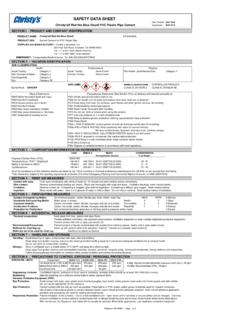
1 SAFETY data SHEETDate Revised: MAY 2016 Supersedes: MAR 2015 SECTION I - PRODUCT AND COMPANY IDENTIFICATION Christy 's Red Hot Blue Glue SYNONYMS:Solvent Cement for PVC Plastic pipe SUPPLIER and MANUFACTURER:T Christy Enterprises, East Ball Road, Anaheim, CA 92805-5910 Tel. 1-714-507-3300 (North America)Tel. 1-714-507-3300 (International)Fax: 86 - 21 - 6428 - 1011 Fax: 86 - 21 - 6428 - 1011 Fax: 86 - 21 - 6428 - 1011 EMERGENCY: Transportation/Medical issues: Tel.
2 INFOTRAC SECTION 2 - HAZARDS IDENTIFICATIONA cute Toxicity: Category 4 Acute Toxicity:None KnownFlammable Liquid/Aerosol/Gas: Category 2 Skin Corrosion/Irritation: Category 3 Chronic Toxicity:None KnownCarcinogenicityCategory 2 Eye: GHS LABEL:WHMIS CLASSIFICATION: CONTROLLED PRODUCTS ignal Word: DANGERCLASS B, DIVISION 2 CLASS D, DIVISION 2BH225 Highly flammable liquid and vaporH302 Harmful if swallowedP202 Do not handle until all SAFETY precautions have been read and understoodH319 Causes serious eye irritationH332 Harmful if inhaledH335 May cause respiratory irritationH336 May cause drowsiness or dizzinessP270 Do not eat, drink or smoke when using this Suspected of causing cancerP330 Rinse MouthP308+P313 IF exposed or concerned.
3 Get medical adivce/attentionP405 Store locked up SECTION 3 - COMPOSITION/INFORMATION ON INGREDIENTS CAS# EINECS #CONCENTRATIONPre-registration Number % by WeightPolyvinyl Chloride Resin (PVC)NON/HAZT etrahydrofuran (THF)** (Stabilized)109-99-9203-726-805-21162977 29-22-000045 -70 Methyl Ethyl Ketone (MEK)*78-93-3201-159-005-2116297728-24-0 0005 - 15 Cyclohexanone108-94-1203-631-105-2116297 718-25-000010 - 30 All of the constituents of this adhesive product are listed on the TSCA inventory of chemical substances maintained by the US EPA, or are exempt from that listing.
4 *This chemical is subject to the reporting requirements of Section 313 of the Emergency Planning and Community Right-to-Know Act of 1986 (40 CFR372).SECTION 4 - FIRST AID MEASURES Contact with eyes:Flush eyes immediately with plenty of water for 15 minutes and seek medical advice immediately. Skin contact:Remove contaminated clothing and shoes. Wash skin thoroughly with soap and water. If irritation develops, seek medical advice. Inhalation:Remove to fresh air. If breathing is stopped, give artificial respiration.
5 If breathing is difficult, give oxygen. Seek medical advice. Ingestion:Rinse mouth with water. Give 1 or 2 glasses of water or milk to dilute. Do not induce vomiting. Seek medical advice 5 - FIREFIGHTING MEASURES Suitable Extinguishing Media:Dry chemical powder, carbon dioxide gas, foam, Halon, water Unsuitable Extinguishing Media:Water spray or stream. Health221-Slight Exposure Hazards:Carbon monoxide, carbon dioxide, hydrogen chloride and smokeFlammability332-Moderate Combustion Products:Carbon monoxide, carbon dioxide, hydrogen chloride and smokeReactivity113-Serious Protection for Firefighters:Self-contained breathing apparatus or full-face positive pressure airline 6 - ACCIDENTAL RELEASE MEASURES Personal precautions.
6 Keep away from heat, sparks and open sufficient ventilation, use explosion-proof exhaust ventilation equipment or wear suitable respiratory protective contact with skin or eyes (see section 8). Environmental Precautions:Prevent product or liquids contaminated with product from entering sewers, drains, soil or open water course. Methods for Cleaning up:Clean up with sand or other inert absorbent material. Transfer to a closable metal container Materials not to be used for clean up:Aluminum or plastic containersSECTION 7 - HANDLING AND STORAGE Handling:Avoid breathing of vapor, avoid contact with eyes, skin and away from ignition sources, use only electrically grounded handling equipment and ensure adequate ventilation/fume exhaust not eat; drink or smoke while handling.
7 Storage:Store in ventilated room or shade below 27 C (80 F) and away from direct away from ignition sources and incompatible materials: caustics, ammonia, inorganic acids, chlorinated compounds, strong oxidizers and all precautionary information on container label, product bulletins and solvent cementing 8 - PRECAUTIONS TO CONTROL EXPOSURE / PERSONAL PROTECTIONEXPOSURE LIMITS: ACGIH TLV ACGIH STEL OSHA PEL OSHA STEL:Tetrahydrofuran (THF) #,##50 ppm skin100 ppm 200 ppm250 ppm # Mfg.
8 Recommended Allowable Exposure Limit (AEL): 25 ppm Methyl Ethyl Ketone (MEK)200 ppm300 ppm200 ppm300 ppm ## Mfg. Recommended STEL: 75 ppm20 ppm skin50 ppm Engineering Controls:If ventilated cabinet, enclosure or fume hood is necessary, average airflow should be at least 100 FPM ( cm/sec). Monitoring:Maintain breathing zone airborne concentrations below exposure limits. Personal Protective Equipment (PPE): Eye Protection:Avoid contact with eyes, wear splash proof chemical goggles, face shield, SAFETY glasses (spectacles) with brow guards and side shields,etc.
9 As may be appropriate for the exposure. Skin Protection:Prevent contact with the skin as much as possible. Polyethylene or PVA coated rubber gloves should be used for frequent immersion. Use of latex/nitrile surgical gloves or solvent-resistant barrier cream should provide adequate protection when normal adhesive applicationpractices and procedures are used for making structural bonds. Respiratory Protection: Prevent inhalation of the solvents. Use in a well-ventilated room. Open doors and/or windows to ensure airflow and air changes.
10 Use localexhaust ventilation to remove airborne contaminants from employee breathing zone and to keep contaminants below levels listed normal use, the Exposure Limit Value will not usually be reached. When limits approached, use respiratory protection Avoid breathing fumes/gas/vapoursPrecautionary Statements (See Section 15 for all advisory and required precautions)P201 Obtain special instructions before StatementsREACH ComponentP501 Dispose of contents/container in accordance with local 's Red Hot Blue Glue PVC Plastic pipe CementPhysicalEnvironmentalGHS CLASSIFICATION: PRODUCT NAME: PRODUCT USE.