Transcription of SAFETY DATA SHEET - U.S. Zinc
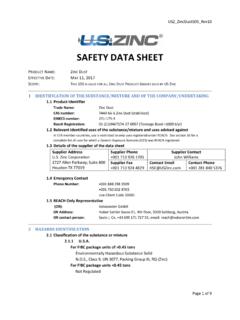
1 USZ_ZincOxideSDS_Rev12 Page 1 of 11 SAFETY data SHEET PRODUCT NAME: ZINC oxide (ALL GRADES) EFFECTIVE DATE: FEBRUARY 9, 2018 SCOPE: THIS SDS IS VALID FOR ALL ZINC oxide PRODUCT GRADES SOLD BY US ZINC 1 IDENTIFICATION OF THE SUBSTANCE/MIXTURE AND OF THE COMPANY/UNDERTAKING Product Identifier Trade Name: Zinc oxide Synonyms: ZINKOXID, OXYDE DE ZINC, OSSIDO DI ZINCO, ZINKOXIDE, ZINK OXID, OXIDO DEL CINC, TLENED CYNKU CAS number: 1314-13-2 EINECS number: 215-222-5 Reach Registration: 01-2119463881-32-0075 (Tonnage Band >1000 t/yr) Relevant identified uses of the substance/mixture and uses advised against In EEA member countries, use is restricted to only uses registered under REACH. Colouring agents, pigments Food/feedstuff additives Fuels and fuel additives Intermediates Laboratory chemicals Lubricants and lubricant additives Plating agents & metal surface treating agents Process regulators, component in batteries Corrosion inhibitors and anti-scaling agents Fertilisers Pharmaceutical substance Photosensitive agents & photo-chemicals Process regulators, used in vulcanisation or polymerisation processes Processing aid, not otherwise listed Semiconductors Details of the supplier of the data SHEET Supplier Address Zinc Corporation 2727 Allen Parkway.
2 Suite 800 Houston TX 77019 Supplier Phone +001 713 926 1705 Supplier Contact John Williams Supplier Fax +001 713 924 4829 Contact Email Contact Phone +001 281 840 5376 Emergency Contact Phone Number: +001 888 298 3509 +001 760 602 8703 Use Client Code 10381 REACH Only Representative (OR): Votorantim GmbH OR Address: Huber Sattler Gasse 01, 4th floor, 5020 Salzburg, Austria OR contact person: Savio J. Ce, +43 699 171 727 55, email: USZ_ZincOxideSDS_Rev12 Page 2 of 11 2 HAZARDS IDENTIFICATION Classification of the substance or mixture : Not Regulated EEA member countries: Regulated Classification according to Regulation (EC) No 1272/2008 [CLP] Aquatic Acute 1: H400 Aquatic Chronic 1, H410 Classification according to Directive 67/548/EEC Dangerous for the environment; N; R50-53 Additional Information For full text of R-phrases and Hazard- and EU Hazard-statements: see Section 16.
3 GHS Labeling Zinc oxide . Signal word: Warning. H410: Very toxic to aquatic life with long lasting effects. P273: Avoid release to the environment. P391: Collect spillage. P501: Dispose of contents/container as hazardous or special waste in accordance with applicable law. These warning labels only apply outside of USA unless transported by air or sea 3 COMPOSITION/INFORMATION ON INGREDIENTS Component Name CAS# EC# % Composition Type Zinc oxide (ZnO) 1314-13-2 215-222-5 95%-100% Main Lead (PbO) < * Impurity Cadmium (CdO) < * Impurity Note: all other constituents are found at trace levels or are not regulated. See individual product specifications for specific composition limits. *- All grades are below these values but some have lower limits USZ_ZincOxideSDS_Rev12 Page 3 of 11 4 FIRST AID MEASURES Description of first aid measures Skin Contact Immediately wash with soap and water.
4 Seek medical attention if irritation occurs. Eye Contact Immediately flush eyes with plenty of water. Get medical attention if irritation occurs. Ingestion Drink plenty of water. Do not induce vomiting. Seek medical attention or contact Poison Control. Inhalation Remove victim to fresh air. Seek medical attention if feeling unwell or experiencing respiratory distress Most important symptoms and effects, both acute and delayed Acute: Dry cough, headache, throat irritation Delayed: No delayed symptoms or effects expected Indication of any immediate medical attention and special treatment needed Bad cough, headache, and/or nausea. Move effected individual to fresh air. 5 FIRE-FIGHTING MEASURES Extinguishing Media Suitable Extinguishing Media Use an extinguishing media suitable for the surrounding fire Unsuitable Extinguishing media None Known Special hazards arising from the substance or mixture Hazards from the substance Water contaminated with this material must be contained and prevented from being discharged to environment Hazardous thermal decomposition products Decomposition products may include Zinc oxide fumes at high temperatures Advice for fire-fighters Special protective actions for fire-fighters No special measures required Special protective equipment for fire-fighters Suitable breathing apparatus 6 ACCIDENTAL RELEASE MEASURES Personal Precautions Avoid breathing dust.
5 Refer to Section 7 and Section 8 for advice on handling/storage and PPE USZ_ZincOxideSDS_Rev12 Page 4 of 11 Environmental Precautions Prevent contamination of soil, drains, and surface water. Inform relevant authorities of spill where required. Spill Cleanup Recommendation Avoid dry sweeping or other methods which raise dust. Vacuum or wet-sweep and place into a suitable closable, labeled container for disposal. Dispose of waste via licensed waste disposal contractor. 7 HANDLING AND STORAGE Precautions for Safe Handling This product should be used in accordance with good industrial SAFETY practices and industrial hygiene standards and all local, state, federal, and international regulations. Avoid creating airborne dust. Ensure adequate exhaust ventilation. Workers who handle material should wear gloves and thoroughly wash hands/forearms after exposure.
6 See Section if exposure exceeds limits. Conditions for Safe Storage/Instabilities This product should be stored in accordance with all local, state, federal and international regulations. Store in a cool (any temperature between 8 and 15 (46 and 59 F), dry (A place that does not exceed 40% average relative humidity at 20 (68 F) or the equivalent water vapor pressure at other temperatures.), well-ventilated space sealed tightly in the original containers. Protect containers from damage and repair if damage occurs. Use all product within 1 year. 8 EXPOSURE CONTROLS/PERSONAL PROTECTION Control Parameters Product/Ingredient Name 8 Hour- TWA (mg/m3) 15 min-STEL (mg/m3) References USA 5 (Fumes) 10 (Dust) 10 (fumes) ACGIH (1991) (guidance values) USA 5 (Fumes) 15 (Dust; total) 5 (Dust; respirable) OSHA (1989) (legal limit values) The Netherlands 5 (Fumes) SZW (1997) Germany 5 (Fumes) 6 (Dust) DFG (1997) UK 5 (Fumes) 10 (Dust) HSE (1998) Sweden 5 (Fumes) National Board of Occupation SAFETY and Health, Sweden (1993) Denmark 4 (Fumes) 10 (Dust) Arbejdstilsynet (1992) Exposure Controls Respiratory Protection Avoid creating dust.)
7 If exposure levels exceed limits, respiratory protection approved for the work being performed must be worn. Hand Protection Always wear glove approved for the work being performed when handling Zinc oxide . Skin Protection Wear normal chemical work clothing. USZ_ZincOxideSDS_Rev12 Page 5 of 11 Eye Protection Always wear approved protective eyewear if there is a potential for dust being created while handling the material. General Protective Hygiene Measures Use local exhaust ventilation to pro-actively reduce dust levels. Other Route(s) of entry Inhalation and mechanical irritation of eyes and skin Carcinogen Status Not a NTP/IARC carcinogen Signs and symptoms of exposure Dry throat, cough, and dry itchy skin Notes Excess bulk exposure may cause acute respiratory irritation or dry skin 9 PHYSICAL AND CHEMICAL PROPERTIES Information on basic physical and chemical properties Appearance: White, cream, or yellow Typical Particle Size: d50 typically 1 um Flammability Limits: ZnO is not flammable Explosive Limits: ZnO is not explosive Odor: Odorless Vapor Pressure: @1500C = 12 mm HG Odor Threshold: Odorless Vapor Density: n/a pH: Neutral Relative Density: Varies Melting point: 1975 C Solubility in water: mg/L Boiling Point: n/a Flash Point: Not flammable Evaporation Rate n/a Specific Gravity: Molecular Weight: Suggested Solvents.
8 Acids and bases Fire qualities: Will not burn Explosive Qualities: Not explosive Volatile: nominal 10 STABILITY AND REACTIVITY Reactivity Stable under normal, dry conditions Chemical stability This product is stable Possibility of hazardous reactions None Conditions to avoid or incompatible materials Heated magnesium. Chlorinated rubbers above 215C Hazardous decomposition products Potential for ZnO fumes at elevated temperatures 11 TOXICOLOGICAL INFORMATION Information on toxicological effects Routes of Entry Oral, Inhalation Acute Toxicity LD50(rat, Inhalation): 7,950 mg/kg (Encyclopedia of Toxicology: Reference Book 2005) Chronic Toxicity NOAEL: 50 mg/day (based on human clinical studies) Mutagenicity No data available Carcinogenicity No data available. Not listed as an IARC Carcinogen. Not listed in the NTP report on carcinogens.
9 USZ_ZincOxideSDS_Rev12 Page 6 of 11 Acute Exposure Symptoms Eye Contact Exposure to airborne concentrations above statutory or recommended exposure limits may cause irritation of the eyes. Inhalation Exposure to airborne concentrations above statutory or recommended exposure limits may cause irritation of the respiratory tract Skin Contact No known significant effects or critical hazards Ingestion No known significant effects or critical hazards 12 ECOLOGICAL INFORMATION Toxicity Product Name Result Species Dose Exposure Reference Zinc oxide LC50 Inhalation Dusts and mists Rat > 4 Hours Klimisch and Freisberg (1982) Zinc oxide LD50 Oral Rat 15000 mg/kg N/A L ser (1972) Zinc oxide LD50 Oral Rat >5000 mg/kg N/A L ser (1977) Persistence and degradability Not rapidly degradable Bioaccumulative potential No evidence to indicate significant bioaccumulative potential Mobility in soil No evidence to indicate significant mobility in soil Results of PBT and vPvB assessment ZnO is not PBT or vPvB.
10 Other adverse effects None 13 DISPOSAL CONSIDERATIONS Waste treatment methods Product Generation of product waste should be minimized wherever possible. Disposal of product, solutions, and any by-products should comply with the requirements of environmental protection and waste disposal legislation and any regional or local authority requirements. Dispose of surplus and non-recyclable products via licensed waste disposal contractor. Waste should not be released into sewer system unless regulations permit such release Containers/Packaging Generation of packaging waste should be minimized wherever possible. Waste packaging should be recycled when possible. Incineration and/or landfill dumping should only be considered when recycling isn t feasible. Make sure to follow all local, state, federal, and international regulations when disposing of packaging materials.