Transcription of SAFETY DATA SHEET - Unimed Corp
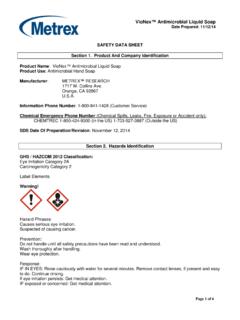
1 #25212 Page: 1 of 8 Issue date 27-March-2015 SAFETY data SHEET 1. Product and Company Identification Product identifier Super Sani-Cloth Germicidal Wipe SDS 0020-00 Other means of identification Not available Recommended use Disinfectant Recommended restrictions For Professional and Hospital Use Manufacturer/Importer/Supplier/Distribut or information Manufacturer Company name Address Professional Disposables International, Inc. Two Nice-Pak Park Orangeburg, NY 10962-1376 Telephone Phone (USA) 1-845-365-1700 (M-F 9am - 5pm) Emergency Phone: 1-800-999-6423 E-mail Emergency phone number 1-800-999-6423 2. Hazards Identification Physical hazards Health hazards Environmental hazards OSHA defined hazards Not applicable.
2 Label elements Flammable solids Serious eye damage/eye irritation Not determined None additional Category 1 Category 2A Signal word Danger Hazard statement Flammable solid. Causes serious eye irritation. Precautionary statement Prevention Read label before use. Keep away from heat/sparks/open flames/hot surfaces. - No smoking. Wash thoroughly after handling. Response If in eyes: Rinse cautiously with water for 15 - 20 minutes. Remove contact lenses, if present and easy to do. Continue rinsing. If eye irritation persists: Get medical advice/attention. In case of fire: Use appropriate media to extinguish. Storage Store away from incompatible materials. Disposal Dispose of waste and residues in accordance with local authority requirements.
3 Hazard(s) not otherwise classified (HNOC) None known. Supplemental information Not applicable. 3. Composition/Information on Ingredients Mixtures Chemical name Common name and synonyms CAS number % Isopropyl Alcohol n-Alkyl (60% C14, 32% C16, 5% C12, 5% C18) dimethyl benzyl ammonium chlorides n-Alkyl (68% C12, 32% C14) dimethyl ethylbenzyl ammonium chlorides 67-63-0 68391-01-5 68956-79-6 55 #25212 Page: 2 of 8 Issue date 27-March-2015 4. First Aid Measures Inhalation Not a normal route of exposure. If inhaled, remove to fresh air. Get medical attention if symptoms develop. Skin contact Take off contaminated clothing. Rinse skin immediately with plenty of water for 15-20 minutes.
4 Eye contact Hold eye open and rinse slowly and gently with water for 15-20 minutes. Remove contact lenses, if present, after the first 5 minutes, then continue rinsing eye. Call a poison control center or doctor for treatment advice. Ingestion Not a likely route of exposure. If ingestion does occur, call a poison control center or doctor for treatment advice. Most important symptoms/effects, acute and delayed Indication of immediate medical attention and special treatment needed Symptoms may include stinging, tearing, redness, swelling, and blurred vision. Treat patient symptomatically. General information Ensure that medical personnel are aware of the material(s) involved, and take precautions to protect themselves.
5 Avoid contact with eyes. 5. Fire Fighting Measures Suitable extinguishing media Water. Water fog. Dry chemical powder. Carbon dioxide (CO2). Unsuitable extinguishing media Specific hazards arising from the chemical Special protective equipment and precautions for firefighters Fire-fighting equipment/instructions None known. During fire, gases hazardous to health may be formed. Firefighters must use standard protective equipment including flame retardant coat, helmet with face shield, gloves, rubber boots, and in enclosed spaces, SCBA. Structural firefighters protective clothing will only provide limited protection. In case of fire and/or explosion do not breathe fumes. In the event of fire, cool product with water spray.
6 Move product from fire area if you can do so without risk. Specific methods Use standard firefighting procedures and consider the hazards of other involved materials. Move products from fire area if you can do so without risk. Cool containers exposed to flames with water until well after the fire is out. In the event of fire and/or explosion do not breathe fumes. General fire hazards Flammable solid. 6. Accidental Release Measures Personal precautions, protective equipment and emergency procedures Methods and materials for containment and cleaning up Wear appropriate protective equipment and clothing during clean-up. For personal protection, see section 8 of the SDS. Eliminate all ignition sources (no smoking, flares, sparks, or flames in immediate area).
7 Pick up and discard towelette. For waste disposal, see section 13 of the SDS. Environmental precautions Avoid discharge into drains, water courses or onto the ground. 7. Handling and Storage Precautions for safe handling Not a skin wipe. For use on hard non-porous surfaces only. Do not use or store near heat or open flame. Use according to package label instructions. Use good industrial hygiene practices in handling this product. Wear appropriate personal protective equipment. Wash thoroughly after handling. When using do not eat or drink. Conditions for safe storage, including any incompatibilities Do not contaminate water, food or feed by storage or disposal. When not in use keep container closed to prevent moisture loss.
8 Store away from incompatible materials (see Section 10 of the SDS). 8. Exposure Controls/Personal Protection Occupational exposure limits US. OSHA Table Z-1 Limits for Air Contaminants (29 CFR ) Components Type Value Isopropyl Alcohol (CAS 67-63-0) PEL 980 mg/m3 400 ppm #25212 Page: 3 of 8 Issue date 27-March-2015 US. ACGIH Threshold Limit Values Components Type Value Isopropyl Alcohol (CAS 67-63-0) STEL 400 ppm TWA 200 ppm US. NIOSH: Pocket Guide to Chemical Hazards Components Type Value Isopropyl Alcohol (CAS 67-63-0) STEL 1225 mg/m3 500 ppm TWA 980 mg/m3 400 ppm Biological limit values ACGIH Biological Exposure Indices Components Value Determinant Specimen Sampling Time Isopropyl Alcohol (CAS 67-63-0) 40 mg/l Acetone Urine * * - For sampling details, please see the source document.
9 Exposure guidelines Chemicals listed in section 3 that are not listed here do not have established limit values for ACGIH or OSHA PEL. Appropriate engineering controls Provide eyewash station. Ensure adequate ventilation. Individual protection measures, such as personal protective equipment Eye/face protection Wear eye protection as appropriate. Skin protection Hand protection Wear disposable protective gloves as appropriate. Other As required by employer code. Respiratory protection In case of insufficient ventilation, wear suitable respiratory equipment. Thermal hazards Not available. General hygiene considerations Handle in accordance with good industrial hygiene and SAFETY practice.
10 Wash hands before breaks and immediately after handling the product. When using do not eat or drink. When using do not smoke. 9. Physical and Chemical Properties Appearance Liquid saturated on wipe Physical state Solid. Form Solid. Color Colorless to Slightly yellow Odor Alcohol Odor threshold Not available. pH - Melting point/freezing point Not available. Initial boiling point and boiling range Not available. Pour point Not available. Specific gravity Partition coefficient (n-octanol/water) Not available. Flash point F ( C) (Liquid) Evaporation rate Not available. Flammability (solid, gas) Flammable solid. Upper/lower flammability or explosive limits Flammability limit - lower (%) Flammability limit - upper (%) Not available.