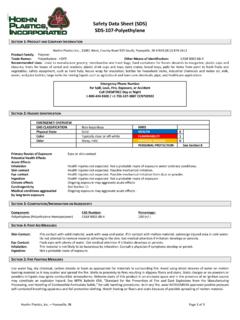
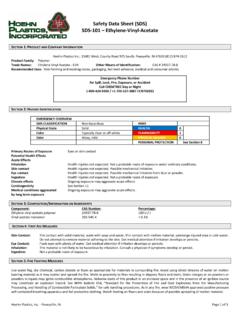
Transcription of Safety @ Hoehn Plastics – Hazard Communication Program ...
1 Safety @ Hoehn Plastics Hazard Communication Program MATERIAL Safety data sheet Hoehn Plastics , Inc. MSDS #104 PA6 Polyamide 6 (Nylon 6) 1 PRODUCT IDENTIFICATION HPI MSDS #104 POLYAMIDE 6 (Nylon 6) CAS NUMBER 25038-54-4 PRODUCT NAME: Polyamide 6 (Nylon 6) PRODUCT USE: Multiple uses in many applications. COMPANY INFORMATION MANUFACTURER: Hoehn Plastics , Inc. 11481 West, County Road 925 South Poseyville, IN. 47633 FOR MORE INFORMATION CALL: Hoehn Plastics , Inc. (812)874-2612 (Monday-Friday 8:00am 4:00pm) IN CASE OF EMERGENCY CALL: Hoehn Plastics , Inc. (812)874-2612 (Monday-Friday 8:00am 4:00pm) All Other Hours: Paul Higgins Plant Operations Manager (812)305-4628 FOR TRANSPORTATION EMERGENCIES: Enoch Carlson Transportation Services Manager (812)205-0636 POTENTIAL HEALTH hazards SKIN: May cause mechanical irritation if the product comes into contact with the skin.
2 Contact with molten material may cause thermal burns. EYES: May cause mechanical irritation if product comes into contact with the eyes. INHALATION: Not a probable route of exposure under normal conditions of use. Elevated processing temperatures may generate fumes and vapors which may cause irritation to the nose and throat. INGESTION: Not a probable route of exposure. No applicable information found. Safety @ Hoehn Plastics Hazard Communication Program MATERIAL Safety data sheet Hoehn Plastics , Inc. MSDS #104 PA6 Polyamide 6 (Nylon 6) 2 POTENTIAL HEALTH hazards (Continued) DELAYED EFFECTS: None known. CARCINOGENICITY: OSHA None National Toxicology Program (NTP) None International Agency for Research on Cancer (IARC) - None FIRST AID SKIN: If in contact with solid material, wash with soap and water.
3 If in contact with molten material, submerge injured area in cold water. Do not attempt to remove material adhering to the skin. Get medical attention if irritation develops or persists. EYES: Flush eyes with plenty of water. Get medical attention if irritation develops or persists. INHALATION: If exposed to vapors at elevated processing conditions, remove to fresh air. Get medical attention if irritation develops or persists. INGESTION: Not a probable route of exposure. ADVICE TO PHYSICIAN: No specific advice, treat symptomatically. FIRE FIGHTING MEASURES FLAMMABLE PROPERTIES FLASH POINT: Not applicable AUTOIGNITION TEMPERATURE: No data Available UPPER FLAME LIMIT (volume % in air): Not applicable. LOWER FLAME LIMIT (volume % in air): Not applicable.
4 FLAME PROPAGATION RATE (solids): Not determined. OSHA FLAMMABILITY CLASS: Combustible solid. NFPA RATINGS: Health 1. Fire 1. Reactivity 0. EXTINGUISHING MEDIA: Use water fog, dry chemical, carbon dioxide or foam as appropriate for materials in surrounding fire. Avoid using direct streams of water on molten burning material as it may scatter and spread the fire. FIRE FIGHTING MEASURES (Continued) Safety @ Hoehn Plastics Hazard Communication Program MATERIAL Safety data sheet Hoehn Plastics , Inc. MSDS #104 PA6 Polyamide 6 (Nylon 6) 3 UNUSUAL FIRE AND EXPLOSION hazards : Melts in proximity to fires resulting in slippery floors and stairs. Static charges on powders or powders in liquids may ignite combustible atmospheres. Airborne dusts of this product in an enclosed space and in the presence of an ignition source may constitute an explosion Hazard .
5 See NFPA Bulletin 654, Standard for the Prevention of Fire and Dust Explosions from the Manufacturing, Processing, and Handling of Combustible Particulate Solids, for safe handling procedures. SPECIAL FIRE FIGHTING PRECAUTIONS/INSTRUCTIONS: As in any fire, wear NIOSH/MSHA approved positive pressure self-contained breathing apparatus and full protective clothing. Watch footing on floors and stairs because of possible spreading of molten material. COMPOSITION / INFORMATION ON INGREDIENTS INGREDIENT NAME CAS NUMBER Polyamide 6 (Nylon 6) 25038-54-4 Material is not known to contain Toxic Chemicals under Section 313 of Title III of the SuperFund Amendments and Reauthorization Act of 1986 and 40 CFR part 372. While this material is not considered as hazardous under OSHA regulations, the MSDS contains valuable information critical to the safe handling and proper use of the product.
6 This MSDS should be retained and available for employees and other users of this product. PERSONAL PROTECTIVE EQUIPMENT SKIN PROTECTION: Not normally required. Use heat-protective clothing as needed for handling hot material. EYE PROTECTION: Wear Safety glasses or goggles that conform to ANSI under normal conditions. Wear Safety goggles and/or a full-face shield if there is potential for contact with molten material. PERSONAL PROTECTIVE EQUIPMENT (CONTINUED) Safety @ Hoehn Plastics Hazard Communication Program MATERIAL Safety data sheet Hoehn Plastics , Inc. MSDS #104 PA6 Polyamide 6 (Nylon 6) 4 RESPIRATORY PROTECTION: Not required for properly ventilated areas. If there is potential for inhalation of dust or vapor, wear a NIOSH approved respirator.
7 The respirator must be selected based on contamination levels and use conditions found in the workplace. Use conditions must not exceed the working limits of the respirator. The respirator must be used in accordance with the OSHA respiratory protection standard (29 CFR ). ADDITIONAL RECOMMENDATIONS: Provide Safety showers and eyewash stations in close proximity to the work area. HANDLING AND STORAGE NORMAL HANDLING: (Always wear recommended personal protective equipment.) Under conditions of storage, vapors may collect in the headspace of the containers causing a sometimes pungent odor during unpacking of these products. Avoid breathing vapors when opening containers. Avoid spillage which can cause very slippery conditions on floors. Follow standard personal hygiene and housekeeping practices for an industrial environment.
8 STORAGE RECOMMENDATIONS: To maintain product quality, store in a cool, dry area, away from direct heat or sunlight. Do not store near strong oxidizing agents and amines. ACCIDENTAL RELEASE MEASURES IN CASE OF SPILL OR OTHER RELEASE: (Always wear recommended personal protective equipment.) Avoid generating dust. Keep away from heat or flame. Collect material and place in a container for reuse or disposal. If material is molten, allow to cool. Use caution, as material may still be hot after solidification. Spills and releases may have to be reported to Federal and/or local authorities. EXPOSURE CONTROLS Safety @ Hoehn Plastics Hazard Communication Program MATERIAL Safety data sheet Hoehn Plastics , Inc. MSDS #104 PA6 Polyamide 6 (Nylon 6) 5 ENGINEERING CONTROLS: General room ventilation is adequate for storage and ordinary handling.
9 Use local exhaust at points of fume generation or if dusty conditions prevail. PHYSICAL AND CHEMICAL PROPERTIES PHYSICAL STATE: Solid Pellet in compounded color. ODOR: Characteristic waxy odor. SPECIFIC GRAVITY ~ SOLUBILITY IN WATER (weight %): Negligible. pH: Not applicable. BOILING POINT: Not determined. MELTING POINT: 220 ~ 250 Degrees C VAPOR PRESSURE: Not applicable. VAPOR DENSITY Not applicable. EVAPORATION RATE: Not applicable COMPARED TO: Not applicable. % VOLATILES: Not determined. FLASH POINT: Not applicable STABILITY AND REACTIVITY NORMALLY STABLE (CONDITIONS TO AVOID) Normally stable. Avoid exposure to open flame or temperatures exceeding recommended processing conditions. INCOMPATIBILITIES: Strong oxidizing agents, acids, flammable materials, halogenated carbon compounds.
10 HAZARDOUS DECOMPOSITION PRODUCTS: Thermal decomposition products may include carbon monoxide, hydrogen cyanide, ammonia. HAZARDOUS POLYMERIZATION: Not likely to occur. TOXICOLOGICAL INFORMATION IMMEDIATE (ACUTE) EFFECTS: Oral Toxicity: LD50 has not been determined Inhalation Toxicity: LD50 has not been determined DELAYED (SUBCHRONIC AND CHRONIC) EFFECTS: No data available. DISPOSAL CONSIDERATIONS RCRA Safety @ Hoehn Plastics Hazard Communication Program MATERIAL Safety data sheet Hoehn Plastics , Inc. MSDS #104 PA6 Polyamide 6 (Nylon 6) 6 Is the unused product a RCRA hazardous waste if discarded? No. If yes, the RCRA ID number is: Not applicable. OTHER DISPOSAL CONSIDERATIONS: Dispose of in compliance with Federal, state and local government regulations.