Transcription of SAMPLE GRANT PROGRESS REPORT - Counselling
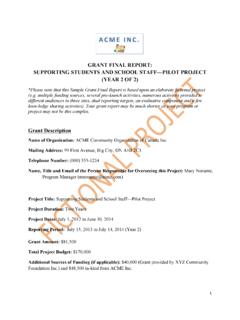
1 1 GRANT PROGRESS REPORT : SUPPORTING STUDENTS AND SCHOOL STAFF PILOT PROJECT (YEAR 1 OF 2) *Please note that this SAMPLE GRANT PROGRESS REPORT is based upon an elaborate fictional project ( multiple funding sources, several pre-launch activities, numerous activities provided to different audiences in three sites, dual reporting targets, an evaluative component and a few knowledge sharing activities). Your GRANT REPORT may be much shorter as your program or project may not be this complex. GRANT Description Name of Organization: ACME Community Organization of Canada Inc. Mailing Address: 99 First Avenue, Big City, ON A1B 2C3 Telephone Number: (000) 555-1234 Name, Title and Email of the Person Responsible for Overseeing this Project: Mary Noname, Program Manager Project Title: Supporting Students and School Staff Pilot Project Project Duration: Two Years Project Dates: July 1, 2012 to June 30, 2014 Reporting Period: July 14, 2012 to July 14, 2013 (Year 1) GRANT Amount: $81,500 Total Project Budget: $170,000 Additional Sources of Funding (if applicable): $40,000 ( GRANT provided by XYZ Community Foundation Inc.)
2 And $48,500 in-kind from ACME Inc. 2 Description of Outputs and Outcomes The answers to these questions provide an overview of the original intent of the GRANT and compares how the project has done so far versus what was initially intended. They also provide insight into how this GRANT has affected the community you serve and your organization at this point. Please describe specifically what you aimed to accomplish with your project. (This content appears in the Goals & Objectives section of your GRANT Application) ABOUT 100 WORDS Our Supporting Students and School Staff Pilot Project will test our violence prevention model that provides students an alternative to using violence to resolve disputes.
3 In brief, this approach will teach students to practice non-violent conflict resolution techniques that will steer them away from violent outbursts (verbal and physical) towards each other and staff members. This model also includes conflict intervention training for school officials and students caregivers to support students in resolving conflicts peacefully. We are also instituting a mechanism (Restorative Justice Model) to allow those involved in incidences of violence (perpetrators, victims, and witnesses) to find an agreeable resolution to the problem. Doing so will decrease the likelihood that the dispute flares up again. This intervention, we believe, will improve conditions in high schools leading to greater academic success for the student body.
4 A more peaceful workplace will also provide better working conditions for staff members therefore improving their career outcomes. What PROGRESS was made toward realizing the outputs of this Reporting Period? (These outputs appear at the top of the Project Description section of your GRANT Application. They are also outlined in your Logic Model Diagram submitted with your GRANT Application) ABOUT 200 WORDS We have completed the Project Planning phase of this initiative on time. Two important steps in this process were hiring Mark Nobody as Program Assistant (See Appendix A: Job Description and CV for Mark Nobody) and developing the Project Activities critical path and Curriculum (See Appendix B).
5 The Theoretical Conflict Management Sessions were held in the first week of October in all three high schools (546 students) followed by the Modeling Conflict Management Sessions in the second week of November (531 students). These were delayed two weeks due to Fall semester exam schedules. The Follow-up Conflict Management Sessions were completed in the second week of January as planned (541 students). The Theoretical and Follow-up Conflict Intervention Sessions were held as scheduled. While the former took place in November (187 caregivers and 103 staff), the latter were held in March (192 caregivers and 101 staff). Our Restorative Justice activities were briefly delayed to accommodate school staff schedules (preparation for mid-term exams).
6 Certification took place in October instead of September and the institution of the model occurred in January in each school. The Project Impact tracking mechanisms were instituted as planned. We have collected the benchmark statistics (violent incidences and workplace indicators) that will be compared 3 with data from the Pilot Project phase. The Impact Survey Beginning and Impact Survey Mid-Project have also been completed. (See Appendix C) This data is being imputed and drafting the preliminary findings is on track. ABC Evaluation Corporation Inc. has been monitoring the project as planned. Their first Implementation Review took place on September 26th.
7 It was repeated on December 18th and March 8th. They have submitted a draft REPORT which we are reviewing. We expect to have the final version by the end of July. Do you anticipate any changes to your planned outputs, expected outcomes, timelines or budget items for the next Reporting Period? If so, describe the changes and note the reason(s) for the change(s). POINT FORM ANSWER Conflict Management Sessions: Delayed two weeks according to Fall student exam schedules. This change will not affect the expected results or budget. Restorative Justice Activities: Delayed ten days according to school staff schedules. Certification took place in October instead of September and the institution of the model occurred in January.
8 This change will not affect the expected results or budget. Conflict Intervention Sessions: The projected expense was $12,500 but convening the event in one high school led to a savings of $3,750. A portion of these funds ($520) will be applied to cover the extra costs of the Restorative Justice Implementation. The remaining $3,230 will be carried over into Year 2 in the same line item (see Budget). Did you undertake any anticipated or unanticipated political activities with funds provided from this GRANT during this Reporting Period? If so, please describe and explain how much of the GRANT amount was dedicated to these activities. (This content appears in the Confirmation of Outputs section of your GRANT Letter of Agreement) ABOUT 200 WORDS -Not applicable.
9 4 Lessons Learned This section is intended to encourage you to reflect on what you have learned from this GRANT so far and to think about whether this learning points you toward making minor or major adjustments to your organization programmatically or changes in resource allocation. What were the primary lessons that you, your staff and/or volunteers learned from this project during this Reporting Period about your organization and/or the clients you serve? How might they impact your future thinking, performance, or services in the next Reporting Period? FROM 200-300 WORDS Organizational Learnings: Although we felt that we had done a good job at getting to know personnel at the high schools as well as their institutional policies, some delays could have been avoided if we had done this better.
10 For instance, we did not have a clear grasp of how school administrators have such tight deadlines leaving little room to maneuver in case something goes wrong with the timing of a planned activity. We learned that they are more likely to cancel the activity as moving around a packed schedule is hardly ever an option. Spending more time learning the work culture of these institutions is key. We have decided that the Program Assistant will work from the respective high schools one day per week during Year 2 to better understand their scheduling needs/limitations. Learnings about our clients: Although gender-based differences were taken into consideration in planning our Conflict Management Sessions, it became apparent that this approach needed to be infused in all aspects of our intervention.