Transcription of SAMPLE LETTER IN RESPONSE TO A SUBPOENA
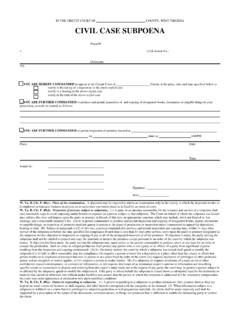
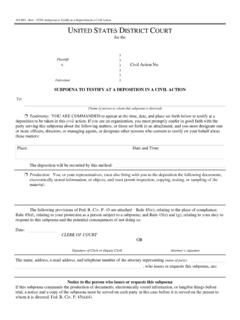
1 SAMPLE LETTER IN RESPONSE TO A SUBPOENA (WHEN PATIENT IS NOT BEING INVESTIGATED OR PROSECUTED FOR CRIME) 1 2018 Legal Action Center This document is informational and does not constitute legal advice. Dear : We have received your SUBPOENA requesting [any records]/[testimony from program personnel] concerning [name of patient]. Federal confidentiality law and regulations (see 42 290dd-2, 42 Part 2) prohibit this program and its personnel from complying with your request or even acknowledging whether or not this individual is or ever was a patient in our program unless he/she executes a proper consent form or the court issues an order authorizing disclosure in accordance with Subpart E of the federal confidentiality regulations.
2 42 The federal confidentiality law and regulations permit the release of information about current or former patients with written patient consent in a particular form specified in the regulations. See 24 A general medical release is not sufficient. The federal law and regulations prohibit a program from disclosing information in RESPONSE to a SUBPOENA (even a judicial SUBPOENA ) unless the SUBPOENA is accompanied by a proper consent or a court issues an order in compliance with the procedures and standards set forth in Subpart E of the regulations, Sections Subpart E of the regulations provides that before the court may issue an order authorizing a program to release patient information, both the alleged patient (or his/her representative)
3 And the program must be notified that a hearing will be held to decide whether an authorizing court order will be issued, and both the patient and the program must be given an opportunity to appear in person or file a responsive statement. 42 (b). In order to issue an authorizing order the court must find, at or after the required hearing, that good cause exists to issue the order. 42 (d). To make this good cause determination the court must find that: 1. Other ways of obtaining the information are not available or would not be effective; and2. The public interest and need for the disclosure outweigh the potential injury to thepatient, the physician-patient relationship and the treatment services.
4 42 (d).The federal regulations also limit the kind and amount of records/information that a court may order a program to release. Section (e) provides that an order must limit disclosure to those parts of the patient s record which are essential to fulfill the objective of the order and that only those persons having a need for the information may receive patient records. Section provides that a court may not order any disclosure of confidential communications made by a 2 2018 Legal Action Center This document is informational and does not constitute legal advice. patient to program staff unless one of these three additional conditions is met: (1) the disclosure is necessary to protect against an existing threat to life or of serious bodily injury, (2) the disclosure is necessary in connection with the investigation or prosecution of a very serious crime, such as homicide or rape, or (3) the patient has already offered evidence about confidential communications.
5 Thus, for the court to issue a court order permitting program personnel to release records/information containing confidential communications by a patient or to testify about any communications made by a patient, it would first have to find that: 1. There is no other way to obtain the necessary information, or other ways would be ineffective; 2. The public interest and need for the disclosure are not outweighed by the potential injury to the patient, the physician-patient relationship, and the treatment services; and 3. One of the three specific conditions of Section has been met to justify disclosure of confidential communications.
6 Since this program has not yet received a proper written consent form from the individual about whom [records/testimony] [is/are] sought, or an authorizing court order that was obtained under 42 Part 2, Subpart E, we are compelled by federal law not to release any information. This decision was reached after a thorough review of the federal law and regulations governing the confidentiality of substance use disorder patient records, and is not intended in any way to impede justice. Sincerely, [Name and title] [Program]