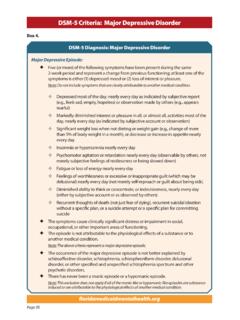
Transcription of Sample Psychiatry Questions & Critiques
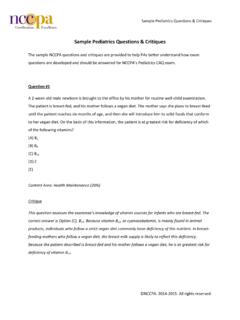
1 Sample Psychiatry Questions & Critiques NCCPA. 2011-2015. All rights reserved. Sample Psychiatry Questions & Critiques The Sample NCCPA items and item Critiques are provided to help PAs better understand how exam Questions are developed and should be answered for NCCPA s Psychiatry CAQ exam. Question #1 A 50-year-old woman who has been treated with sertraline for major depressive disorder for more than two years comes to the office because she has had weakness, cold intolerance, constipation, and weight gain during the past six months. Physical examination shows dry, coarse skin as well as bradycardia, hypothermia, and swelling of the hands and feet.
2 Which of the following laboratory studies is the most appropriate to determine the diagnosis? (A) Liver function testing (B) Measurement of serum electrolyte levels (C) Measurement of serum estrogen level (D) Measurement of serum sertraline level (E) Measurement of serum thyroid-stimulating hormone level Content Area: depressive disorders /Bipolar and Related disorders (Mood disorders ) (16%) Area of Interest: Evaluation and diagnosis Critique This question tests the examinee s ability to determine the laboratory study that is most likely to specify the diagnosis. The correct answer is Option (E), measurement of serum thyroid-stimulating hormone level.
3 Hypothyroidism is suspected on the basis of the patient s symptoms of depression, weakness, constipation, and weight gain as well as the physical findings of bradycardia, hypothermia, swelling of the hands and feet, and dry, coarse skin. Measurement of serum thyroid-stimulating hormone level is the study that will either confirm or refute this suspected diagnosis. Sample Psychiatry Questions & Critiques NCCPA. 2011-2015. All rights reserved. Option (A), liver function testing, is a plausible choice based on the patient s signs and symptoms of weakness, weight gain, and swelling of the hands and feet. However, liver function testing does not address the remaining findings in the patient and, therefore, is incorrect.
4 Option (B), measurement of serum electrolyte levels, is incorrect because although it is included in general diagnostic testing, this study would not specify a diagnosis considering the patient s symptoms. Option (C), measurement of serum estrogen level, is a plausible choice considering the patient s age and the signs and symptoms of dry skin and depression, but it does not address the remaining findings. Option (D), measurement of serum sertraline level, is plausible because adverse effects can include dryness of the mouth, cardiac abnormalities, and lack of energy. However, measurement of serum sertraline level does not address the remaining findings in this patient and is, therefore, incorrect.
5 Question #2 A 35-year-old man with bipolar disorder, most recent episode mixed, comes to the clinic for routine follow-up examination. His condition has been difficult to control and has required treatment with multiple medications during the past two years. The patient says his mood has been stable with his current regimen, but for the past three months, he has had tremor primarily affecting his hands. Which of the following medications is the most likely cause of this patient's tremor? (A) Carbamazepine (B) Gabapentin (C) Lamotrigine (D) Lithium carbonate (E) Topiramate Content Area: depressive disorders /Bipolar and Related disorders (Mood disorders ) (16%) Area of Interest: Psychopharmacology Sample Psychiatry Questions & Critiques NCCPA.
6 2011-2015. All rights reserved. Critique This question tests the examinee s ability to recognize the indications for and adverse effects of psychopharmacologic agents. The correct answer is Option (D), lithium carbonate. Lithium carbonate is approved by the Food and Drug Administration for management of bipolar I disorder and is the most commonly used pharmacologic therapy for that condition. Tremor, as noted in the patient s history, is a common adverse effect of lithium carbonate. Such tremor is seen in the fingers of the outstretched hands, usually at a frequency of 8 to 10 Hz, and is sometimes related to peak serum lithium levels.
7 Dividing the dose of lithium carbonate and decreasing caffeine intake can decrease the tremor. In the case of a severe coarse tremor, lithium carbonate toxicity (serum lithium level greater than mEq/L) must be ruled out. Option (A), carbamazepine, Option (C), lamotrigine, and Option (E), topiramate, are incorrect because even though they are used off-label for management of bipolar disorder, tremor is not caused by these medications. Option (B), gabapentin, is incorrect because even though tremor may occur as an adverse effect of this medication, it is not prescribed for management of bipolar disorder. Question #3 A 19-year-old woman who is a college student is brought to the clinic by her roommate because she has been acting strangely during the past six months.
8 During the past month, the patient has been describing how another person's thoughts have been entering into her mind. The patient's grades have been slipping, and she does not talk as much as she did previously. The roommate says that when the patient does talk, she strays from the topic and is hard to follow. During the interview, the patient says a television reporter told her that the government had a special message for her and she should listen to the radio for further instructions. Which of the following conditions is the most likely cause of this patient's symptoms? (A) Acute stress disorder (B) Delusional disorder (C) Schizoaffective disorder (D) Schizophrenia (E) Schizophreniform disorder Sample Psychiatry Questions & Critiques NCCPA.
9 2011-2015. All rights reserved. Content Area: Schizophrenia Spectrum and Other Psychotic disorders /Other Mental disorders (Schizophrenia and Other Psychotic disorders ) (14%) Area of Interest: Evaluation and diagnosis Critique This question tests the examinee s ability to discriminate between characteristics of behavior disorders . The correct answer is Option (D), schizophrenia. The patient has had classic symptoms of schizophrenia for at least six months, including hallucinations (voices speaking to her), social dysfunction affecting grades and friendships, and disorganized speech. Although the patient is somewhat young for schizophrenia (peak incidence in women is between 25 and 35 years), her symptoms meet the DSM criteria for the condition.
10 Option (A), acute stress disorder, is incorrect because there is no evidence that the patient has endured or witnessed a traumatic event or expressed intense fear, helplessness, or horror in response to such an event. Option (B), delusional disorder, is incorrect because the patient s delusions are bizarre in nature (for example, a television reporter telling her to listen to the radio for a message and instructions from the government). However, in patients with delusional disorder, delusions are typically plausible, such as the belief that one is being followed. Option (C), schizoaffective disorder, is plausible but can be ruled out based on the fact that there is no evidence of concurrent manic or depressive symptoms during the schizophrenic episode described.