Transcription of Sampling Instructions Drinking Water Samples
1 Environmental Conservation Laboratories, Inc. 10775 Central Port Drive 4810 Executive Park Ct #111 102A Woodwinds Indust. Ct. Orlando, FL 32824 Jacksonville FL 32216 Cary, NC 27511 Environmental Conservation Laboratories, Inc. 10775 Central Port Drive 4810 Executive Park Ct #111 102 Woodwinds Orlando, FL 32824 Jacksonville FL 32216 Cary, NC 27511 Shipping Instructions : Pack all bottles into the provided cooler. Place glass sample bottles into the provided bubble bags for protection. Add a sufficient amount of wet ice (if temperature preservation is required) to keep Samples cold for 24 hours and to prevent sample movement & breakage in transit.
2 Seal the completed COC in the provided Water -proof baggie to keep it dry. Seal the cooler with packing tape and ship or hand-deliver to the lab. Laboratory Certifications: Orlando: FL DOH/NELAC # E83182 Cary: NCDHS # 37724, NC DWQ # 591, FL DOH/ NELAC # E87610, VA # 00117 Rev. 020309 Sampling Instructions Preparing to Sample o Reference the provided Chain-of-Custody or Bottle Summary for a list of bottles provided. o Unpack the bottles to prepare for Sampling . If you have more than one Sampling point, the bottles needed for each discrete Sampling point are segregated into individual bags.
3 Do not mix bottles between Samples . o If shipping back to the lab, plan to collect Samples in the late afternoon just prior to the pick-up time for your overnight carrier. This will allow the laboratory to complete all tests within specified holding times. All Samples should be submitted to the lab within 24 hours after collection. o Check with the laboratory in advance if you plan to submit Samples on a Saturday. Filling the Sample Bottles o If you are Sampling from a faucet with an aerator, leave the aerator on to collect Lead and Copper Samples . However, the aerator must be removed prior to sample collection for all other tests. o Lead/Copper Samples must be first draw.
4 Do not flush the Sampling line prior to collecting Lead/Copper Samples . Collect 1 liter of sample after Water has sat idle in the pipes for a minimum of 6 hours. o For Sampling other than Lead/Copper, flush the coldwater Sampling line for a minimum of 10 minutes after removing the aerator. Slow the stream prior to Sampling . o Do NOT open the bottles until you are ready to fill them. Avoid debris/dust touching in the cap or bottle. o Record the Sampling date, time, site, and name of sampler on both the bottle labels and the enclosed Chain of Custody. Provide your PWSID # and State reporting requirements for compliance Samples . o Follow any required test-specific Sampling Instructions , as follows: Analyses that require Preservation in the field (Methods , & Cyanide): VOCs : Fill vials to the bottom of the bottle neck, add 2 drops 1:1 HCl, add more sample to fill vial.
5 SOCs : Fill 1L Ambers with sample to within inch of top, add entire contents of provided 1:1 HCl vial. Cyanide: Fill 250 mL bottle with sample to within inch of top, add entire contents of provided 1:1 NaOH vial. Analyses requiring Zero-Headspace Sampling (Methods , , & 505) Zero headspace is defined as having no air bubbles > 5 mm in the vials after filling and sealing. Fill the vials slowly with sample to the bottom of the container neck. Add any preservative specified for the method. Slowly fill the remainder of the vial with sample so that NO AIR remains when capped. After tightening the cap, the vials should be inverted and tapped to check for air bubbles. If bubbles are present, do not empty the vial. Remove the cap and add several additional drops of sample to the bottle and cap and reseal.
6 Microbiology Sample Containers: Fill the container to the fill line so that the appropriate amount of air space remains at the top of the bottle. All Other Sample Bottles: Fill all other provided Sampling containers to the top of bottle without overflowing or flushing out any preservative that may be present. Drinking Water Samples GENERAL Instructions & SAMPLE ACCEPTANCE POLICY All Samples received at ENCO are evaluated for the below criteria. You will be notified if any sample is received in damaged condition or cannot be properly processed due to issues including incorrect preservation, insufficient volume, or lack of remaining holding time. In this event, ENCO will request that a sample be resubmitted for analysis.
7 All Samples are accepted by the lab under ENCO standard terms and conditions. The following information must be recorded on the Chain of Custody (COC): Client name, address, phone number and fax number or email address. Analyses requested & the total number of containers for each sample ID and test. Public Water System ID # (if applicable). Project name & number and/or number. Indicate whether the lab data is intended for State compliance purposes. Date, time and location of Sampling & collector s name and signature. Date, time & signature for each person receiving/relinquishing sample custody. General Sampling considerations: The presence or absence of residual chlorine must be verified and documented for each sample in the field prior to sample collection for organics methodology (500 series).
8 For Chlorinated Samples - dechlorination and subsequent confirmation of field pH adjustment is required for Methods , , and Cyanide. Additional empty sample containers may be provided to meet Lab Quality Control requirements - fill them and return with Samples to the lab. If filled & sealed vials are received with your sample bottles labeled Trip Blanks do not open trip blanks. The Trip blanks are to accompany the Samples back to the lab. Caution: Bottles and vials may contain chemical preservatives. Always wear gloves and eye protection when handling acid preservative or pre-preserved bottles and avoid skin contact. Do not rinse vials or bottles prior to filling with sample. Do not fill bottles to the point they are overflowing to prevent flushing out the preservative.
9 Recap the sample bottles & preservative containers tightly after they are used or filled. Recap and return any used and unused preservatives and bottles to the lab for proper processing and/or disposal. If you have any questions regarding your bottle kit or the Sampling procedure call the laboratory and ask to speak to a Project Manager. Environmental Conservation Laboratories, Inc. 10775 Central Port Drive 4810 Executive Park Ct #111 102A Woodwinds Indust. Ct. Orlando, FL 32824 Jacksonville FL 32216 Cary, NC 27511 Environmental Conservation Laboratories, Inc. 10775 Central Port Drive 4810 Executive Park Ct #111 102 Woodwinds Orlando, FL 32824 Jacksonville FL 32216 Cary, NC 27511 Shipping Instructions : Pack all bottles into the provided cooler.
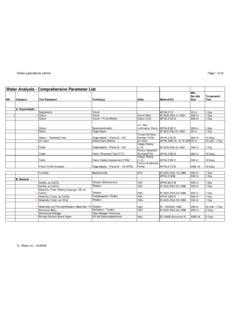
10 Place glass sample bottles into the provided bubble bags for protection. Add a sufficient amount of wet ice (if temperature preservation is required) to keep Samples cold for 24 hours and to prevent sample movement & breakage in transit. Seal the completed COC in the provided Water -proof baggie to keep it dry. Seal the cooler with packing tape and ship or hand-deliver to the lab. Laboratory Certifications: Orlando: FL DOH/NELAC # E83182 Cary: NCDHS # 37724, NC DWQ # 591, FL DOH/ NELAC # E87610, VA # 00117 Rev. 020309 PARAMETER METHOD CONTAINER (2) PRESERVATIVE STORAGE(3) HOLD TIME General Chemistry Alkalinity, Total SM18 2320B 250-ml P - 4 deg C 14 d Asbestos EPA 2 x 1-L P - 4 deg C 48 hr Bromide EPA / EPA 250-ml P - - 28 d Bromate EPA 250-ml P For chlorinated Samples - (10uL) of ethylene diamine (EDA) + 1mL reagent Water (1) 4 deg C 28 d Chlorate EPA 250-ml P For chlorinated Samples - (10uL) of ethylene diamine (EDA) + 1mL reagent Water (1) 4 deg C 28 d Chloride EPA / EPA 250-ml P - - 28 d Chlorite EPA 250-ml Opaque P EDA + 1mL reagent Water (1) 4 deg C 14 d Color SM18 2120B / 250-ml P - 4 deg C 48 hr Conductivity (Specific Conductance)