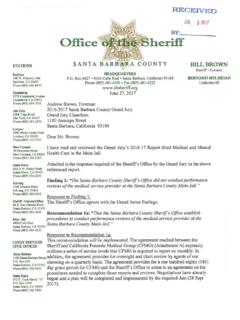
Transcription of SANTA BARBARA COUNTY JAIL Intake Screening Process …
1 SANTA BARBARA COUNTY jail . Intake Screening Process summary . The 2015-2016 SANTA BARBARA COUNTY Grand Jury (Jury), reviewed the inmate Intake procedures of the SANTA BARBARA COUNTY jail ( jail ) to ensure the facility is operating within the scope of California Code of Regulations Title 15 (Title 15) and the SANTA BARBARA Sheriff's Office (SBSO) Custody Operations Policy and Procedures Manual. This report outlines the operations, procedures, and observations made of the Intake Process , as well as findings, discrepancies, and recommendations made by the Jury. The Jury found the Intake Screening Process of the SBSO and Corizon Health (Corizon) was inconsistent in following established protocols, policies, and procedures. The medical Intake Process is cumbersome as the inmate medical records are not computerized. SBSO staff does not provide adequate oversight of Corizon contracted medical staff. In at least one instance, Corizon employees failed to follow established medical Intake protocols.
2 According to SBSO staff, they are aware of these problems with the Intake Screening Process and are already taking steps to reorganize the Intake Process to correct the problems identified. New protocols, policies, and procedures are being discussed by Corizon and the SBSO. In addition, a new Health Services Administrator and a Grievance Coordinator have been hired to ensure that any protocol deviations are addressed. As of the completion of this report, these changes are still in the implementation Process . BACKGROUND. The SANTA BARBARA COUNTY jail ( jail ) is a Type II detention facility, as described by the California Code of Regulations, Title 15 (Title 15), used for the custody of persons pending arraignment, during trial and upon sentencing. The jail is operated by the SANTA BARBARA Sheriff's Office (SBSO). It has been described as a revolving door with many of the same people being arrested, jailed, and released only to be arrested again.
3 Arrestees are transported to the jail daily from throughout the COUNTY . The SANTA BARBARA COUNTY Grand Jury (Jury) learned that approximately 75 percent of the jail inmates are categorized as pretrial inmates. Some may stay less than one day or until their court arraignment proceeding and are then released. It is not uncommon for about 60 percent of the inmate population to leave within two to four weeks. There are at least 40 to 60 arrestees a day who must go through the Intake procedure. Whether it's a short stay or a long stay, all arrestees entering the jail must go through an Intake Process which includes a medical evaluation. Agreement with Corizon Health Since July 1, 2013, SBSO has had a Correctional Medical Agreement with Corizon Health (Corizon), a 2015-16 SANTA BARBARA COUNTY Grand Jury 1. national for-profit correctional health care company based in Tennessee. This two year contract with the SBSO was scheduled to expire on June 30, 2015.
4 However, the Board of Supervisors (BOS) extended the contract to March 31, 2017. The SBSO contract with Corizon is intended to ensure arrestees entering the jail receive adequate medical evaluations and that inmates are provided appropriate medical care. Corizon staff are required to work within the contracted budget and operational constraints of the jail . The Jury recognizes this can be a challenging task because many arrestees enter the jail in poor health with preexisting medical conditions. According to SBSO staff, approximately 75 percent of inmates in the jail have substance abuse issues. The Jury was told that most of the arrestees entering the jail have one or more medical problems. It costs approximately $60,000 a year to house an inmate in the The recidivism rate is approximately 70 percent which means that seven out of ten inmates will re-offend and end up back in the jail and will have to go through the Intake Screening Process again.
5 METHODOLOGY. Members of the Jury toured the jail and observed the Intake operation of the jail , during regular work hours, and reviewed a video of an Intake Process . The Jury reviewed the SBSO Custody Operations Policy and Procedures Manual (Manual), staff memorandums, and reports. The Jury also examined Intake assessment forms. In addition, the Jury also interviewed SBSO custody officers and Corizon staff. OBSERVATIONS AND ANALYSIS. The jail provides the following core set of prisoner Intake functions: Identifying the prisoner Developing the prisoner's record Conducting medical and mental health assessments. Determining the prisoner's threat to public safety and his/her security requirements Identifying sex offenders, sexual predators, and vulnerable inmates Scheduling transfers to the long-term facility Identifying and validating security threat group membership The Intake Process at the jail operates 24 hours a day with approximately 40 to 60 arrestees arriving at the jail daily.
6 Many are under the influence of drugs or alcohol, have physical injuries, or are mentally ill. These factors make the Intake Process challenging for the SBSO and Corizon staff. According to SBSO staff, the jail is understaffed, under-funded and not well designed to carry out all of their required responsibilities. Individuals who need significant medical attention at the time of Intake are generally not accepted in the jail . Instead they are taken to the local hospital for medical evaluation and stabilization. The Intake Screening would then be performed at the jail when the inmate returns from the hospital. Once an inmate is admitted to the jail the COUNTY of SANTA BARBARA is responsible for the cost of any outside medical care. 1. jail Staffing and Operating Cost Analysis, SANTA BARBARA COUNTY , Final Report CGL Companies, October 2015. 2015-16 SANTA BARBARA COUNTY Grand Jury 2. The Health Services Administrator (HSA), a Corizon employee, is a Registered Nurse (RN) and is responsible for the day-to-day operations of the medical programs at the jail .
7 The HSA has the authority to oversee the administrative requirements of the programs, as well as recruitment, staffing, data gathering, financial monitoring, and enforcing policies and procedures. Processing Procedures The inmate Intake procedure is a twofold Process that includes a medical evaluation and a classification procedure that requires the cooperation of both SBSO staff and Corizon staff. The first step starts with a SBSO SANTA BARBARA Sheriff Medical Pre- Screening questionnaire, (see Appendix A) used to determine if there are current health issues that require prompt attention. In the past, this prescreening was performed by custody officers. According to the contract, SBSO staff receives up to 24 hours of training on medical issues annually by Corizon. However, this training is not adequate for SBSO staff to make many medical decisions. Therefore, deputies are no longer doing the medical Intake prescreening on new bookings. The Jury learned that as of April 11, 2016, Corizon RNs are now performing the entire medical Intake assessments.
8 This is intended to ensure that medical needs are being met at Intake . The medical prescreening questionnaire is an assessment tool used to determine if the inmate is ambulatory, alert, sick, suicidal, intoxicated, on medication, or has a history of drug or alcohol abuse. The name of the arrestee is entered into the jail Management System (JMS), an inmate management software package, to determine if the arrestee has a previous record. If so, and if the arrestee has a significant medical condition such as heart problems, diabetes, drug/substance abuse history or psychological issues that were identified and recorded, the JMS would red flag the inmate information for ease of future retrieval. During the pre- Screening , the detainee is asked about medication or street drugs recently used. Depending on the types of medications the detainee claims to be using, the nurse attempts to verify the prescribed medication by calling the detainee's doctor, clinic, or pharmacy.
9 After conducting the medical prescreening using the SBSO questionnaire, the Corizon RN also evaluates whether the arrestee has significant medical issues that need to be addressed. This second medical evaluation uses Corizon's Intake and Receiving Screening form CS1101 (see Appendix B). Based on this evaluation the RN refers any arrestee with an urgent medical need to the Corizon contracted medical doctor (MD) for a follow up appointment. The Medical Process Overview, Medical Referral Sources, flow chart provided by SBSO staff (see Appendix C), does not reflect the new medical Intake procedure and needs to be revised. An arrestee who discloses a history of drug or alcohol abuse is assessed with the Clinical Opiate Withdrawal Scales (COWS) (see Appendix D.) According to Corizon staff, if an arrestee is identified as having a history of substance abuse, there is a protocol to ensure they are monitored closely. For example, if it is determined that the arrestee is a habitual intravenous drug user, according to the Corizon staff the inmate is to be placed in observation and medication ordered to help reduce withdrawal symptoms.
10 These procedures are not outlined in the Receiving Screening Process (see Appendix E). These protocols are only referenced in the Manual Section of Sobering/Observation Cell. The Jury observed, that although SBSO and Corizon are supposed to work together, this cooperative collaboration has not always existed. SBSO staff has not always followed established oversight procedures to ensure Corizon staff are operating in accordance with their contract. Fundamental responsibilities may not be completed during a work shift. With proper monitoring, problems can be alleviated. SBSO staff does not have checklists or guidelines to reduce the risk of incomplete evaluation 2015-16 SANTA BARBARA COUNTY Grand Jury 3. by Corizon staff. The Jury recommends that the Sheriff Office update Appendices C and E. Additionally, two signature blocks, one for medical clearance staff the other for the custody officer prior to classification should be added to the forms in Appendices A and B.