Transcription of SAT Subject Physics Facts & Formulas Math Stuff
1 SAT Subject Physics Facts & Formulas This document is a concise but comprehensive guide to the Facts and Formulas typically used in the material covered by the SAT Subject Physics test. The test is designed to determine how well you have mastered the Physics concepts taught in a typical one-year college-prep high school course. This guide is mainly intended as a reference, as opposed to a full tutorial (which would probably be book-length), and so the explanatory material is pretty brief. You can use the guide as a simple formula reference, or as a quick review of the material that you've already studied elsewhere. Either way, good luck on your Subject Test!
2 Math Stuff Although this guide is for the SAT Subject test in Physics , you'll need to know quite a bit of math. If you're thinking that you'll just use your calculator to do the math, don't forget that calculators are not allowed on the SAT Subject Physics test. Here is a summary of the really important math Facts and Formulas . Exponents xa xb = xa+b xa /xb = xa b 1/xb = x b . (xa )b = xa b (xy)a = xa y a n +1, if n is even;. ( 1) =. 0. x =1 xy = x y 1, if n is odd. Scientific Notation Scientific notation is a short-hand form to write numbers which would have a lot of zeros when written as decimals. For example, instead of writing 1230000, you can just write 1000000, or 106.
3 The familiar powers of ten include: 10 3 = , 10 2 = , 10 1 = , 100 = 1, 101 = 10, 102 = 100, 103 = 1000. To go from scientific notation to a plain decimal number, move the decimal to the right or left according to the sign of the exponent, putting a zero down when you have no other digits there. For example, for 1012 , move the decimal right 12 places and add 11. zeros. Move the decimal to the left for a negative exponent. 11 zeros z }| {. 37 00000000000 . = 1012. 11. | {z } 23 = 10.. 0000000000. 10 zeros To go from a plain decimal number to scientific notation, just move the decimal to the right or left (counting how many places you move) until there is only one digit to the left of the decimal point, then add 10n where n is the number of places you moved the decimal point (positive if you went left and negative if you went right).
4 Pg. 1. SAT Subject Physics Facts & Formulas Basic Metric Prefixes Common powers of ten (both positive and negative) have names that come before the metric unit of measurement, , they are prefixes. The most typically used ones are given below. Prefix Symbol Power of Ten Common Example nano n 10 9 nanometer micro 10 6 microsecond milli m 10 3 milligram centi c 10 2 centimeter kilo k 103 kilogram mega M 106 megawatt Basic Trigonometry e us opposite en c p ot b hy . a adjacent In the first triangle above, a2 + b2 = c2 (pythagorean theorem). Referring to the second triangle, there are three important functions which are defined for angles in a right triangle: opposite adjacent opposite sin = cos = tan =.
5 Hypotenuse hypotenuse adjacent SOH CAH TOA . (the last line above shows a mnemonic to remember these functions: SOH-CAH-TOA ). An important relationship to remember which works for any angle is: sin2 + cos2 = 1. Vectors Many important quantities in Physics are represented by vectors, which specify both a number (the length of the vector) along with a direction (where the vector points). In contrast, scalars are simple numbers without a direction. pg. 2. SAT Subject Physics Facts & Formulas For example, velocity is a vector (represented by a boldface v) and is given by a number (say, 50 m/sec) along with a direction (say, 30 north of east).
6 Mass (m) is just a number (say, 80 kg), for which a direction doesn't make any sense, so it is a scalar. We can define components of a vector as the projection (or shadow ) of the vector on the x and y axes, as in the figure below. y vy v . vx x Using basic trigonometry, vx = v cos (the x-component of v). vy = v sin (the y-component of v). Note from the figure that v (which is sometimes denoted explicitly by |v|, which means the length of the vector v) is given by v 2 = vx2 + vy2 , using the pythagorean theorem. In the example above, v = 50 m/sec and = 30 , so that vx = 43 m/sec and vy = 25 m/sec. In this case, the x-component of v is greater than the y-component of v since the direction of v is closer to the x-axis (east) than it is to the y-axis (north).
7 The easiest way to add two vectors is to add their x components to get a total x component, and separately do the same thing for the y components. Then, a new total vector can 2 2 2. be made with the two total x and y components, using vtot = vx,tot + vy,tot and =. 1. tan (vy,tot /vx,tot ). Graphically, this is the same as the tip-to-tail method, as in the figure below. y B (shifted). B B. A+. A. x Ax Bx Here, vectors A and B are added by moving B so that its tail is at the tip of A, and then drawing the vector from the origin to the new tip of B. It should be clear from the figure that the x components of A and (the shifted) B add up to the x component of the new vector, and similarly for the y components.
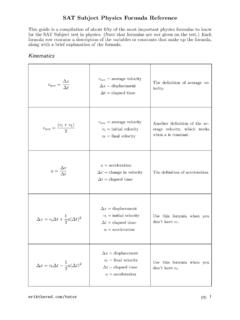
8 Pg. 3. SAT Subject Physics Facts & Formulas Kinematics The following Formulas for position x, velocity v, and acceleration a are valid when the acceleration of the object is constant. The initial value of a variable, such as position for example, is given by xi , and the final value is given by xf . The change in the variable, such as velocity for example, is given by v = vf vi . There are five main equations for kinematics which are all valid, but the one or two that you use will depend on the variable that you need and the information that you have. When you don't have Equation to Use 1. a x = vave t = (vi + vf ) t 2. x v = a t 1.
9 Vf x = vi t + a( t)2. 2. 1. vi x = vf t a( t)2. 2. t vf2 = vi2 + 2a x A note about graphs: the slope of a position vs. time graph is the velocity. Also, the slope of the velocity vs. time graph is the acceleration. Dynamics Dynamics is the application of Newton's Laws to determine how a mass m moves when a force (or forces) is applied. Newton's First Law is: an object which moves at a constant velocity will continue moving at the same velocity unless it is acted upon by an non-zero force. The force could be a single force, or several forces which are unbalanced (don't add to zero). Note that an object at rest has a constant velocity of zero, so it will remain at rest unless acted upon by such a force.
10 Newton's Second Law is: the force on a mass equals the mass multiplied by the acceleration. As a formula : F = ma where F is the force vector, m is the mass, and a is the acceleration vector. It is important to remember that the force in F = ma is the sum of all the forces (often called the net force ) acting on the mass, not just one particular force. The net force acting on a book pg. 4. SAT Subject Physics Facts & Formulas resting on a table is zero: the weight of the book and the force of the table pushing up on the book add to zero. Note that the weight of an object (which is a force) due to gravity is: W = mg where W is the weight, m is the mass, and g is the acceleration due to gravity (g is approximately 10 m/s2 at or near the surface of the earth).