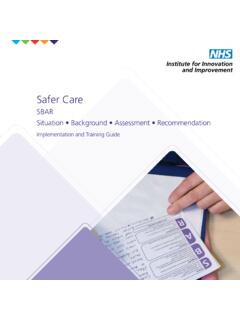
Transcription of SBAR communication tool – situation, background ...
1 SBAR communicationtool Online library of Quality,Service Improvementand Redesign toolssituation, background , assessment , recommendationNHS England and NHS ImprovementSBAR communication tool situation , background , assessment , recommendationQuality, Service Improvement and Redesign Tools: SBAR communication tool situation , background , assessment , recommendationWhat is it?SBAR is an easy to use, structured form of communication that enables information to betransferred accurately between individuals. SBAR was originally developed by the UnitedStates military for communication on nuclear submarines, but has been successfully usedin many different healthcare settings, particularly relating to improving patient consists of standardised prompt questions in four sections to ensure that staff aresharing concise and focused information.
2 It allows staff to communicate assertively andeffectively, reducing the need for repetition and the likelihood for errors. As the structureis shared, it also helps staff anticipate the information needed by colleagues andencourages assessment skills. Using SBAR prompts staff to formulate information with theright level of to use itCommunication can be defined as a two-way process of reaching mutual understanding,in which participants not only exchange information but also create and share meaning .SBAR helps to provide a structure for an interaction that helps both the giver of theinformation and the receiver of it.
3 It helps the giver by ensuring they have formulatedtheir thinking before trying to communicate it to someone else. The receiver knows whatto expect and it helps to ensure the giver of information is not interrupted by the receiverwith questions that will be answered later on in the can be used in any setting but can be particularly effective in reducing the barrier toeffective communication across different disciplines and between different levels of staff use the tool in a clinical setting, they make a recommendation that ensuresthe reason for the communication is clear. This is particularly important in situationswhere staff may be uncomfortable about making a recommendation, eg those who areinexperienced or who need to communicate with someone who is more senior than use of SBAR provides clarity to communication and prevents the unreliable process of hinting and hoping that the other person 1: SBAR communication toolQuality, Service Improvement and Redesign Tools: SBAR communication tool situation , background , assessment , recommendationSituation.
4 I am (name), (X) nurse on ward (X)I am calling about (patient X)I am calling because I am concerned ( BP is low/high, pulse is XX, temperature is XX, Early Warning Score is XX) background :Patient (X) was admitted on (XX date) ( MI/chest infection)They have had (X operation/procedure/investigation)Patien t (X) s condition has changed in the last (XX mins)Their last set of obs were (XX)Patient (X) s normal condition ( alert/drowsy/confused, pain free) assessment :I think the problem is (XXX)And I ( given O2/analgesia, stopped the infusion)ORI am not sure what the problem is but patient (X) is deterioratingORI don t know what s wrong but I am really worriedRecommendation:I need you to see the patient in the next (XX mins)ANDIs there anything I need to do in the mean time?
5 ( stop the fluid/repeat the obs)Ask receiver to repeat key information to ensure understandingThe SBAR tool originated from the US Navy and was adapted for use in healthcare byDr M Leonard and colleagues from Kaiser Permanente, Colorado, USASBARQ uality, Service Improvement and Redesign Tools: SBAR communication tool situation , background , assessment , recommendationHow to use itS situation Identify yourself the site/unit you are calling from. Identify the patient by name and the reason for your communication . Describe your following example shows how to explain the specific situation about which you arecalling, including the patient s name, consultant, patient location, code status, and vitalsigns.
6 This is Jenny, a registered nurse on Nightingale Ward. The reason I mcalling is because Mrs Taylor in room 225 has become suddenly short ofbreath, her oxygen saturation has dropped to 88% on room air, herrespiration rate is 24 per minute, her heart rate is 110 and her bloodpressure is 85 have placed her on six litres of oxygen and her saturation is 93%, herwork of breathing is increased, she is anxious, her breath sounds are clearthroughout and her respiratory rate remains greater than 20. B background Give the patient s reason for admission Explain significant medical history Inform the receiver of the information of the patient s background : admitting diagnosis, date of admission, prior procedures, current medications, allergies, pertinent laboratory results and other relevant diagnostic results.
7 For this part in the process you need to have collected information from the patient s chart and notes. For example: Mrs. Smith is a 69 year old woman who was admitted 10 days ago followinga car accident with a T 5 burst fracture and a T 6 ASIA B SCI. She had T 3-T 7instrumentation and fusion nine days ago. Her only complication was a righthaemothorax for which a chest drain was put in place. The drain wasremoved five days ago and her chest x-ray has shown significantimprovement. She has been mobilising with physio and has been progressingwell. Her haemoglobin is 100 gm/L but otherwise her blood work is withinnormal limits.
8 She has been on Enoxaparin for DVT prophylaxis andOxycodone for pain management. Quality, Service Improvement and Redesign Tools: SBAR communication tool situation , background , assessment , recommendationA assessment Vital signs. Contraction pattern. Clinical impressions, need to think critically when informing the receiver of your assessment of thesituation. This means you have considered what might be the underlying reason for yourpatient s condition. Not only have you reviewed your findings from your assessment butyou have also consolidated these with other objective indicators, such as you do not have an assessment , you may say: I think she may have had a pulmonary embolus.
9 I m not sure what the problem is, but I am worried. R recommendationFinally, what is your recommendation? That is, what would you like to happen by theend of the conversation. Any advice that is given on the phone needs to be repeatedback to ensure accuracy. Explain what you need be specific about request and time frame. Make suggestions. Clarify example: Would you like me get a stat CXR and ABGs? Start an IV? Should I begin organising a spiral CT? When are you going to be able to get here? Although SBAR is a simple and effective tool, incorporating it can take considerableeffort and require significant training.
10 It can be very difficult to change the way peoplecommunicate, particularly with more senior can be used anywhere, including: inpatient or outpatient urgent or non urgent communications conversations between clinicians, either in person or over the phone - particularly useful in nurse to doctor communications and also helpful in doctor to doctor communication conversations with peers change of shift report communication between different disciplines, eg care home to emergency department escalating a concern when patients move between NHS services or from social care to NHS services, eg care homes and into/out of , Service Improvement and Redesign Tools.