Transcription of SCA COMPLIANCE PRINCIPLES - DOL
1 DEPARTMENT OF LABOR SCA COMPLIANCE PREVAILING WAGE RESOURCE BOOK PRINCIPLES SCA COMPLIANCE PRINCIPLES DEPARTMENT OF LABOR SCA COMPLIANCE PREVAILING WAGE RESOURCE BOOK PRINCIPLES INTRODUCTION DISCHARGING WAGE AND FRINGE BENEFIT OBLIGATIONS EMPLOYEE NOTIFICATION AND POSTER TIMELY PAYMENT OF WAGES AND FRINGE BENEFITS HOURS WORKED BONA FIDE FRINGE BENEFITS FRINGE BENEFIT REQUIREMENTS HEALTH AND WELFARE BENEFITS FRINGE BENEFIT REQUIREMENTS VACATION BENEFITS FRINGE BENEFIT REQUIREMENTS HOLIDAY BENEFITS EQUIVALENT BENEFITS TEMPORARY AND PART-TIME EMPLOYMENT PAYMENT OF OVERTIME UNDER FLSA/CWHSSA RECORDKEEPING 1 DEPARTMENT OF LABOR SCA COMPLIANCE PREVAILING WAGE RESOURCE BOOK PRINCIPLES INTRODUCTION Service Contract Act (SCA) wage determinations set forth the prevailing wages and benefits that are to be paid to service employees working on covered contracts exceeding $2,500.
2 Wages Wages are the monetary compensation provided employees. The minimum monetary wages required under the SCA are usually listed in wage determinations applied to covered contracts exceeding $2,500, as hourly wage rates for the various classes of service employees. 29 Where no SCA wage determination applies to a covered service contract, such as those valued at $2,500 or less, the SCA requires payment of not less than the minimum wage under section 6(a)(1) of the FLSA to service employees engaged in contract work. 29 If an employee works in different capacities in the performance of a covered contract, then the time the employee spends in work in each classification should be segregated and paid according to the wage rate specified for each class of work. If the contractor cannot provide affirmative proof (employer records) of the hours spent in each class of work, then the contractor must pay the employee the highest of such rates in the applicable wage determination for all hours worked in the workweek.
3 29 Workers with disabilities and apprentices that meet certain criteria may work on SCA-covered contracts at wage rates below those contained in the applicable SCA wage determination pursuant to section 4(b) of the SCA. 29 (o) (p). Fringe Benefits As provided in section 2(a)(2) of the SCA, fringe benefits include: [M]edical or hospital care, pensions on retirement or death, compensation for injuries or illness resulting from occupational activity, or insurance to provide any of the foregoing, unemployment benefits, life insurance, disability and sickness insurance, accident insurance, vacation and holiday pay, costs of apprenticeship or other similar programs and other bona fide 2 DEPARTMENT OF LABOR SCA COMPLIANCE PREVAILING WAGE RESOURCE BOOK PRINCIPLES fringe benefits not otherwise required by Federal, State, or local law to be provided by the contractor or subcontractor. 29 Fringe benefits listed above are illustrative of those that may be furnished.
4 Two Separate Requirements Monetary Wages and Fringe Benefits The monetary wage requirement and the fringe benefit requirement are two separate requirements in the SCA. SCA 2(a)(1) and 2(a)(2). SCA wage determinations generally state the fringe benefit requirements after the listing of monetary wage rates that apply to each classification of service employee. The fringe benefits required under the SCA must be furnished, separately from and in addition to the specified monetary wages, by the contractor/subcontractor to the employees engaged in the performance of a covered contract. 29 A contractor must keep appropriate records separately showing amounts paid for wages and amounts paid for fringe benefits. 29 3 DEPARTMENT OF LABOR SCA COMPLIANCE PREVAILING WAGE RESOURCE BOOK PRINCIPLES EMPLOYEE NOTIFICATION AND POSTER SCA 2(a)(4), 29 (e) and FAR, 48 (g) The SCA contract clauses require contractors on covered contracts to notify each service employee commencing work on the contract of the minimum monetary wage and any fringe benefits required to be paid under the contract (in accord with the SCA wage determination in the contract), or post the wage determination.
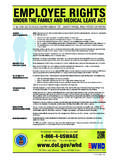
5 Contractors are also required to post the Notice to Employees Working on Government Contracts (WH Publication 1313) in a prominent and accessible place at the worksite. WH 1313 is available at: TIMELY PAYMENT OF WAGES AND FRINGE BENEFITS Wages The SCA does not permit pay periods longer than semi-monthly (twice a month). Wage payments at greater intervals are not proper payments in COMPLIANCE with the SCA. 29 (h) and (b). Failure to pay for certain hours of work at the required rate cannot be offset by reallocating excess payments made for other hours. 29 Fringes Cash payments to employees in lieu of payments for fringe benefits must be made promptly on the regular payday for wages. 29 (a)(1). Payments to bona fide fringe benefit plans may be made on a periodic payment basis that is not less often than quarterly. 29 (d)(1). 4 DEPARTMENT OF LABOR SCA COMPLIANCE PREVAILING WAGE RESOURCE BOOK PRINCIPLES HOURS WORKED The hours worked by employees on an SCA-covered service contract are determined in accordance with the PRINCIPLES established under the Fair Labor Standards Act (FLSA), as set forth in 29 Part 785.
6 29 In general, FLSA hours worked by an employee include all periods in which the employee is suffered or permitted to work, whether or not required to do so, and for all periods of time during which the employee is required to be on duty or to be on the employer s premises or to be at a prescribed workplace. Hours worked subject to the compensation provisions of the SCA are those in which the employee is engaged in performing work on SCA-covered contracts. 29 In any workweek where the contractor/subcontractor is not exclusively engaged in work on a covered service contract, the contractor should identify separately and accurately in its records, or by other means, those periods during which its employees are engaged in work on a covered service contract. 29 In the absence of records that adequately segregate periods of covered contract work from non-covered work, all employees working in the establishment or department where such covered work is performed shall be presumed to have worked on or in connection with the covered contract during the period of contract performance.
7 29 5 DEPARTMENT OF LABOR SCA COMPLIANCE PREVAILING WAGE RESOURCE BOOK PRINCIPLES BONA FIDE FRINGE BENEFITS A contractor may discharge his/her obligation to provide SCA fringe benefits by paying the specified fringe benefit contributions to a trustee or third person pursuant to a bona fide fund, plan, or trust on behalf of covered employees. Examples are life or health insurance and pension or retirement plans. 29 and To be considered a bona fide fringe benefit for purposes of the SCA, a fringe benefit plan, fund, or program must constitute a legally enforceable obligation which meets the following criteria. 29 (a). The fringe benefit plan, fund, or program must be specified in writing and must be communicated in writing to the affected employees. The primary purpose of the plan must be to provide systematically for the payment of benefits to employees on account of death, disability, advanced age, retirement, illness, medical expenses, hospitalization, supplemental unemployment benefits, and the like.
8 The plan must contain a definite formula for determining the amount to be contributed by the contractor and a definite formula for determining the benefits for each of the employees participating in the plan. Contributions must be made pursuant to the terms of such plan, fund, or program. Any contributions made by employees must be voluntary, and if such contributions are made through payroll deductions, such deductions must be made in accordance with 29 (No contribution towards fringe benefits made by the employees themselves or provided from monies deducted from their wages may be included or used by an employer in satisfying any part of any SCA fringe benefit obligation.) Generally, the contractor s contributions must be paid irrevocably to a trustee or third person, no less often than quarterly, pursuant to an insurance agreement, trust or other funded arrangement (except as indicated below with regard to certain unfunded fringe benefit plans).
9 Unfunded fringe benefit plans: With the exception of fringe benefit plans to provide vacations and holidays, unfunded "self-insured" plans under which a contractor typically pays insurance 6 DEPARTMENT OF LABOR SCA COMPLIANCE PREVAILING WAGE RESOURCE BOOK PRINCIPLES claims out of pocket to cover fringe benefit obligations are normally not considered bona fide plans or equivalent benefits for purposes of the SCA. 29 (b). A contractor must request approval by the WHD Administrator for an unfunded self-insured plan. 29 (b)(2). The following are not bona fide fringe benefits (nor can they be considered equivalent benefits for SCA purposes): Benefit plans or trusts which are disapproved by the Internal Revenue Service as not satisfying the requirements of the Internal Revenue Code or which do not meet the requirements of the Employee Retirement Income Security Act of 1974. 29 (a)(5).
10 Any benefit required by any other federal law or by any State or local law, such as unemployment compensation, workers compensation, or social security. 29 (c). Board, lodging or other facilities for which the cost or value, determined in accordance with regulations under the FLSA contained in 29 Part 531 (though they may be creditable toward the payment of monetary wages specified under the SCA). 29 and (d). Facilities primarily for the benefit or convenience of the contractor or the cost of which is properly a business expense of the contractor, such as relocation expenses, travel and transportation expenses incident to employment; incentive or suggestion awards, recruitment bonuses; tools and other materials and services incidental to the employer s performance of the contract and the carrying on of his business; and the cost of furnishing, laundering, and maintaining uniforms and/or related apparel or equipment where employees are required by the contractor, the SCA contract, by law, or by the nature of the work, to wear such items.