Transcription of Scaffolding
1 Level 1 Mason Bird Building 303 Sevenoaks Street (entrance Grose Avenue) Cannington Western Australia 6107 Website: Email: Regional Offices Great Southern (08) 9842 8366 Mid-West (08) 9920 9800 South-West (08) 9722 2888 ScaffoldingWorkSafe has developed this publication to provide information and assistance to workplaces which use Scaffolding in Western Australia. This newsletter will assist you with identifying occupational safety and health requirements and will provide you with information on how to comply with the requirements of the Occupational Safety and Health Act 1984 and regulations.
2 Scaffolding must meet Australian Standards The Occupational Safety and Health Regulation requires Scaffolding to meet the following Australian Standards AS/NZS - General requirements AS/NZS - Couplers and accessories AS/NZS - Prefabricated and tube-and-coupler Scaffolding AS/NZS - Suspended Scaffolding AS/NZS - Prefabricated Splithead and trestles AS/NZS - Metal tube-and-coupler Scaffolding deemed to comply with AS/NZ AS 1577:1993 - scaffold planks AS/NZS 4576:1995 - Guidelines for Scaffolding Is a licence or Job Safety Analysis required?
3 If you are either erecting, dismantling or working on a scaffold it could involve activities defined as high risk construction work under the Occupational Safety and Health Regulations, Under these regulations high risk construction work is any construction work where there is a risk of a person falling more than two metres. However for licensing purposes Scaffolding work is defined with a four metre threshold. In some instances this means a high risk work licence may not be required to erect a scaffold as it is less than four metres high.
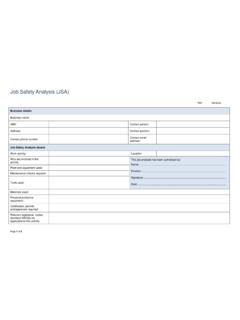
4 However, a Job Safety Analysis/Safe Work Method Statement may still be required if the scaffold is higher than two metres. For more information refer to the General guide for scaffolds and Scaffolding work Safe Work Australia How do I use the CHECKLIST? A checklist has been developed to assist you with identifying hazards and assessing the risk of injury or harm to persons, including employees and members of the public. the checklist in this newsletter to inspect your workplace. You may see other hazards as you are goingthrough add them to the that you have ticked No or added to the list needs to be fixed.
5 So, look at each hazard using thetable below to prioritise identified the hazard falls into high or extreme , based on your view of how likely it is someone will get hurt and whatlevel of injury could happen, then you need to fix it straight away. If it is moderate or low then plan when youwill fix rating table for working out level of risk - Use the vertical and horizontal columns to consider both the likelihood of injury or harm to health and the consequences to work out the level of risk. Likelihood of injury or harm to health Consequences of any injuries or harm to health Insignificant eg no injuries Moderate eg first aid Major eg extensive injuries Catastrophic eg death Very likely High Extreme Extreme Extreme Likely Moderate High Extreme Extreme Moderate Low High Extreme Extreme Unlikely Low Moderate High Extreme Highly unlikely (rare) Low Moderate High High Risk assessment is a 'best estimate' on the basis of available information.
6 It is important the responsible person undertaking a risk assessment has the necessary information, knowledge and experience of the work environment and work process, or such a person is Guidance note - Falls from Scaffolding There is potential for scaffolders to fall from incomplete scaffolds during their erection and dismantling. In particular, scaffolders can be exposed to fall hazards during the placement or removal of scaffold planks, from the open sides or ends of the scaffold , and in climbing from one lift of the scaffold to the next lift.
7 The Commission for Occupational Safety and Health Guidance note: Falls from Scaffolding has been adapted from guidance material published by WorkSafe Victoria and modified to reflect Western Australian terminology and practice. This guidance note deals specifically with the erection and dismantling of typical independent scaffolds constructed from prefabricated modular Scaffolding systems. It may not be appropriate for unorthodox or unusual scaffold configurations such as large birdcage scaffolds. Work practices for such scaffolds should be developed by employers on a case-by-case basis in consultation with scaffolders, safety and health representatives (where they exist) and workers who may use the scaffold to carry out their work.
8 Guidance note: Falls from scaffoldingIncidents involving Scaffolding Mobile scaffold collapse A fourth year electrical apprentice suffered a broken right arm when an aluminum mobile scaffold on hire collapsed while he was working from it. The collar locking device on the base frame was not properly engaged in the lower position to lock the threaded leg, which allowed the base frame to slip down the threaded leg causing an imbalance sufficient to topple the scaffold . The collar locking mechanism can be a hazard if operators do not engage the lock correctly.
9 They are progressively being phased out in favour of an adjustable leg that has a compression-locking device, which engages when a weight is applied to the assembled scaffold . Factors erecting the scaffold did not ensure the collar lock was engaged in the locked (lower) position ofthe base frame sleeve to the threaded leg of the castor erecting the scaffold were carrying out 'prescribed work' (erecting a scaffold from which a person orthing could fall more than 4 metres) and were not competent (certificated scaffolders)
10 To perform that erecting the scaffold had no prior instruction or training in the erection of persons carrying out this work must be directly supervised by a certificated scaffold was moved and then altered without the authority of the main mesh panel failure A self employed plasterer sustained serious head and back injuries when he fell approximately metres from a framed scaffold at a two storey residential construction site. The erected scaffold had mesh panel type edge protection along the working platform.